Groundwork: the dev log
How Groundwork was made for the 2026 Epic AI MegaJam: the calls I made, what the agents built from them, and what went wrong.
I didn't write the code or model anything by hand. For four days I said what I wanted, judged what came back as numbered sheets and films, and decided what made the cut. AI agents on two machines did the building: a Claude coordinator on my Mac with lanes of agents that build, review and fix, and Hermes, an agent on my Windows PC that models in Blender and builds for Windows. In Groundwork you play four small robots who land on a world of Tau Ceti and build a base for the people coming after them. It's the prequel to Frontier Colony, a colony sim I've been planning since January, and a game I had kept shelving because I'm one person.
Three failures to read first: the two compilers turned one seed into two worlds, Hermes sat idle while I was told it was working, and a second night film arrived after I'd said not to make one. The rest are under What went wrong, and What made the cut is the triage for the final build.
6e7711c6, with the blue hold in view. The flight shot was re-recorded on the final head, 371f7b78, so it shows the generated land. The other shots predate that land's merge. Building shots run at 2 and 4 times speed. The ending pans up to the campus, staged with the showcase switch, with the HUD hidden.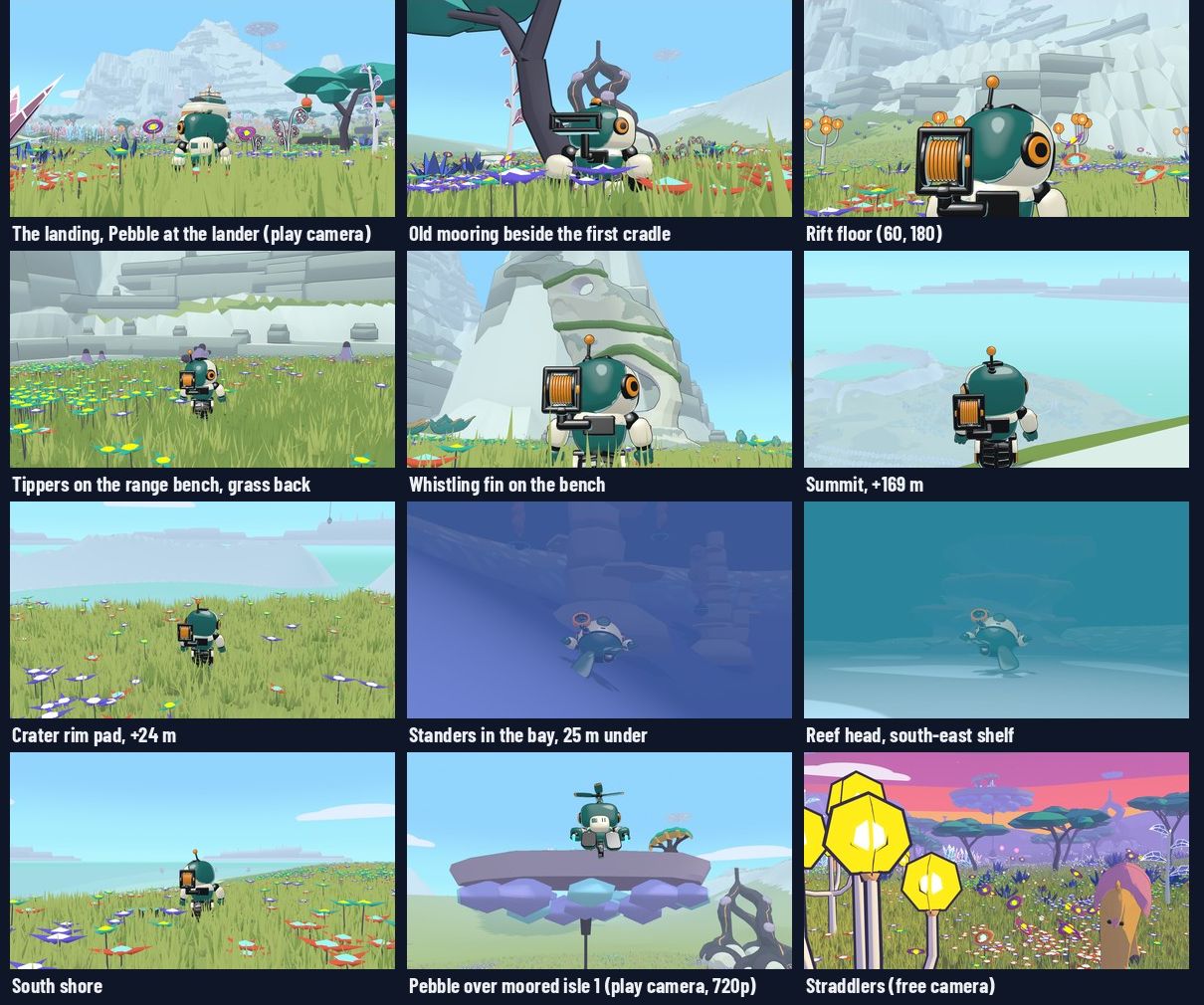
Where to start if you read only five entries
-
Same seed, two worlds
On Saturday morning Windows drew 2.5 to 17 times more flower pixels than the Mac from the same camera, and one seed gave each machine a different layout, 170 lamp flowers against 150. When one line of code draws several random numbers, the two compilers work through them in opposite orders, the Mac's left to right and Microsoft's right to left. A test switch that made the Mac draw in Windows order placed 232,735 pieces of ground cover, exactly the Windows count. Read the entry
-
A crash read from engine source
On Thursday night the Windows package quit two seconds after starting, while the same code ran on the Mac. By 00:16 a subagent had read the engine's source and found a likely cause: one flag in the Windows packaging script,
-NoLiveCoding, compiled the game differently from the engine libraries it loads, and the two disagreed on the size of one record in memory, 24 bytes against 32. Nobody could test that on Windows that night. Ten hours later a build on the PC without the flag ran. Read the entry -
“Doesn't look even half as good”
I wrote that when I set the first playable film beside the Pebble from before the jam (Pebble is the scout robot). The earlier Pebble became the benchmark, and a study by 13 agents measured what had been lost. The proportions already matched (head 0.39 of his height against 0.38). The dusk light's warm and cool split, the haze, the pools of lamp light, the tall plants, the glossy glass face and the banked flight were gone. A look pass that night moved the dusk numbers toward the earlier film's, and the face came back as solid eyes under glass. Read the entry
-
The HUD from 30.6 % of the frame to 3.1 %
On Saturday evening I called the HUD “an overly verbose cluttered HUD”. A lean one was built behind a switch: one NEXT line with the count of orders met, the orders folded onto the O key, the robot card shown for five seconds after a switch, panels a little more than half opaque. On the meadow at rest it shows 6 boxes instead of 12 and covers 3.1 % of the frame instead of 30.6 %. I made it the default on Sunday. Read the entry
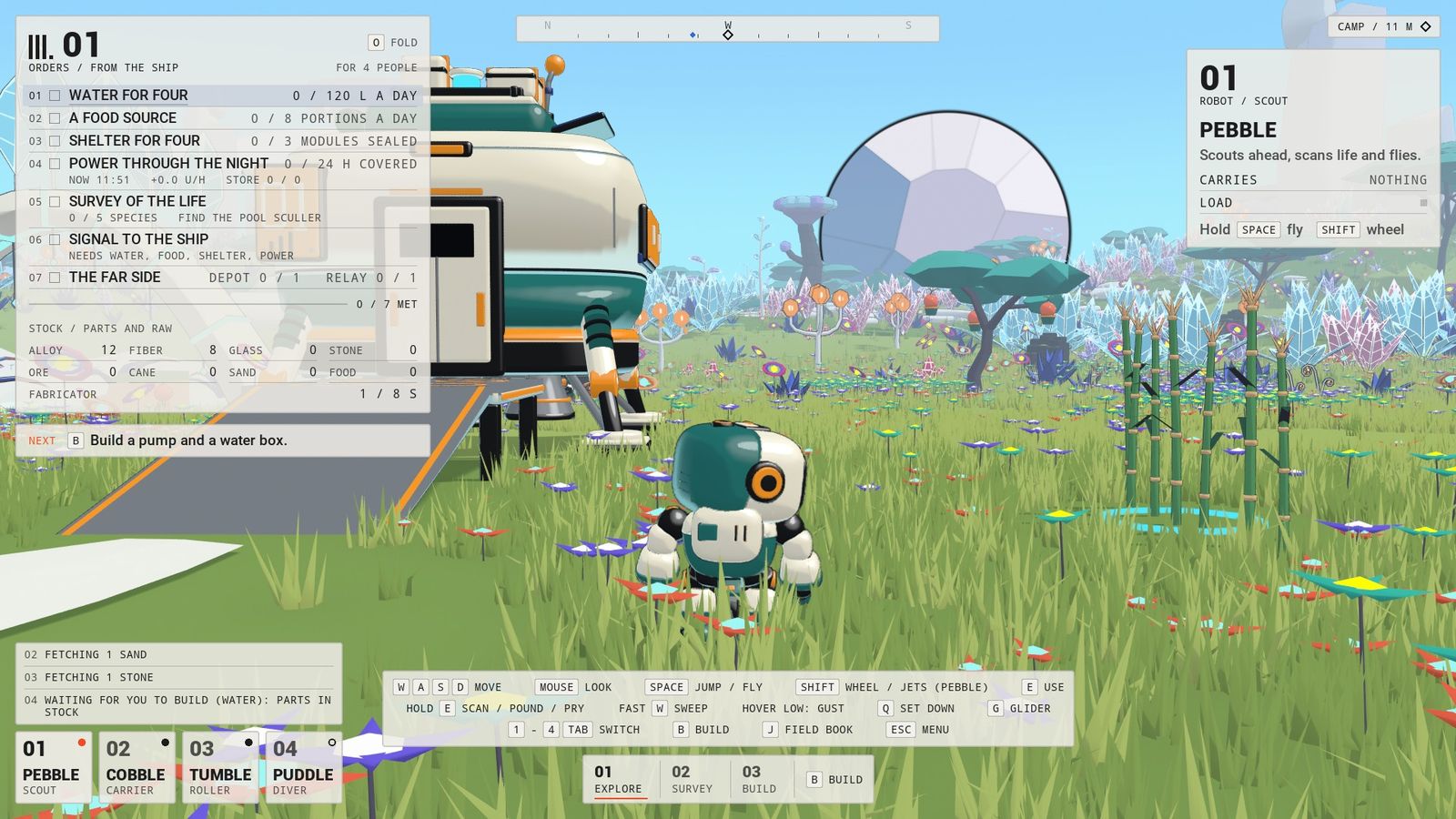
Full HUD · merge 11gThe meadow at rest with the full HUD. 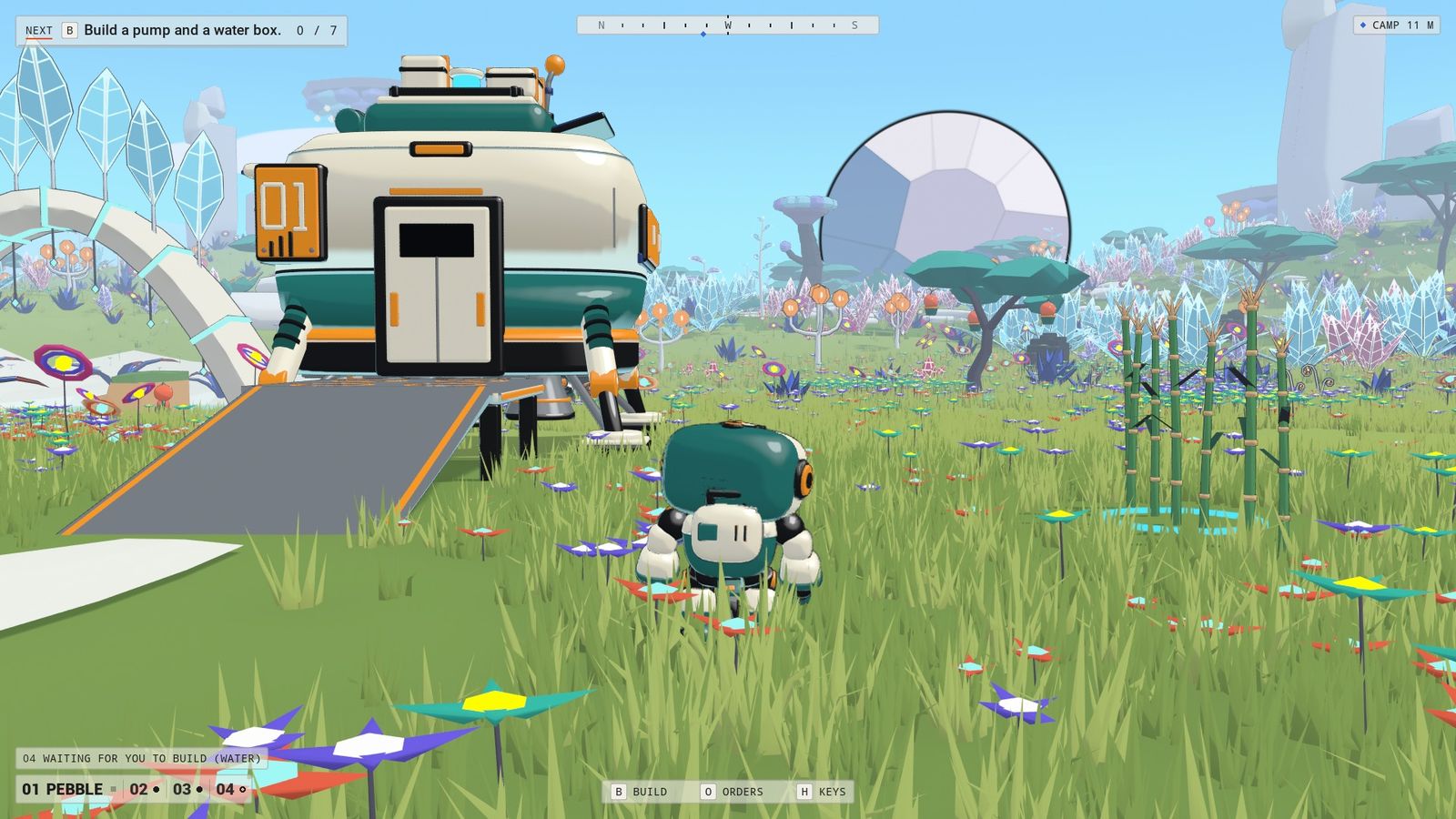
Lean HUD · merge 11gThe same camera and moment with the lean HUD. The 30.6 % and 3.1 % were measured on the lean lane's own frames of this view. -
DLSS: a wrong no, then 0.0
I asked whether my PC could run DLSS, NVIDIA's upscaling and anti-aliasing, for NVIDIA's award. The research said to leave it out, because NVIDIA's plugin listed Unreal 5.5 to 5.8 and its licence asks for marks and approval. I answered “this doesnt make sense because they are offering a prize for using it for this contest”. Three hours later a trial on the PC built the plugin on 5.9 after ten one-line casts, and with DLAA, its anti-aliasing mode, the ink outline on two near surfaces went from 45.5 and 29.3 changing pixels a frame to 0.0. Read the entry
Four robots land first
Groundwork is my entry in the 2026 Epic AI MegaJam, which runs from 12 to 15 November with the theme “Director's Cut”. I entered alone, as team Good Machines. The game is built in Unreal Engine 5.9 and written in C++.
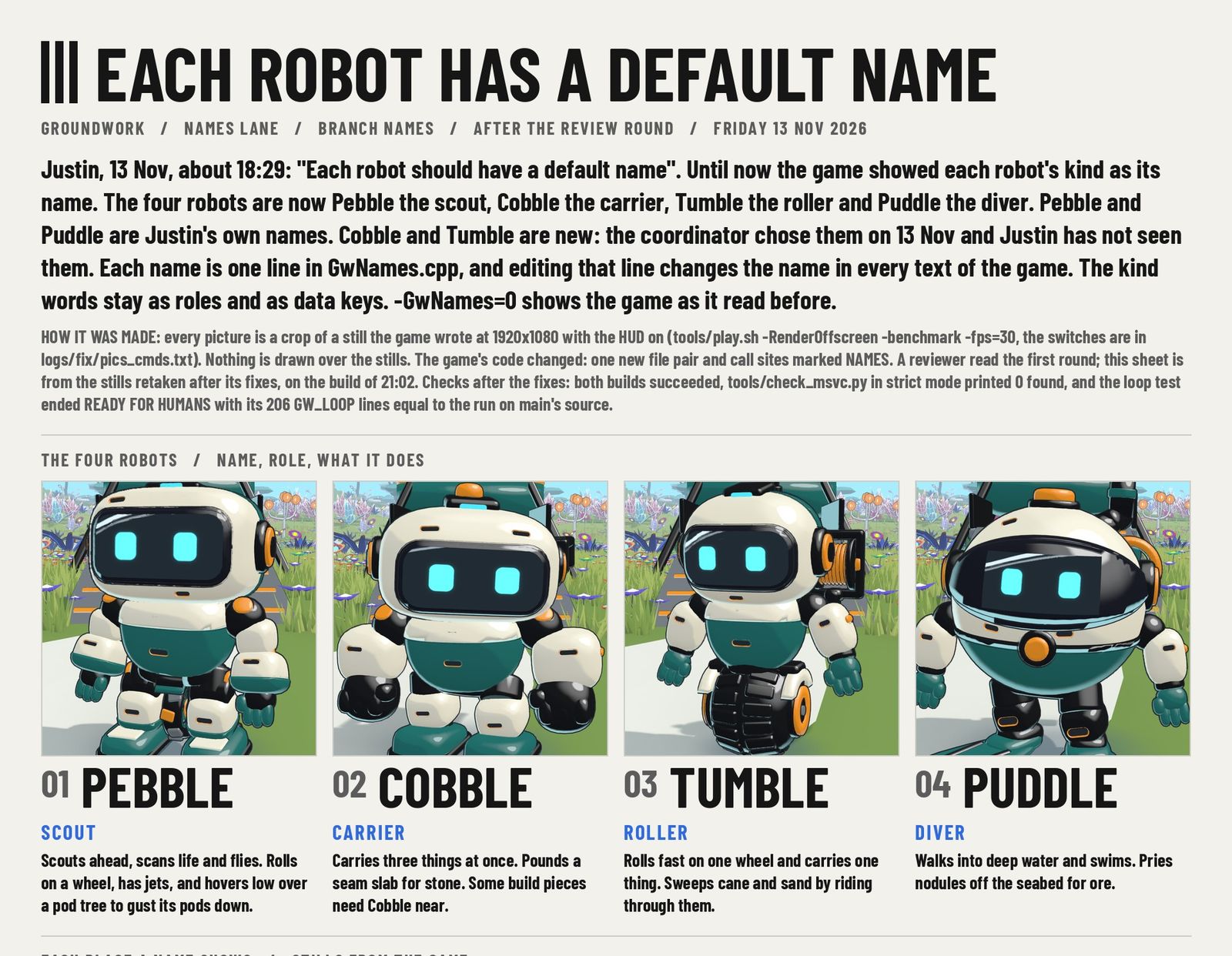
You play four small robots that land on a world of Tau Ceti before the people do. Pebble scouts, flies and rides a wheel. Cobble carries. Tumble rolls on one tyre. Puddle dives. Each has an action the other three lack: Cobble pounds a seam slab for stone, Tumble sweeps a row of cane by riding through it, Pebble's downwash shakes the pods off a lamp-flower, and Puddle pries a nodule off the lagoon floor. The ship sends orders, starting with water and food for four people. You gather materials, make parts and build the base to meet them, driving one robot while the other three keep working, and you can call one over when a job needs a different body.
What is in the game by Sunday 16:00, on the final head 371f7b78 and in the Windows zip for the submission:
- It starts on the large land: a sheet of land and sea 1.28 km across with a massif, a crater bay and floating isles, with generated animals, five landmarks and three rare giants.
- A field book keeps a page for every material, find, landmark and animal you scan, and a glider carries any robot that fits and climbs once you charge its cell.
- There is no ending. The colony keeps growing, and the lean HUD shows one line for the next order, with the orders on the O key.
- The campus kit is on main: quarters on two storeys, a commons, a lounge and connecting wings make one building. Rooms count through enclosure, access and furniture. The final zip has its fixes and angled canopy, menu clicks, settings with the last save-switch fix, scan brackets and blue scan feedback.
- Generated land beyond the whole landing island is on main and in the final Windows zip. It lies south across the sea, with ground and dressing from one fixed seed. Its hash and dump match the Mac's inside the Windows game. It has no objective, prompt or map mark, and lacks the scarp blocks, crest stones, vents, seabed garden, moored isles, Perch decks, finds and creatures. The save does not record the land. Puddle reaches dry ground round the west shore, but stalls on the direct walk up the steep north coast.
My theme statement for the jam
Groundwork is the game I kept shelving. I've been planning Frontier Colony, a colony sim, since January, and in March we started building the agent backend for its characters. Groundwork is its prequel. Before the humans arrive, four small robots land on a world of Tau Ceti and get the base ready for them. I'd only ever made mockups of that world, to explore design styles, and I never had the hands to build it. A world, four characters, building and gathering, sound and an opening add up to a studio's list of work, and I'm one person.
For this jam I directed it instead. I set the vision and AI agents did the building: Claude Fable 5.2 on my Mac, and Hermes running GPT-6 Astra at extra-high effort, modelling on my PC. Using some old mockups for design styles we finally made the world real. I decided what made the cut: which lander, which robots, which sky, and what got thrown out.
One director, two machines of agents
I say what the game should be, judge each sheet and film, and decide what makes the cut.
One Claude Code session. It plans, writes each lane's brief, merges what comes back, keeps the log, and records every call it makes while I sleep.
One piece of work each, in its own git worktree and branch.
- Build
- Review
- Fix
Models in Blender and builds for Windows, on GPT-6 Astra at extra-high effort. From Friday 16:13 to Saturday 16:04 its settings named deepseek/deepseek-v4-flash-0731, provider Nous, at medium reasoning effort instead.
A merge has to compile, pass a lint for the Windows compiler, and play the colony loop to its end with nobody at the keys.
- The coordinator
One Claude Code session on my Mac, on Claude Fable 5.2. It split the work into lanes, wrote each lane's brief, merged what came back and kept a capture log with a row for every event.
- Lanes
A lane is one piece of work in its own git worktree and branch: the weather, the opening, the field book. Most lanes ran a builder, then a reviewer, then a fixer for what the review found. The agents were Claude Opus 5.5, Claude Sonnet 5.5 and Claude Fable 5.2. From Saturday some lanes ran as separate Claude Code sessions on another of my team's accounts, each started from a written request and answering in a reply file. Codex running GPT-6 Astra at extra-high effort made the creature kit on Thursday, and from Saturday night it built in some lanes, with Claude Opus 5.5 checking its work. On Sunday at 10:18 I asked more lanes to hand the building to Codex workers, and a Codex worker took the submission pack refresh without a Claude session in the loop. At 12:33 the Outland lane began on another team account, with a Claude coordinator and Codex building the land beyond the island. Opus checked the feel and Outland work before the final merge. Outland finished its merged-tree checks and cleanup at 15:16. The pilot delivered the first final film at 15:57 and the second cut at 16:21. I chose the second cut at 16:24. A Codex worker refreshed the submission documents, while an Opus reader checked the previous dev log update and the coordinator applied its seven corrections.
- The PC lane
Hermes is an agent on my Windows PC. It made the first Windows builds and from Friday modelled in Blender: the lander, the stations, the base pieces. Its briefs go to it as comments on GitHub pull requests. Hermes doesn't watch for new comments, so the Mac starts each of its runs over a remote shell. Hermes pushes what it made to a branch, and the Mac imports it into the game and measures it there. From Saturday morning it ran up to three threads, each with its own Blender. On Sunday the Mac coordinator ran the interim and final Windows builds and packages on the PC, reproduced the generator hash difference with compiler flags, and verified the fixed hash and byte-equal dump inside the final game. It pushed the final head after the Windows checks passed, built and checked the optional Mac zip, and checked the final film files and contact sheet. I then played the final Windows zip by hand.
- What reaches me
Numbered sheets and short films, 137 to 370 by Sunday morning. Each one says what was built, what was measured and what nobody checked. I answer in a line or two, and my answers are quoted on this page as I typed them, typos included.
- The gate on main
A merge reaches main only after it compiles with the source files batched together and one by one, passes a lint for C++ that the Mac's compiler accepts and Microsoft's rejects, and plays the colony loop to READY FOR HUMANS with nobody at the keys. From Saturday afternoon the PC also built, packaged and ran each merge on Windows before it went to main.
- Nights
Before I slept I said to make judgement calls and save them in a note. The coordinator wrote down each call with its reason and how to undo it, 45 on the first night.
- Decision pages
When open questions piled up, the coordinator put them on a private page with one card per question, its own pick, and what happens if I say nothing. I answered 62 cards in 15 minutes on Saturday morning.
- Usage limits
My account's Fable 5.2 limit ran out twice, on Friday at 01:45 and on Saturday at 20:00. After the first, builders and reviewers moved to Opus. After the second, the three stopped agents restarted on Opus from their own state notes. Lanes on another team account spread the load from Saturday, and on Sunday morning the coordinator itself moved to another of my accounts. A limit stopped the index publish at 11:55; it resumed after the reset and went live at 12:18.
- The entry
I submitted it myself at 17:25 on Sunday. The jam's rules require that, and an agent may not do it.
What a brief looks like
An excerpt of the brief for merge 11g, written at 20:50 on Saturday for the merge to run while I slept. […] marks a cut.
# Request: merge 11g of the Groundwork jam game (the glider's upward flight, the large land as the start with the field book, the lean HUD switch, the PC's last base pieces)

## Whose task this is
[…] He is asleep; nothing in this merge needs him, and nothing in it may be decided as if he had approved it.

His words that decide what goes in (Sat 14 Nov):
- 17:50, on what to do next: "Start on large and start covering the gaps". So the large land (`sheet_a`) becomes the default start in this merge; the island stays one switch away (`-GwLand=isle_a`).
- 19:2x, on the HUD: […] He has NOT seen the lean HUD. It goes in behind its switch with today's HUD as the default; only his yes flips it.

## Branch
[…] Do not push, do not open pull requests, do not touch `main`. After every group: `python3 tools/check_msvc.py --strict` prints 0 found, and the Mac build succeeds.

## Group 4: the PC's last base pieces […]
- Deck tile: […] Take it only if the same measurement shows no new flicker on its own pixels; otherwise keep main's and say so.

## Checks at the end […]
- Loops ending `READY FOR HUMANS`: plain start (large land), […] Quote each end line and say whether any `stuck` line appears.
[…]
- One Opus reviewer at medium effort reads the merged diff against the four reports and reruns two checks of its choosing; fix what it finds that holds.
The gate, as the merge reported it
End lines quoted in merge 11g's reply, from the Mac runs on the final merged code. A folder path is cut where […] stands.
check_msvc: 0 found in […]/Source/Groundwork
check_rng_order: 7 known (baseline), 0 new
check_names: 0 found in […]/Source/Groundwork (154 files)
GW_COLONY 900.0 test orders_met=53 issued=53 room=86 (at milestone 4) sites=53 max_open=1 part_orders_rose=53/53 room_falls=0 PASS
GW_LOOP 1020.8 end READY FOR HUMANS
GW_LOOP 1020.8 summary built=34+2 drops=37 fab=27 scans=10 minutes=17.0
save_check compare: 528 fields in colony-rt.gwsave (100 pieces, 5 sites, 0 orders, 4 robots, found 41), 0 different: PASS
One review finding and its fix
The reviewer's row for the blocker, from the same reply. […] marks a cut. In it, colony900 is the 900-second colony test and b2 is the merge's second full round of checks.
- Finding
Blocker: default colony900 loses ROOM in rain
- Evidence
b2 and the independent reviewer both log
GW_COLONY 623.9 ROOM fell 60 -> 59 (WATER 59)and room_falls=1 FAIL. The reviewer's island run logs room_falls=0 PASS. Water was cached with rain, then had a newer rain sample subtracted. - Action
c0634843 shares MainWaterLpd between the water order and main-pad ROOM. It includes pump stations and excludes rain. […] RoomFalls and its verdict are unchanged.
After the fix the same test ended room_falls=0 PASS on the large land, the island and a generated land.
Three calls from the first night
From the coordinator's note of 12 to 13 November, as written. Each says what was decided, why, and how to undo it.
4. 21:10. No generated sound replaces a code-made one without you. The takes are made, checked and put side by side with the code version in review films; the game keeps the code-made kit until you pick by ear. Why: I cannot listen, and a take can pass every measured check and still sound wrong. Undo or apply: one
choosecommand per sound, listed indocs/sound-takes.mdwhen the takes exist.10. 21:14. Hermes may now make the smallest possible Windows-only fixes in Mac-owned code (a rename, a cast, a missing include) on its own branch, listed with the error text, as small pull requests. Why: nobody on the Mac can see MSVC errors, and waiting for me on each one would cost the PC the night. It may not change behaviour or the look. Undo: say so in a pull request and I review each such line anyway.
21. 22:05. The world design is chosen (
docs/world-design-alien.md). The landing site becomes a 1.28 km sheet of land and sea. […] Why this one of the three designs: its features share one cause (impacts, then vents making hydrogen, then isles that drink it), and its sizes fit the days left. Undo: the sheet is a second landform file, and today's island keeps working without it.
Three cards from Saturday's decision page
| Question on the card | What I tapped or typed | Pick shown | Same as pick |
|---|---|---|---|
| The glider's rules, chosen without you: fine? | “I think we should make it so we can also fly upward but only after finding rare material that can charge it. Everything else sounds good.” | Fine as chosen | No |
| Is ROOM, set by the colony's shortest need, the colony's measure? | “it needs room, food, water at minimum.” | Yes, ROOM | No |
| Calling a robot: is R the right key? | R | R | Yes |
Of the 62 cards, 35 answers matched the pick shown, 17 differed and 10 cards had no pick. The first note became the glider's climb on a charged cell; the second changed what the colony counts.
Checking what no agent can see or hear
No agent can listen, and none judges a frame the way I do, so the checks became numbers. Sounds were measured and drawn as spectrograms. Film 248 plays each action sound over its spectrogram, and I judged those by ear. Flicker is counted as the pixels that change between settled frames: the base door went from 4,526 to 55 with the PC's pieces, and with DLAA the ink outline went from 45.5 to 0.0. Every merge plays the colony loop with nobody at the keys, to READY FOR HUMANS at about 1,000 game seconds. Runs on the Mac and on Windows are compared by count. The compiler bug first showed up as 232,096 ground-cover instances on the Mac against 232,735 on Windows.
The run in numbers
- 232
numbered sheets, stills and films: the distinct capture numbers 137 to 370, counted again for this update. The newer campus, feel, Outland and Mac pictures and pilot cuts have names outside that sequence and are not in this count.
- 16
game integrations to main from Friday 05:51 to Sunday 15:36: two on Friday morning, merges 7 to 10 on Friday, 11a to 11g from Saturday 02:24 to Sunday 03:05, Sunday's small branch, the campus and the final head. The final push counts once for its combined lanes. One Windows fix went to main on its own on Saturday and is counted separately.
- 98
decisions I answered across the four batches counted here: 25 in one line on Friday night, 6 in one line on Saturday morning, 62 cards on Saturday's page and 5 on Sunday's. A second page on Saturday afternoon isn't counted, because the log doesn't give its size.
- 45
calls the coordinator made on the first night while I slept, each with how to undo it.
- 3
occasions of hand play recorded in the log: my ten minutes on Friday morning, the Mac Shipping zip on Sunday at 10:12, and the final Windows zip at 15:58. Neither Sunday duration is recorded, so I cannot give a total.
- 4 kinds
of C++ that the Mac's compiler accepts and Microsoft's rejects stopped Windows builds: float literals and names that hide a class member on Thursday night, a narrowing inside braces on Saturday at 06:10, a local hiding a global at 15:28, and inherited member names at 21:30. Each kind is now a rule in a lint that runs on the Mac.
- 2.60 USD
in cash at fal's list prices, for three runs of the Rodin model generator and four of Tripo (both under Tools), against a cap of 25 dollars. What fal billed wasn't read.
- 60 runs
of Hyper3D Rodin through its own API, at 0.5 credits each, 30 credits in all.
- ~110,600
ElevenLabs grant credits: 44,961 on the first night, about 11,700 for the opening, 910 for the robots' actions, 7,328 for the narrator's voice and 18,504 and 27,203 for the two night films' narration.
- 6
stops or changes of plan because of a usage limit or one approaching: my Fable 5.2 limit on Friday at 01:45 (three hours stopped) and on Saturday at 20:00; another team account's five-hour limit on Saturday from 17:52 to 18:41; and on Sunday at 07:58 the coordinator moved to another account, because the one it had run on was low on its weekly limit. At 10:18 I moved more building to Codex before another five-hour limit was reached. At 11:55 a limit stopped the index publish until the reset; it went live at 12:18.
A pitch at 17:20, a playable island by night
-
Three pitches on one sheet
I found the jam late on its first day and wrote:
My message
we could use what we learned and start in a fresh world with fresh characters but improved. I think we should get UE 5.9 for this
The coordinator came back with one sheet: three game ideas, a concept picture for each, its own recommendation, and the facts from the jam's rules. Nothing was built yet.
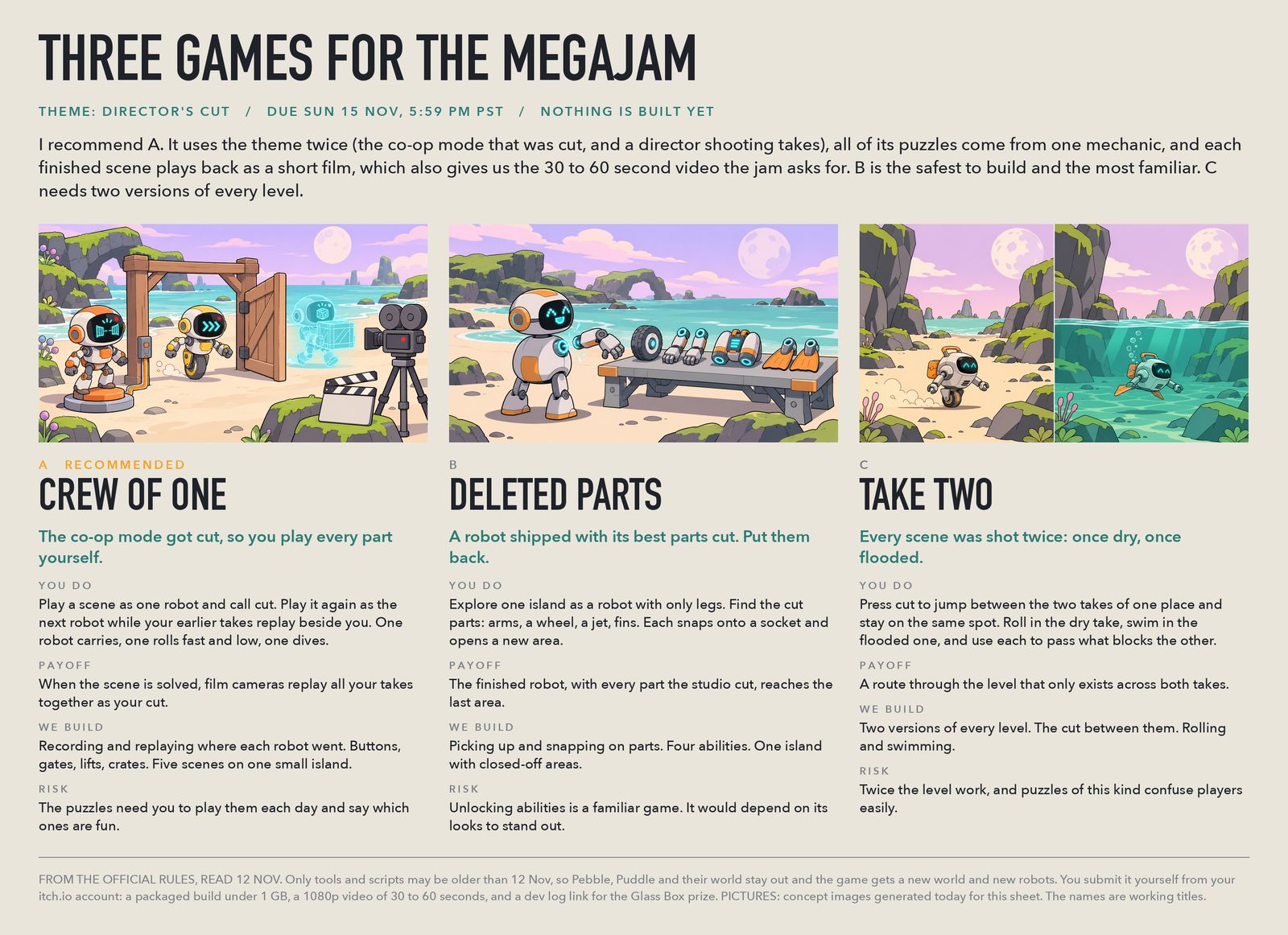
Sheet 137 · Thu 17:20The three pitches. The concept pictures were made with Codex image generation. Open full size -
I changed the premise
My message
oh i wanted this to be a precursor to Frontier Colony. We play as the robots who land on tau ceti ... and we work on setting up the base and world for the humans
The working title became Groundwork. I asked for the crew to look more like Pebble and Puddle, two robots I'd directed in the days before the jam: “more cute and friendly looking”. At 17:36 I approved the second picture.
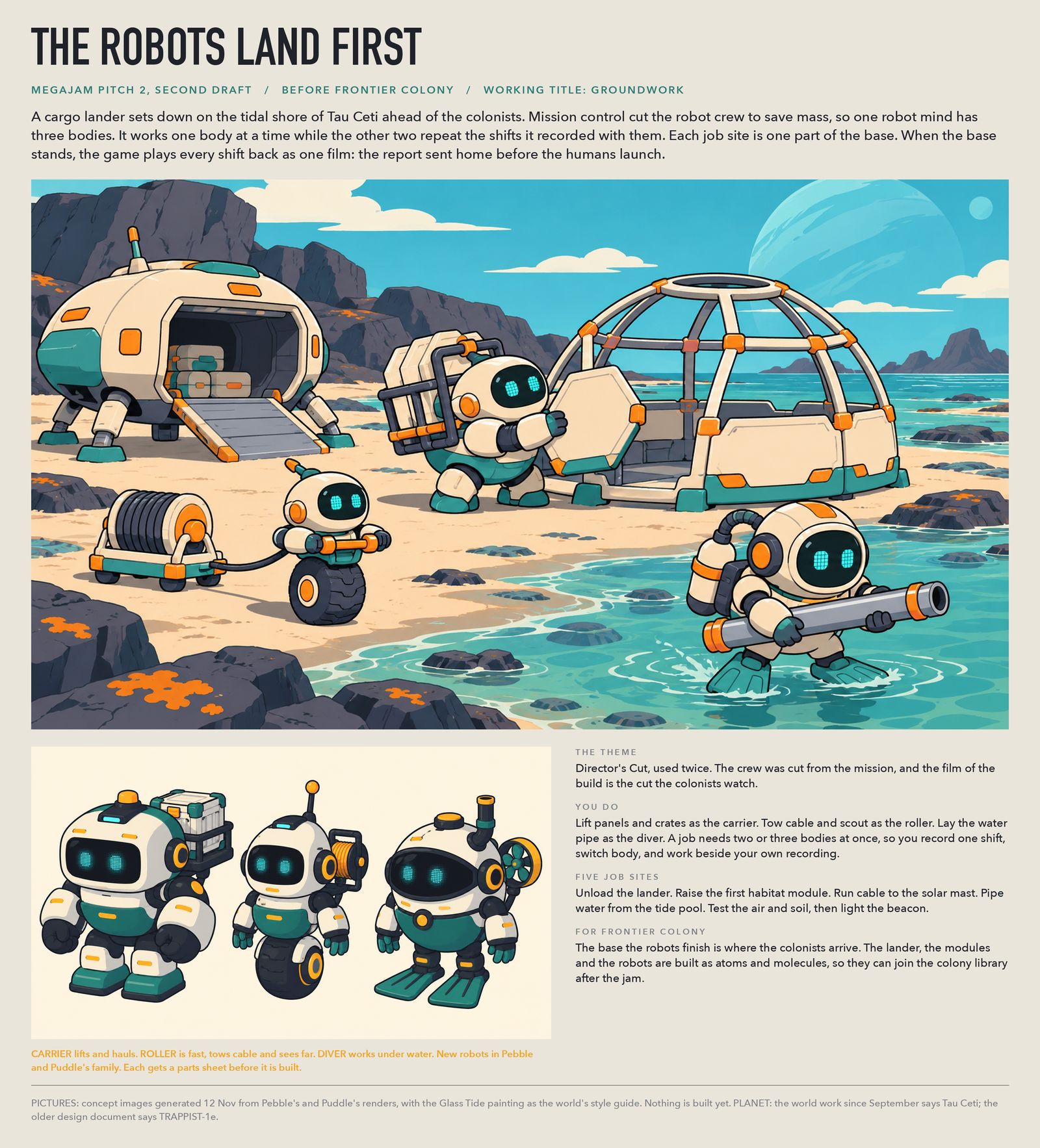
Sheet 139 · Thu 17:31The crew in the look I asked for. These are generated concept pictures. Preview renders of Pebble and Puddle, both made before the jam, were the look reference. Open full size -
Built from parts, the robots came out boxier than the picture
I had asked for the robots to be built from atoms, the small reusable part files in my asset library. By 18:06 three robots existed that way, 26 new atoms in all. The Carrier had 28 placed atoms, 27 joints with none failing, and stood 1.05 m tall. At 18:23 the first film from the game showed a job playing itself along written routes.
Then sheet 145 put the concept picture above the built robots. They were boxier and thinner, with small fists and feet. Three of my messages had also sat in a queue since 17:38 during one long coordinator turn, so I sent them again at 18:28. They changed the plan: drop the atom requirement for the jam and match the picture, make the game an open sandbox of gathering, discovering and building, and run the building through subagents so the main session can keep answering me.
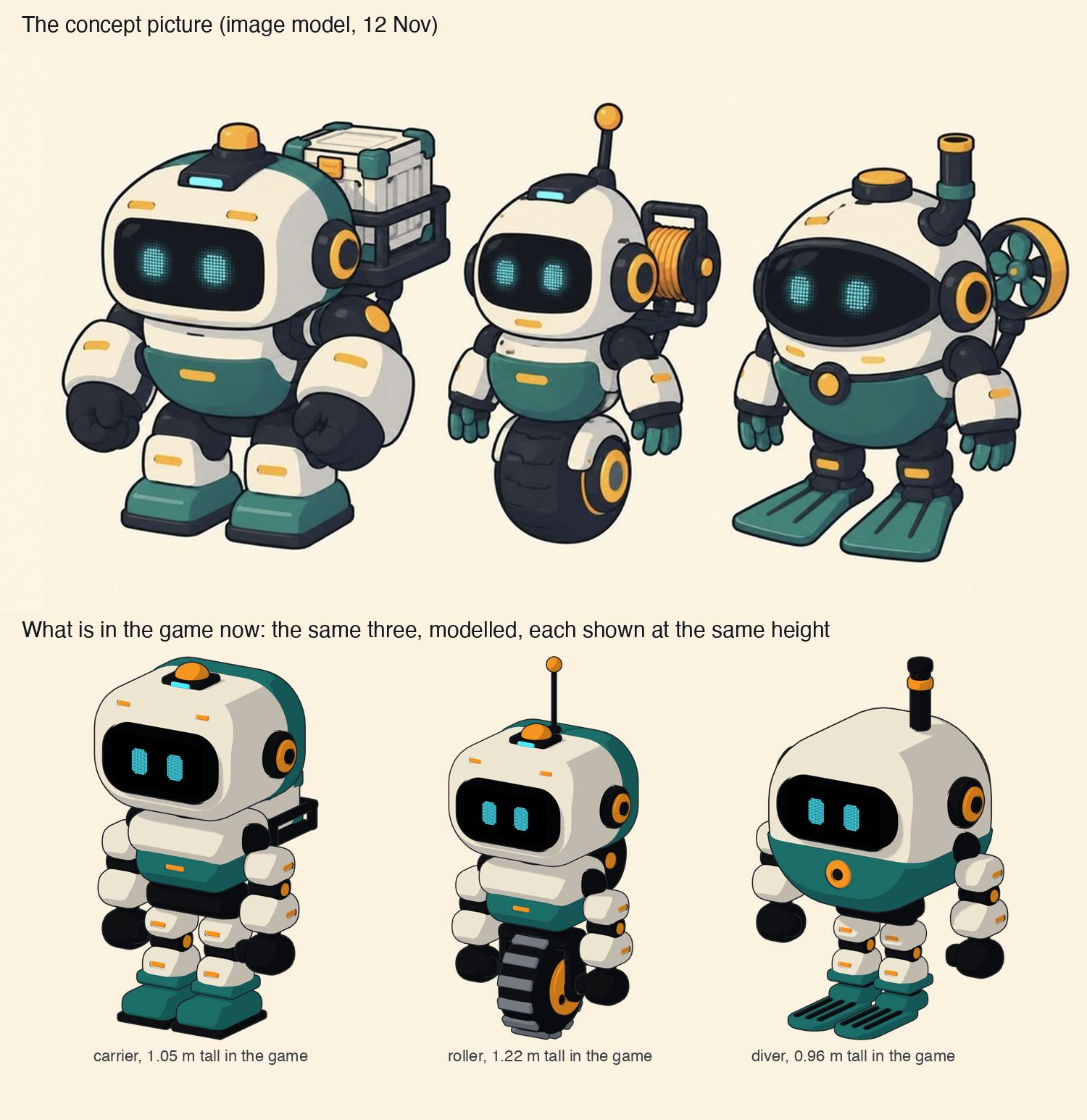
Sheet 145 · Thu 18:32The picture I approved, above what was built from atoms. Open full size 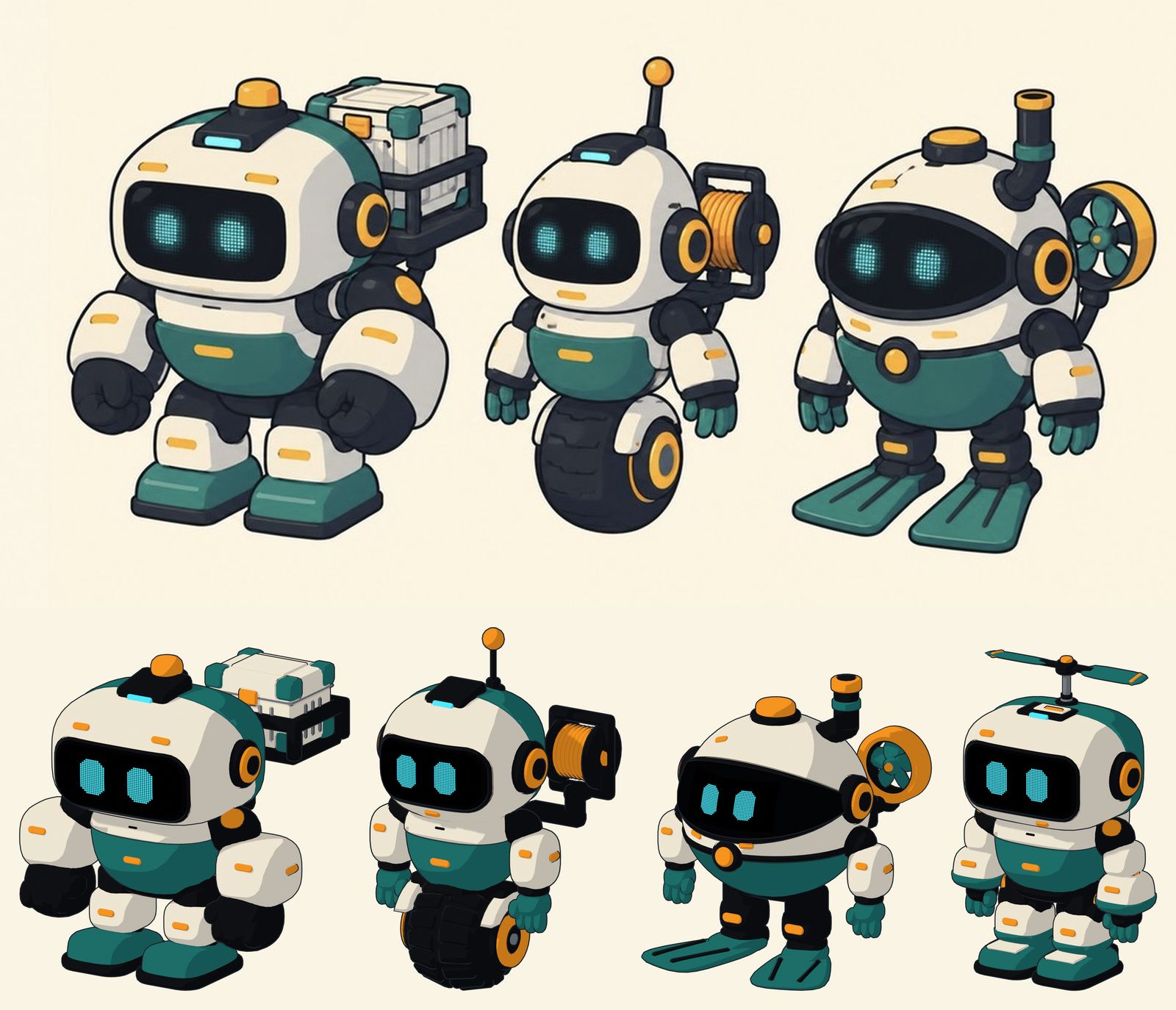
Sheet 147 · Thu 19:26After two remodelling passes, with Pebble added. The second pass was a Fable 5.2 subagent. Open full size -
“Doesn't look even half as good”
Film 149 was the first playable sandbox: Pebble scans a tide bulb, the Carrier delivers basalt and glass sand, and a solar mast goes up. It ran on a flat test shore with the first-pass robots. I wrote:
My message, on film 149
doesn't look even half as good as our pebble robot we made before
From then on the earlier Pebble was the benchmark, and the jam's Pebble had to fly and ride a wheel as that one did. A look job started in the game: camera, shading, shadows, bloom, the interface.
Film 149 · Thu 19:23The film I was talking about. A built-in demo route plays it, and it has no sound. 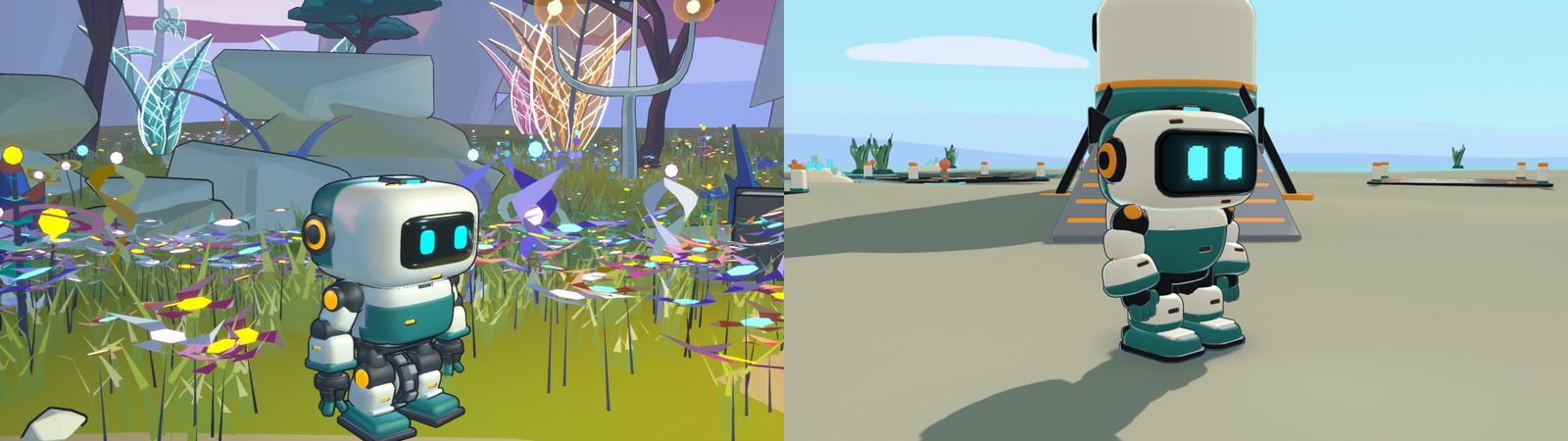
Picture 158 · Thu 20:16Left: a frame from my film of the earlier Pebble, made before the jam. Right: the jam's Pebble in the game with a richer material, still on the old shore. Open full size -
A wheel, a base kit, a day and an island
Four lanes reported within twenty minutes. Pebble was remodelled with a four-blade rotor 75.7 cm across and a wheel that unfolds in five steps. A base kit arrived: 31 pieces on a 3 m grid, and a main base of 41 pieces. A day and night cycle ran in the game, with a day lasting 12 minutes. A meadow island about 240 m across replaced the flat shore, with 7,340 larger plants and rocks and about 240,000 pieces of ground cover round the camera, at the display's cap of 120 frames a second at 1920 × 1080.
The base kit sheet asked me one thing, the colour of the stripe. I chose blue.
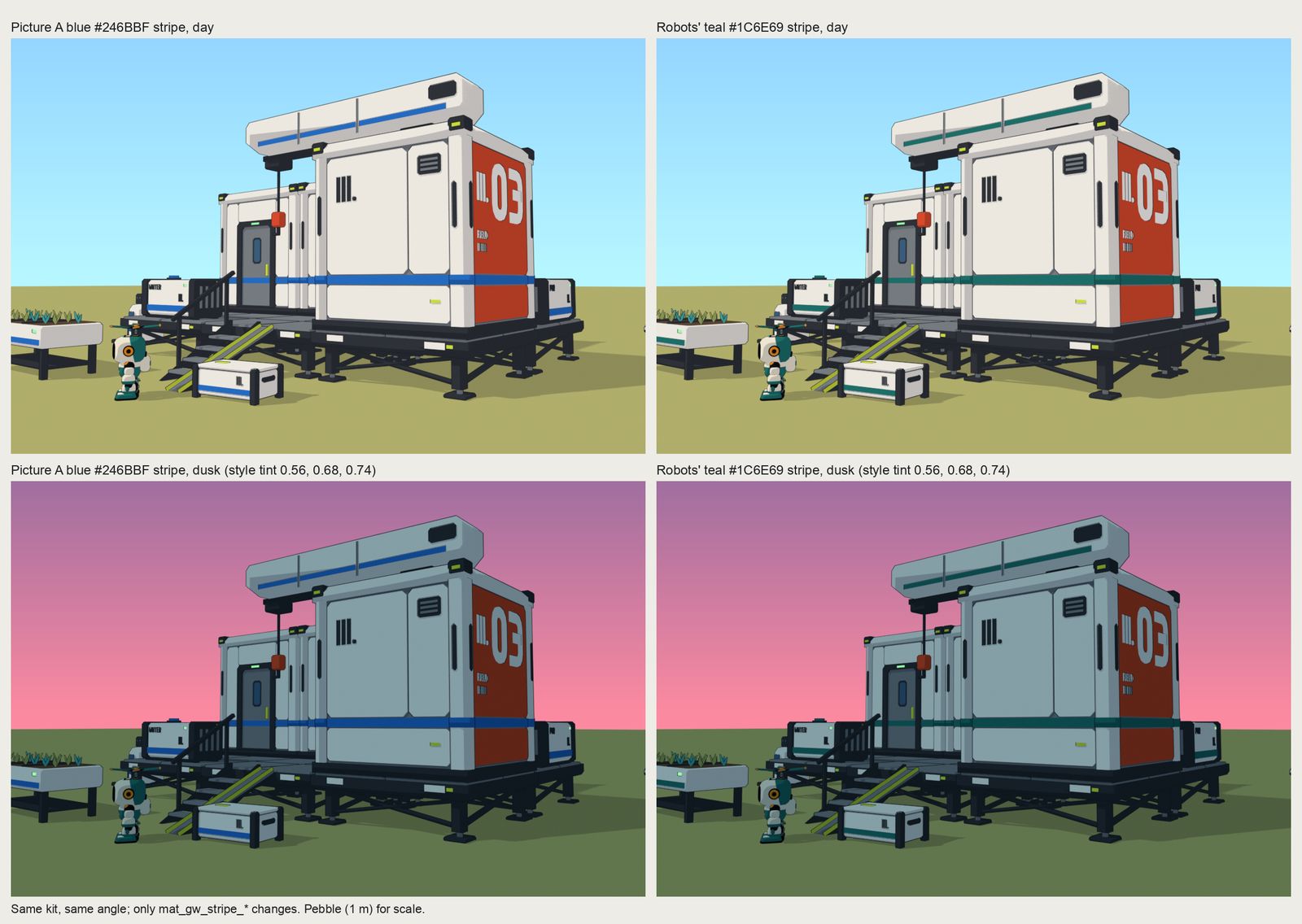
Sheet 160 · Thu 20:18Blue or teal, by day and at dusk. Open full size 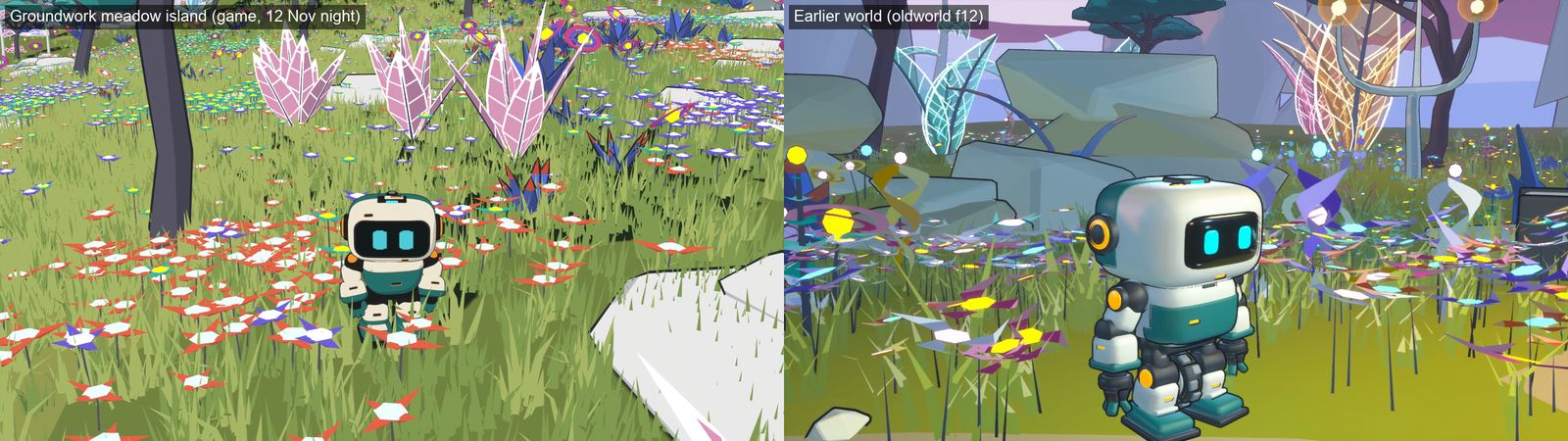
Picture 168 · Thu 20:34Left: the meadow island in the game. Right: a frame of my earlier film, made before the jam, as the bar to reach. Open full size -
Sounds nobody had heard, and lost charm
A sound kit arrived: 89 sounds synthesized by code, with no samples. An agent can't listen, so the kit was checked by measurement and by spectrogram, and the report said my ear would be the first check.
I also said the current version “lost charm that our previous one had” and asked for a study of everything about the earlier one. A workflow of 13 agents started on that.
-
I went to sleep
My message
im about to sleep. continuing working on this until we have a working game. Make judgement calls and just save them in a note for me to review tomorrow.
The first night: 45 calls in a note, and a three-hour stop
By the morning the coordinator's note held 45 numbered decisions, each with why it was made and how to undo it.
-
The first Windows build stopped on a variable name
Hermes's first pull request reported that the Windows build had stopped on a warning treated as an error (C4458): a local variable named
Mesh. The Mac's compiler doesn't check for that. The coordinator fixed it on main and later wrote a lint that lists C++ the Mac accepts and Microsoft's compiler rejects. -
I mistook a test shore for the world
Film 181 showed Pebble's wheel working, filmed on the old flat shore. I read it as the world and wrote:
My message
We need mountains and valleys and going under water and floating islands and things I can't even think of because it's an alien planet
The coordinator's note says it should have labelled the film's ground. A world design followed, then four builders in separate worktrees: a sheet of land and sea 1.28 km across with a crater bay, a rift, a 170 m massif, nine floating isles and chimneys under the bay.
-
The charm study came back with numbers
The 13-agent study found that Pebble's proportions already matched the earlier version: the head was 0.39 of his height against 0.38. What had been lost was the dusk light's split between warm and cool, the haze, the pools of lamp light, plants several times his height, a glossy glass face, fast banked flight and an unhurried walk. A look pass that night moved the dusk numbers toward the earlier film's. The report says the study's target was not reached.
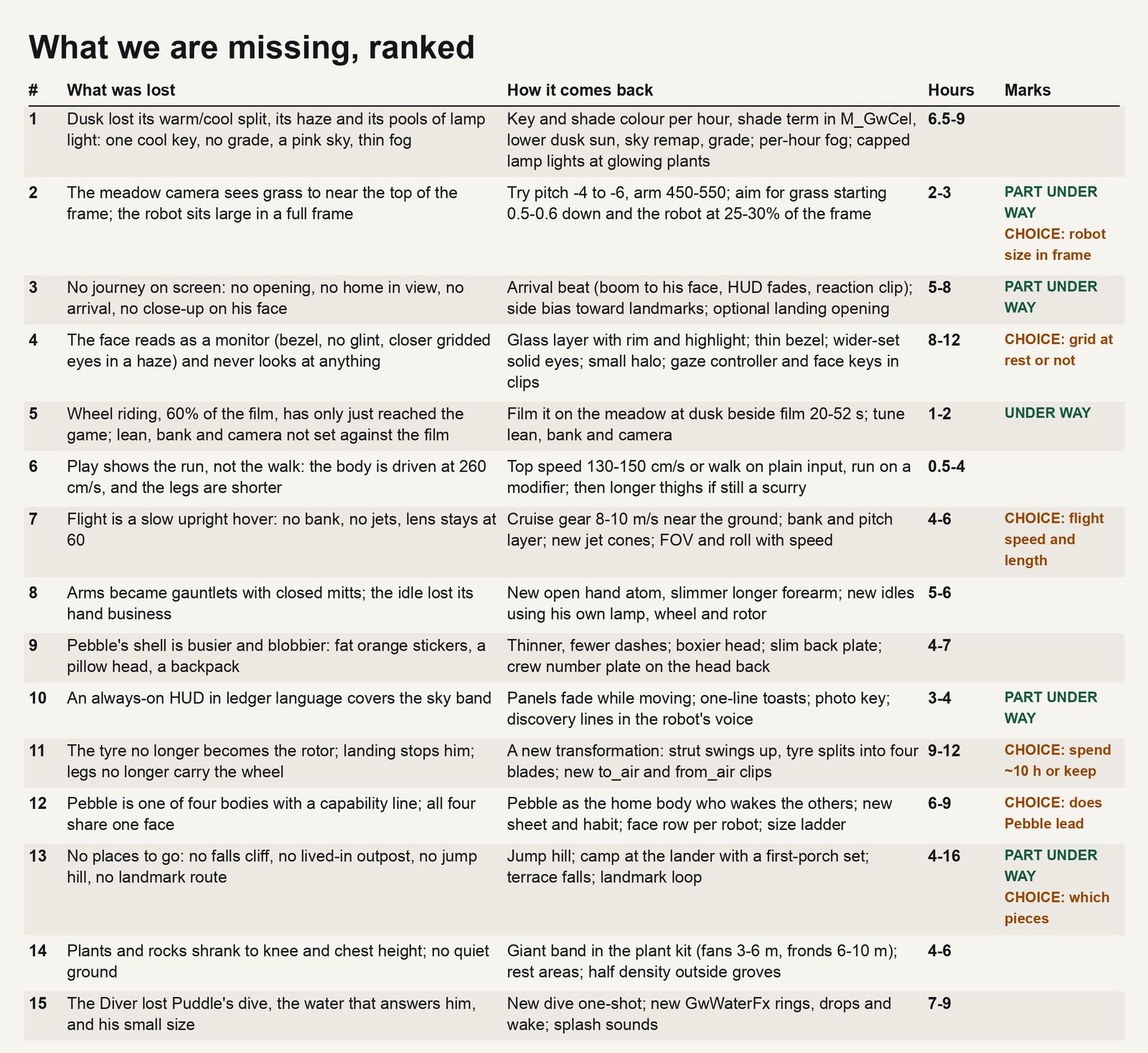
Sheet 186 · Thu 21:32, croppedThe study's ranked list: what the jam's Pebble had lost against the earlier one, how each thing comes back, the hours of work it would take, and which rows waited for my choice. Open full size 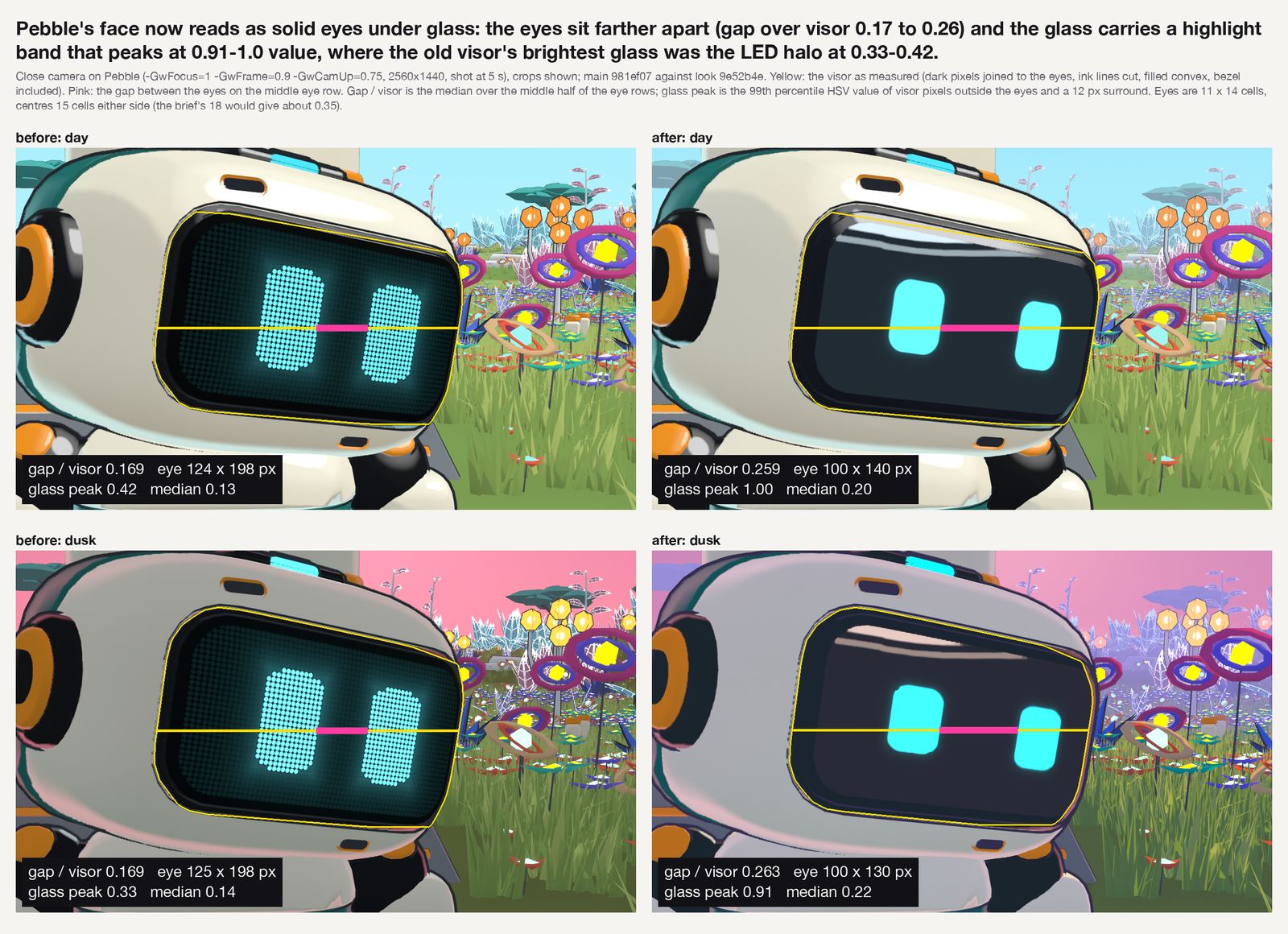
Sheet 204 · Thu 23:11The face before and after that night's look pass, measured on the frame. The gap between the eyes over the visor's width went from 0.169 to 0.259 by day, and the brightest glass from 0.42 to 1.00. Open full size -
Two packages, two failures
The first Mac package took 35 minutes. The archived app didn't start because of a missing library, and the staged copy started but wrote no screenshot. The cause of the second one was the engine signing a Mac package with the App Sandbox on, so the game could only write inside its own container.
On Windows, Hermes's packaged game exited two seconds after starting with an access violation. The same code ran on the Mac. A subagent read the engine source and by 00:16 had a likely cause, which the coordinator checked line by line: a flag in the Windows packaging script,
-NoLiveCoding, built the game against engine libraries built the other way, and the two sides disagreed about the size of a record (24 bytes against 32). The flag had come from the Windows kit written on the Mac. At that hour it was a diagnosis that nobody had confirmed on Windows. -
Five species in the meadow
Five creature species replaced two stand-in animals: 16 creatures and 16,932 triangles, with no measurable change in frame time. They come from a kit that Codex made earlier that evening, running GPT-6 Astra at extra-high effort: 24 species from 26 parts in five body plans.
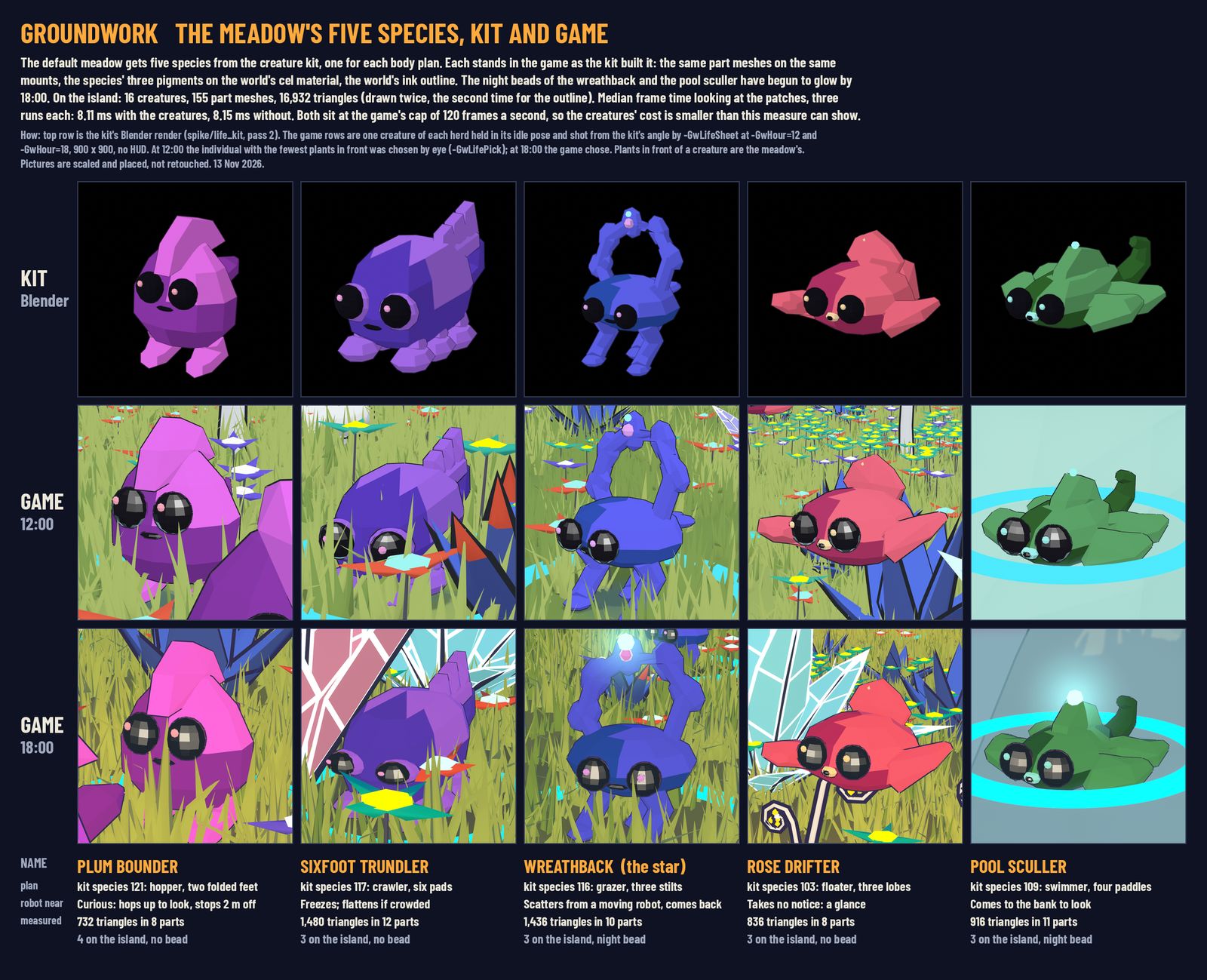
Sheet 209 · Fri 01:24The meadow's five species, as kit renders and in the game. Open full size -
The session stopped for three hours
At about 01:45 my account's Fable limit ran out. A creature lane on Fable 5.2 died in the middle of an edit, and the coordinator stopped until I woke and typed “Resume” at 04:53. Three lanes on Opus (weather, the colony loop and the first slice of the world) finished in that gap and sat unmerged.
After that, build and review agents ran on Opus. On Friday at 17:56 I moved new builder lanes back to Fable with this: “Let's use more fable sub agents for tasks because I have 75% usage of fable left.”
-
A game that plays to its end
The colony loop ran unattended and ended on READY FOR HUMANS at 973.5 game seconds, 16.3 minutes: 34 plus 2 pieces built, 37 drops, 27 parts made, 9 scans. The weather lane had all seven of the world's weather events on a seeded schedule.
The coordinator merged the three lanes itself, 705 files, after its integrator agent was cut off. The merge turned up two name clashes that only appear when the engine batches source files together, the way the Windows build does. It also found why the merged run came up one scan short: the Diver walked to within 120 cm of the creature it was sent to scan, which is the distance at which that creature bolts. It now stands 190 cm off.
Film 216 · Fri 04:57The colony loop as a timelapse, 43 seconds, no sound. Nobody is at the controls. 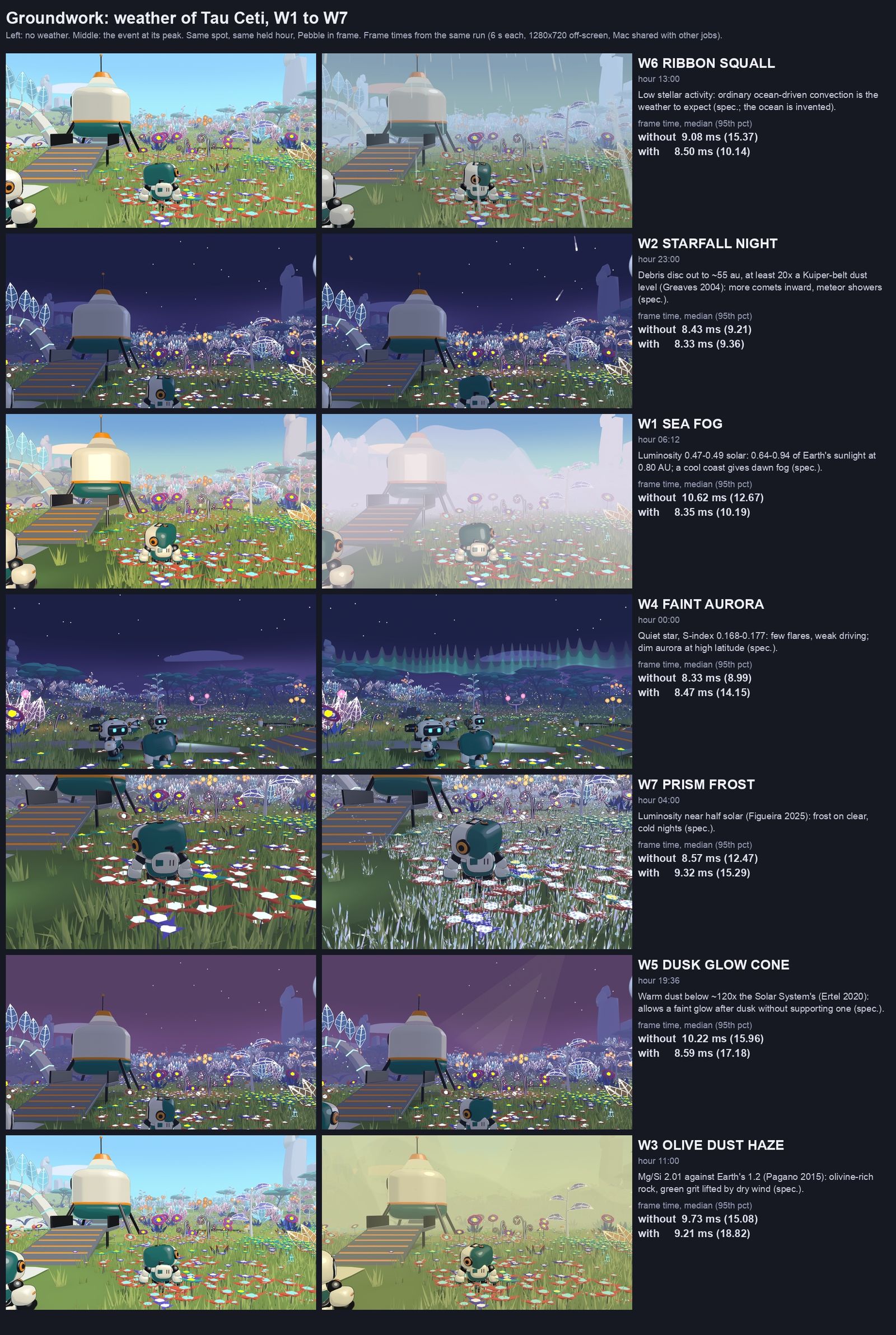
Sheet 213 · Fri 04:57The seven weather events, each beside the same view without it. Open full size
Ten minutes of play, then Windows, the lander and the field book
-
Ten minutes at the keys
By 08:39 the game opened on a title, the ship's message gave the orders, and Esc paused. I played that build for ten minutes. Until then nobody had pressed a real key, and every run had been a script.
My message
its really charming and going in a good direction. We just need a better UI system and onboarding to show us how to use the controls. When we start with a character it does like a quick explanation of how to use their kit. Also Pebble needs jets like he does in our previous version so he can fly faster.
Two lanes started: a guide with a kit card for each robot, and jets.
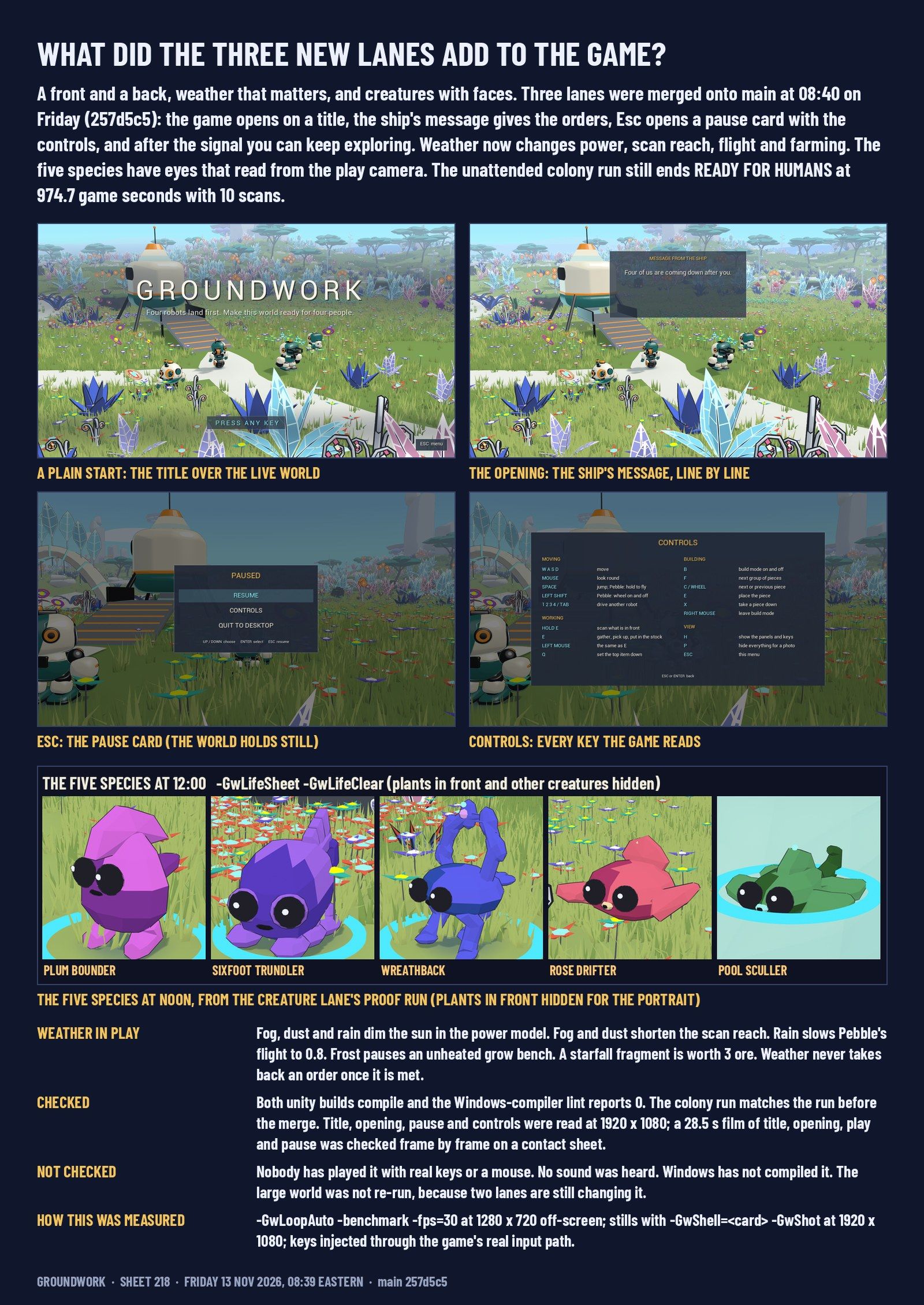
Sheet 218 · Fri 08:39What three merged lanes added before I played: a title, an opening, a pause card, weather that changes play, and creatures with eyes. Open full size -
It runs on Windows
The coordinator stopped waiting for a reply from the PC and ran the build on the PC itself. Microsoft's compiler gave 0 errors and 0 warnings, the package drew the title and play, and the unattended run ended on READY FOR HUMANS at 974.0 game seconds against 973.9 on the Mac. Removing
-NoLiveCodingfrom the Windows scripts ended the crash, which confirmed the night's diagnosis.The run found one new fault. On the first launch after packaging the world stayed black for 12 seconds or more while the graphics card compiled the game's shaders. A loading card that holds until that work is done went in that afternoon. At 10:39 a Shipping package ran alone on the PC, drew the title at 6 seconds and finished the colony run. Its first two launches had been black because they were cold or processor-starved launches.
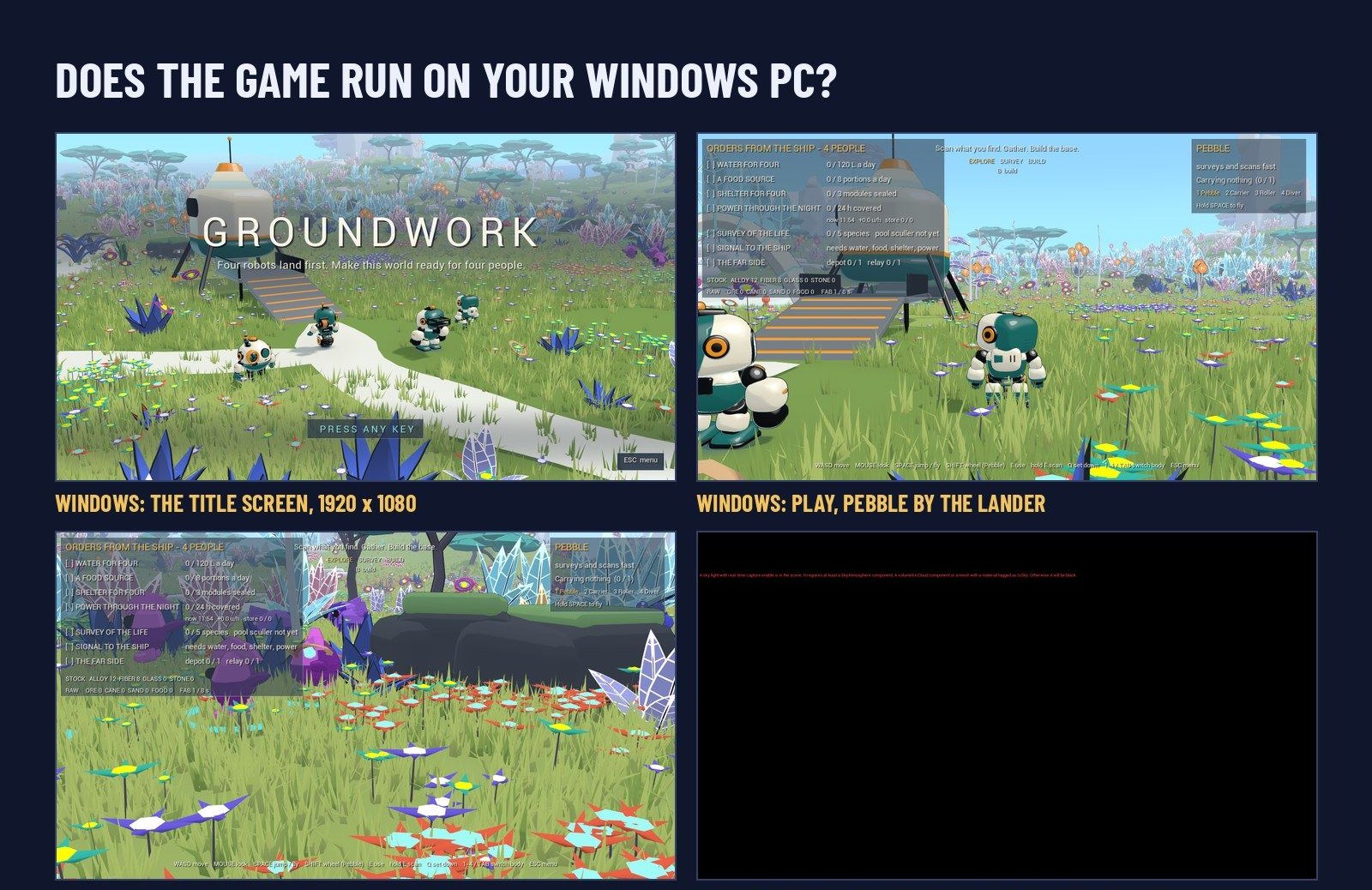
Sheet 220 · Fri 09:42, top partThe Windows package on my PC, including the black first launch. Open full size -
One thing wrong with the interface
At 09:47 I sent five reference pictures for the interface: light panels, dark ink, orange-red and blue as the only accents, labels in monospaced capitals. Fifteen minutes later I saw the first restyle.
My message, on picture 221
We need to take out the left bar side orange accent thing. But other than that it looks good.
That sentence became rule 8 in the game's interface style document. The bar came off the order row and the toasts.
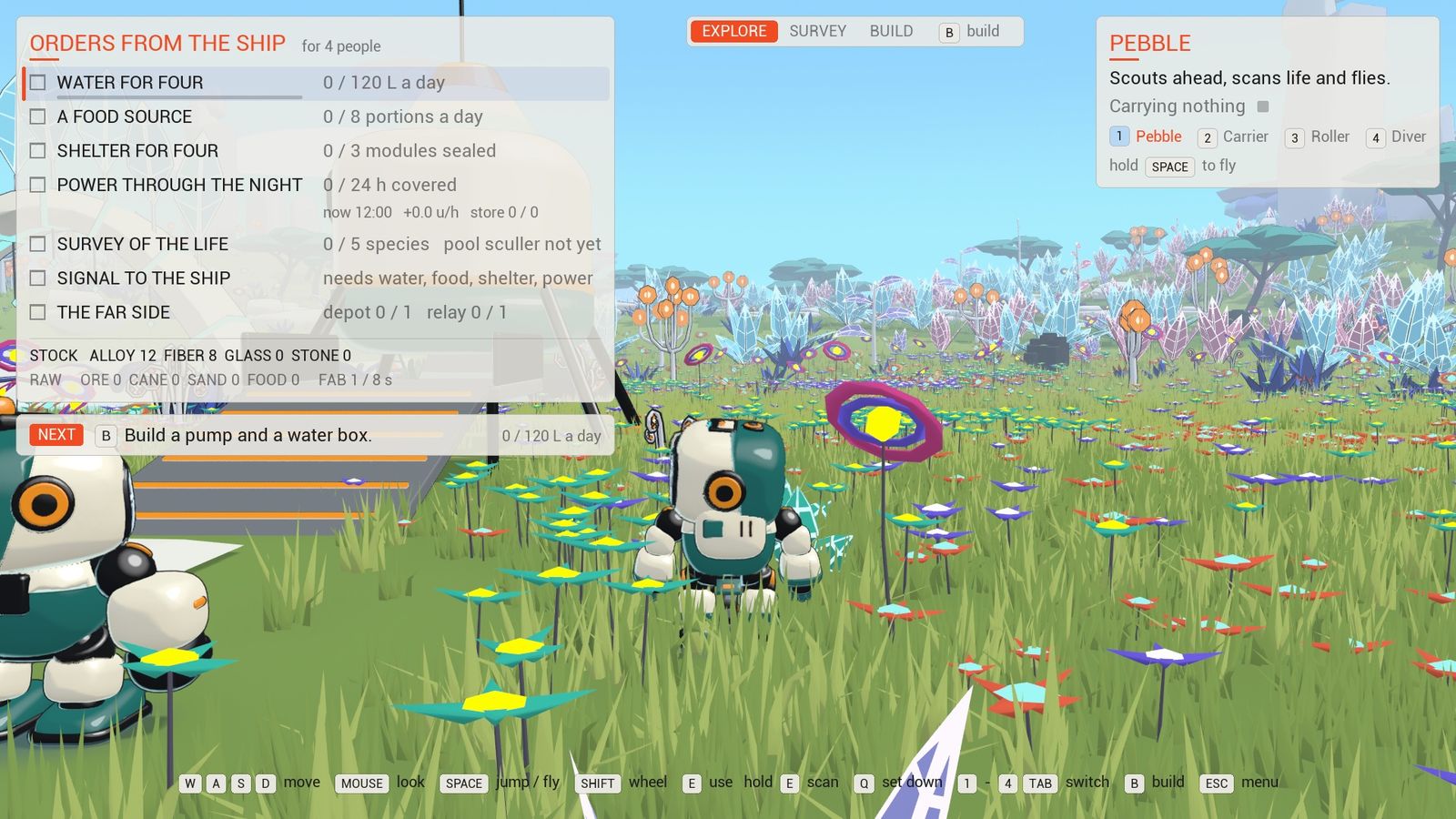
Picture 221 · Fri 09:57The first look, with the orange bar on the left. Open full size 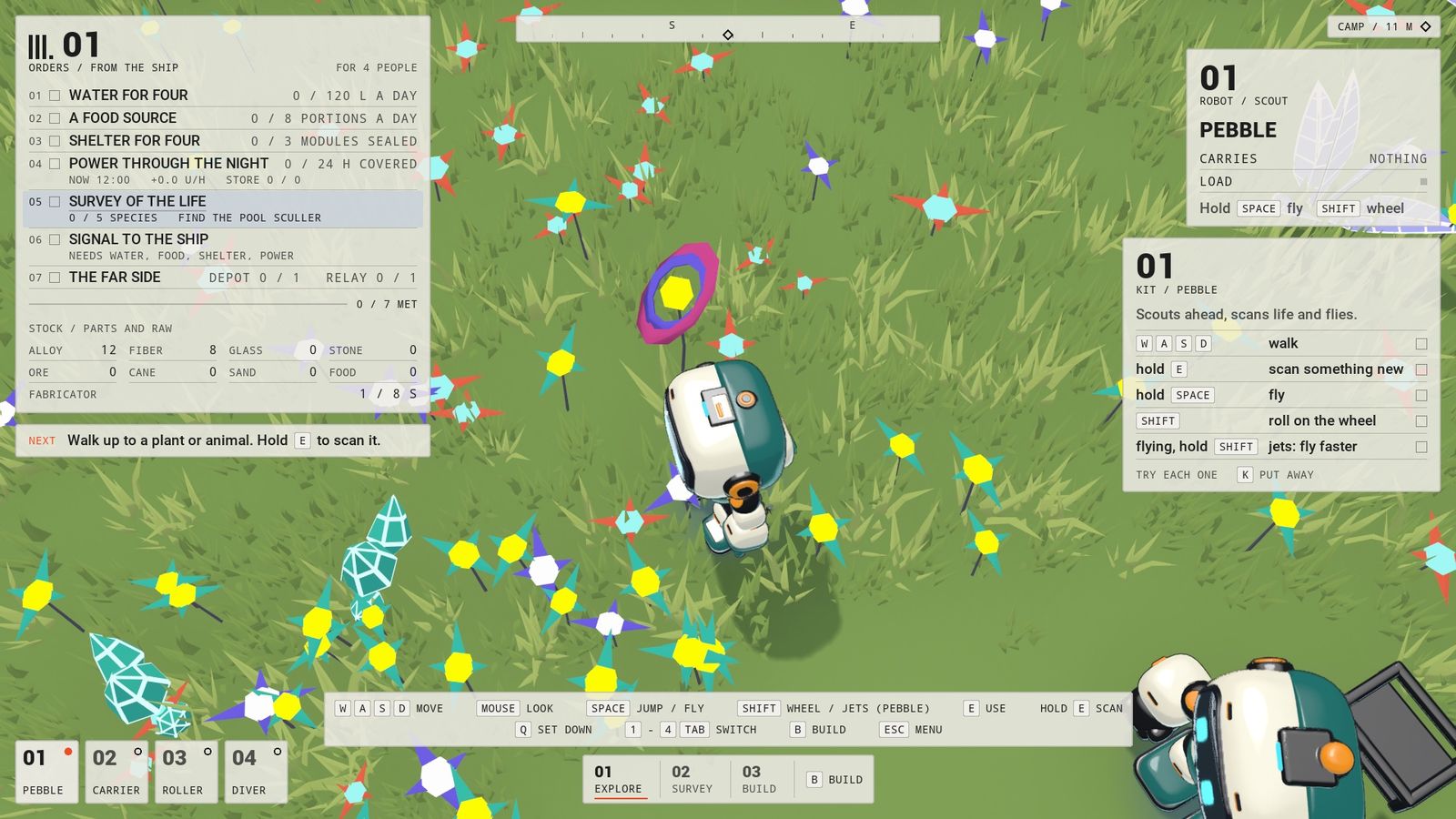
Still 239 · Fri 12:55As merged, without it. Open full size -
The title moved into space
At 10:05 I described the opening: a ship lands, four robots wake and walk out, and a screen gives them the goal. A design pass planned 21 seconds of it. Then I changed where it starts:
My message
We should be in space in the title screen above Tau Ceti when we click to play that's when we start to enter the atmosphere and land
A lane built the title 50 km over the landing site and a 7-second entry. A check with fresh eyes found that the planet read as Earth and the star as a grey moon, and a second pass fixed both. At 13:36 I wrote “The space title and entry look good.” The whole opening was built by 20:13. Play starts 29.9 seconds after the title key, or 7.2 seconds with the two-key skip.
Film 280 · Fri 20:12The opening as built on Friday evening, 36 seconds, with sound. The title sits in space, a key starts the entry, the lander comes down on a retro burn, and the four robots wake and walk down the ramp. The film's sound was rebuilt afterwards from the game's log lines. 
Still 234 · Fri 12:12The title in space, first look, with Friday's subtitle. The planet was redone in a second pass that afternoon. Open full size -
Which lander
I asked whether modelling could go to Hermes, because “the rocket for example looks a little weak”. Hermes drew three lander studies in Blender beside the current one. I wrote “I like B”.
An hour later I looked at B again and wrote “The lander needs more detail and charm.” Hermes drew three treatments, and the coordinator recommended a mix: A's face and antenna, B's roof gear and C's legs. I wrote “Agree with the mix”. By 16:10 the mixed lander was in the game at 25,402 triangles. The first lander had 7,256.
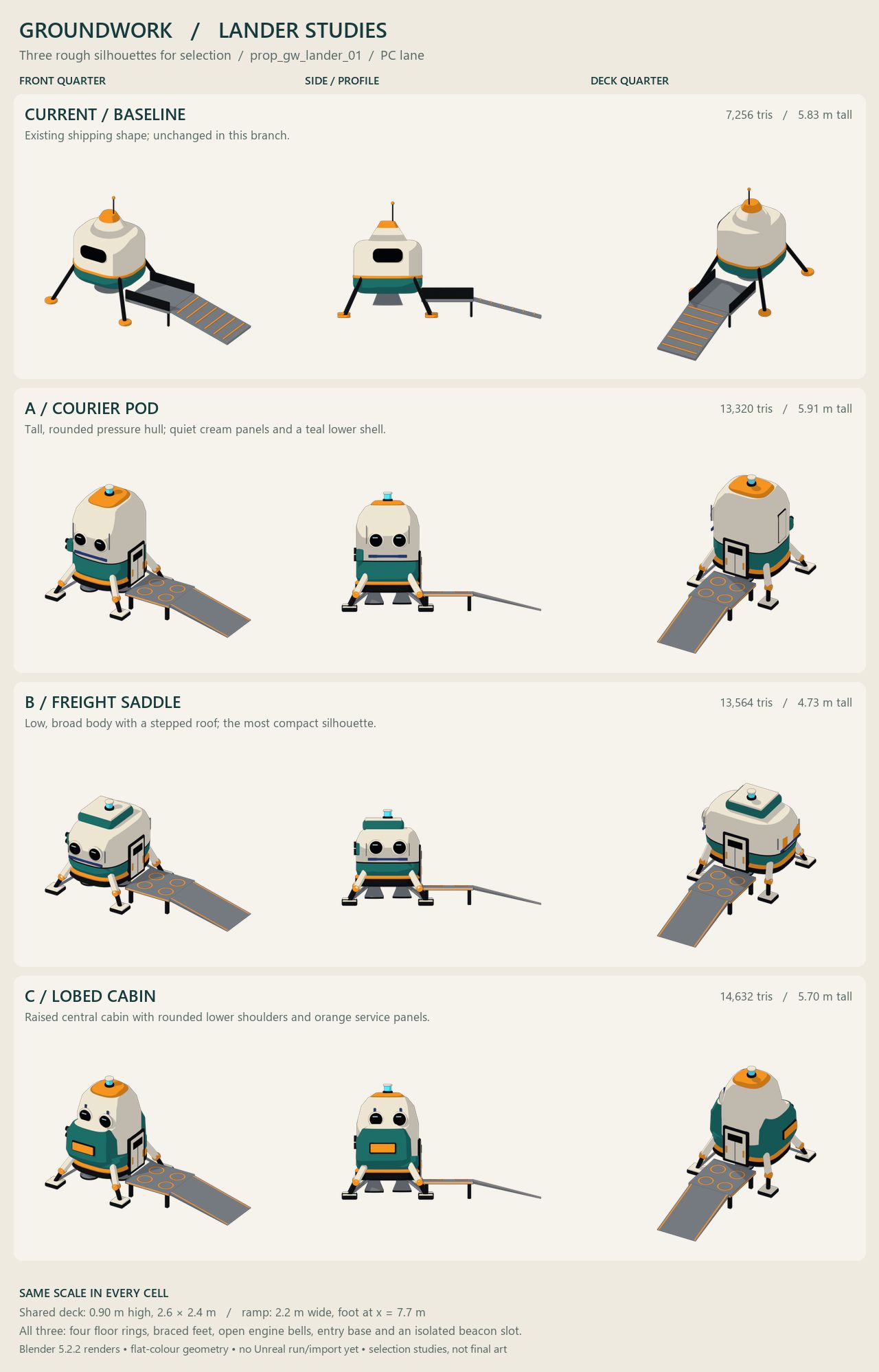
Sheet 236 · Fri 12:24Three studies from the PC. I picked B. Open full size 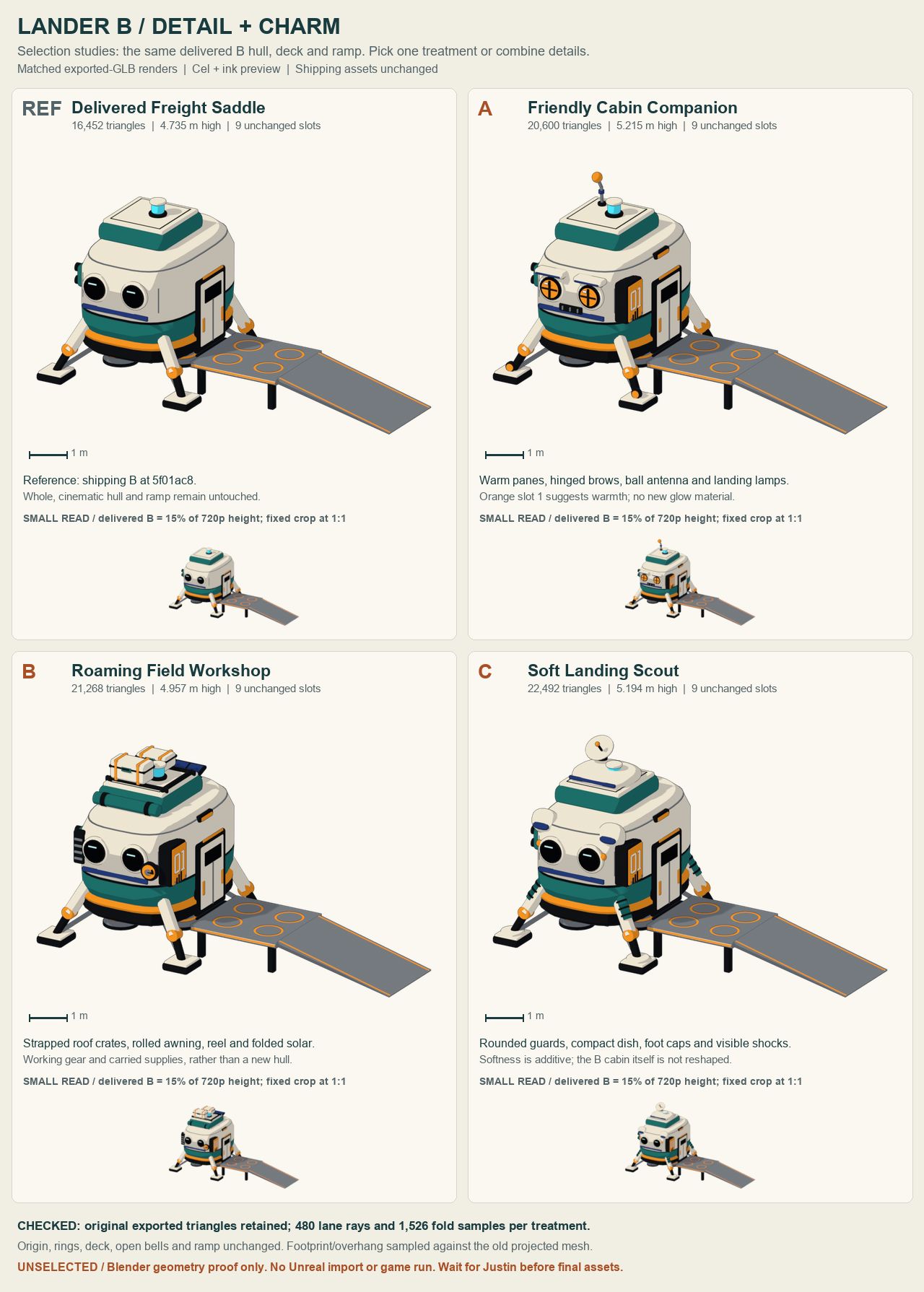
Sheet 251 · Fri 14:10Three treatments of B. I took the mix. Open full size 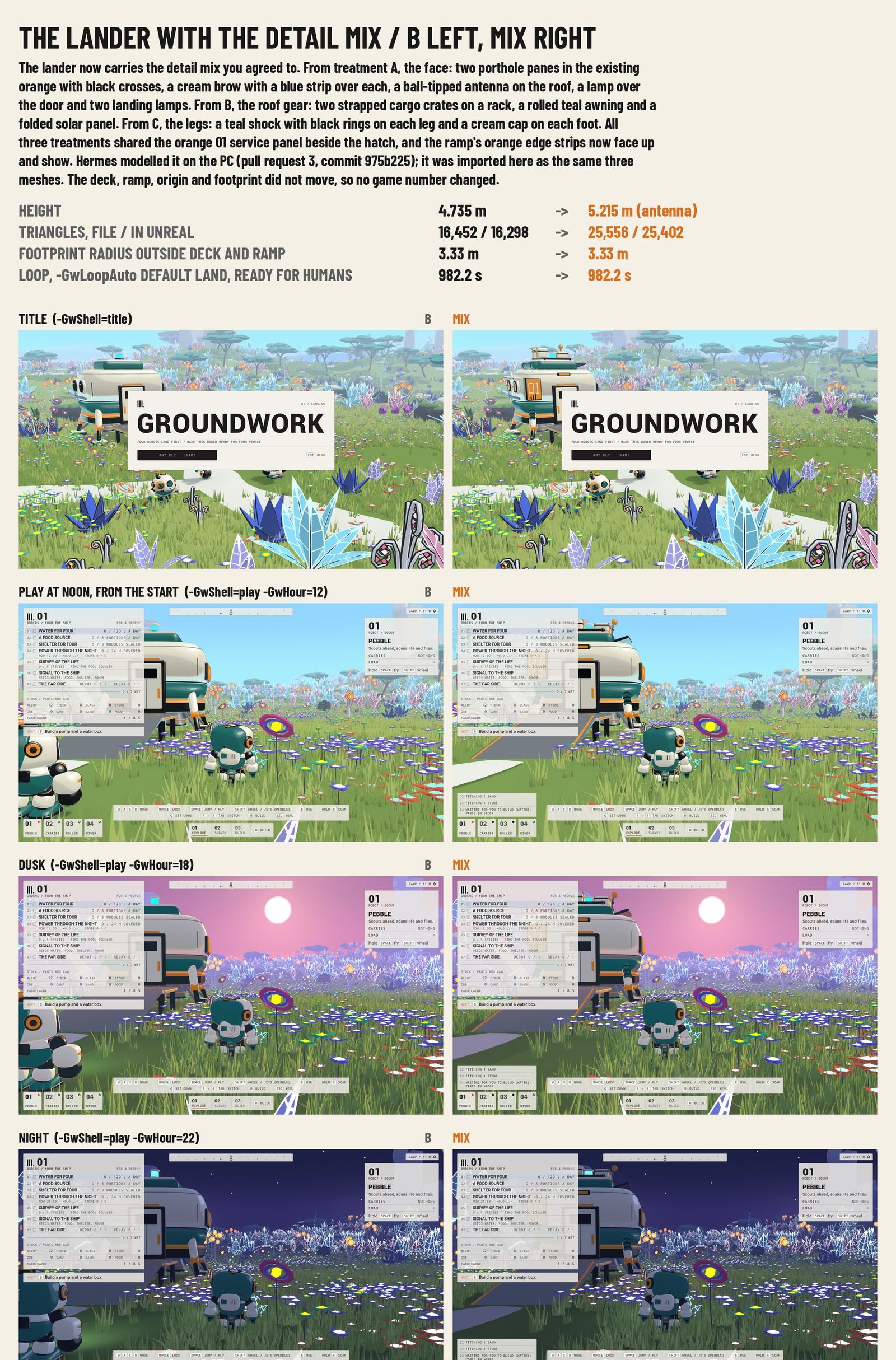
Sheet 264 · Fri 16:09, top partIn the game: B on the left, the mix on the right. Open full size 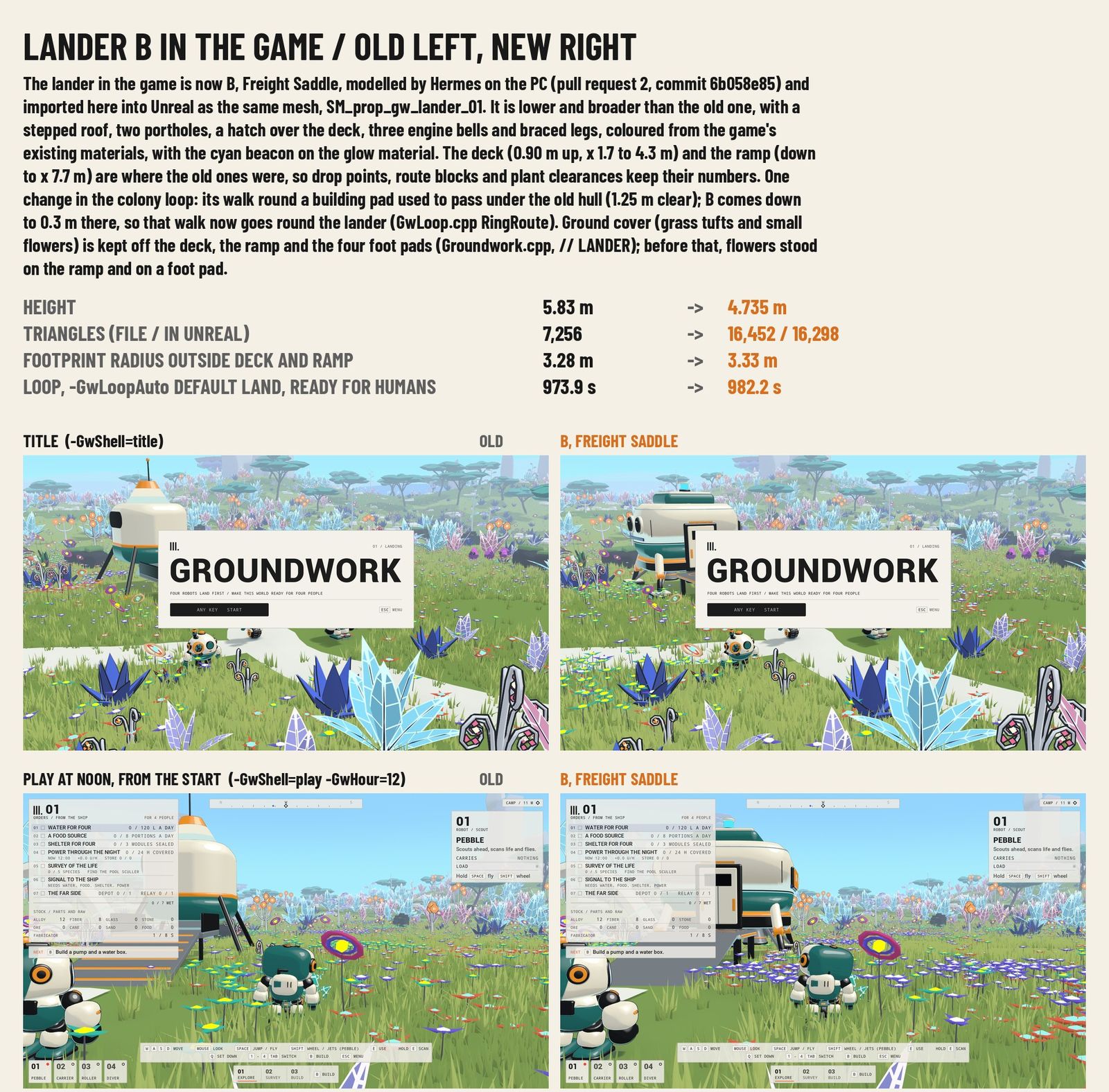
Sheet 252 · Fri 14:19, top partBefore the mix: the first lander on the left and B on the right, in the game. B stands 4.735 m tall against 5.83 m and has 16,298 triangles in Unreal against 7,256. Open full size 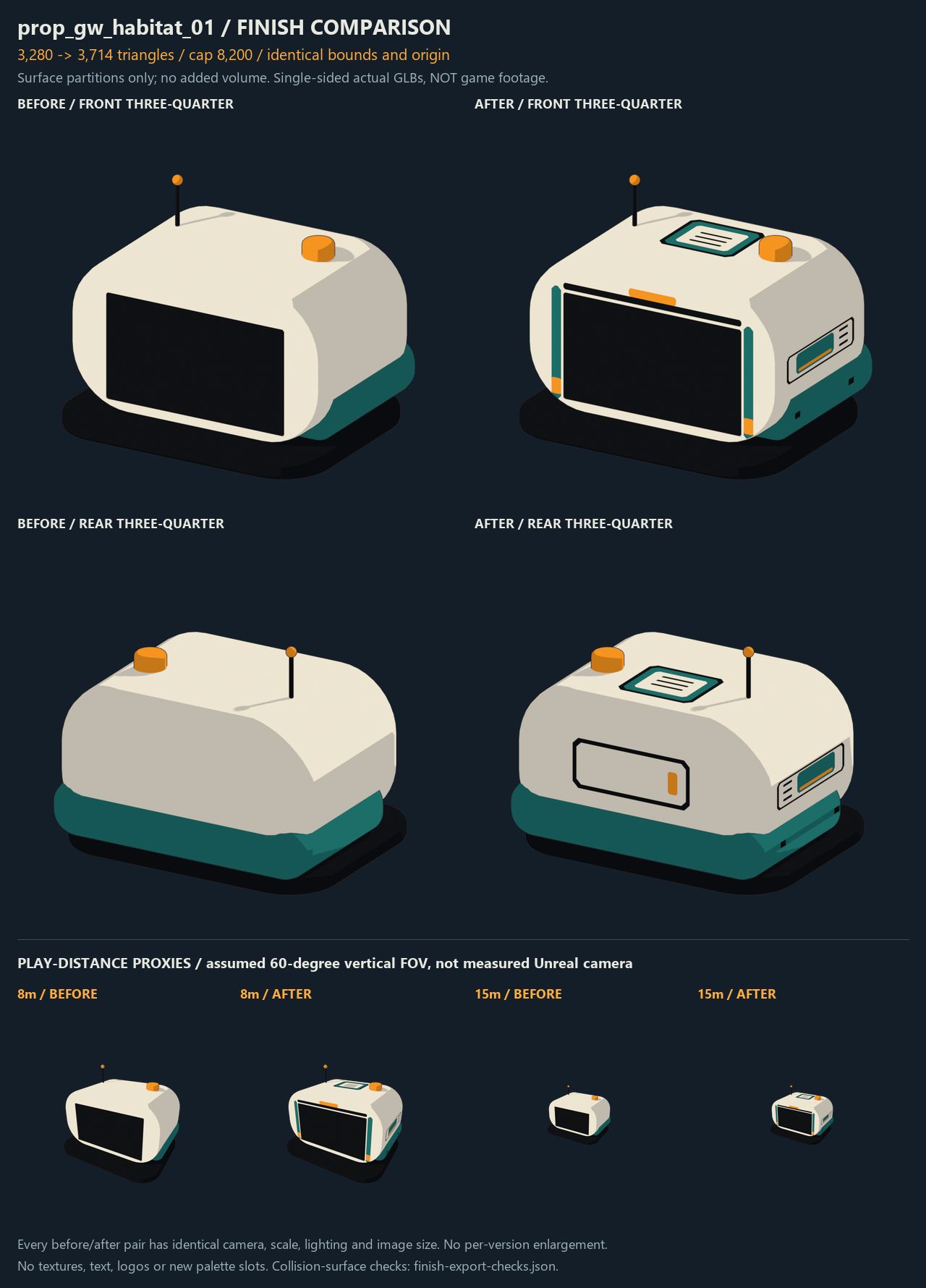
Sheet 261 · Fri 16:07The same afternoon Hermes gave the habitat a finish pass: 3,280 to 3,714 triangles, same bounds and origin, same camera and scale. These are renders of the exported files, not frames from the game. Open full size -
Sounds I could judge by ear
The robots' actions got generated sounds from ElevenLabs: cane snaps, leaves, a pod snap, a muffled pull. Each take had been measured. I listened to the review film and wrote “sounds are good.”
Film 248 · Fri 13:55The sound review film, 14 seconds, with sound. Each sound plays over its spectrogram and waveform. -
A dictionary of the world became a field book
My message, 13:36
Can we start planning out a dictionary of what exist in the world and if we decompose those parts what do we get. For example if we decompose a plant, it provides ingredients for fuel
The plan came back at 14:32 with 102 things, 132 parts, 8 ingredients and 10 recipes, read from the game's own source. I wrote “let's build it.” The plan's default was scan lines only, with a screen if I asked. I wrote “i want screen too.”
The designer named the screen the field book and sent a mock drawn from the real data. It broke one of the interface rules by using the world's colours for ingredient swatches, and it asked me. I wrote “colors are good”. The built field book was on film by 18:26: J opens it, the world waits, and each scanned thing gets a page with an ink drawing made from the game's own meshes.
Film 275 · Fri 18:26The field book in the game, 18 seconds, no sound. 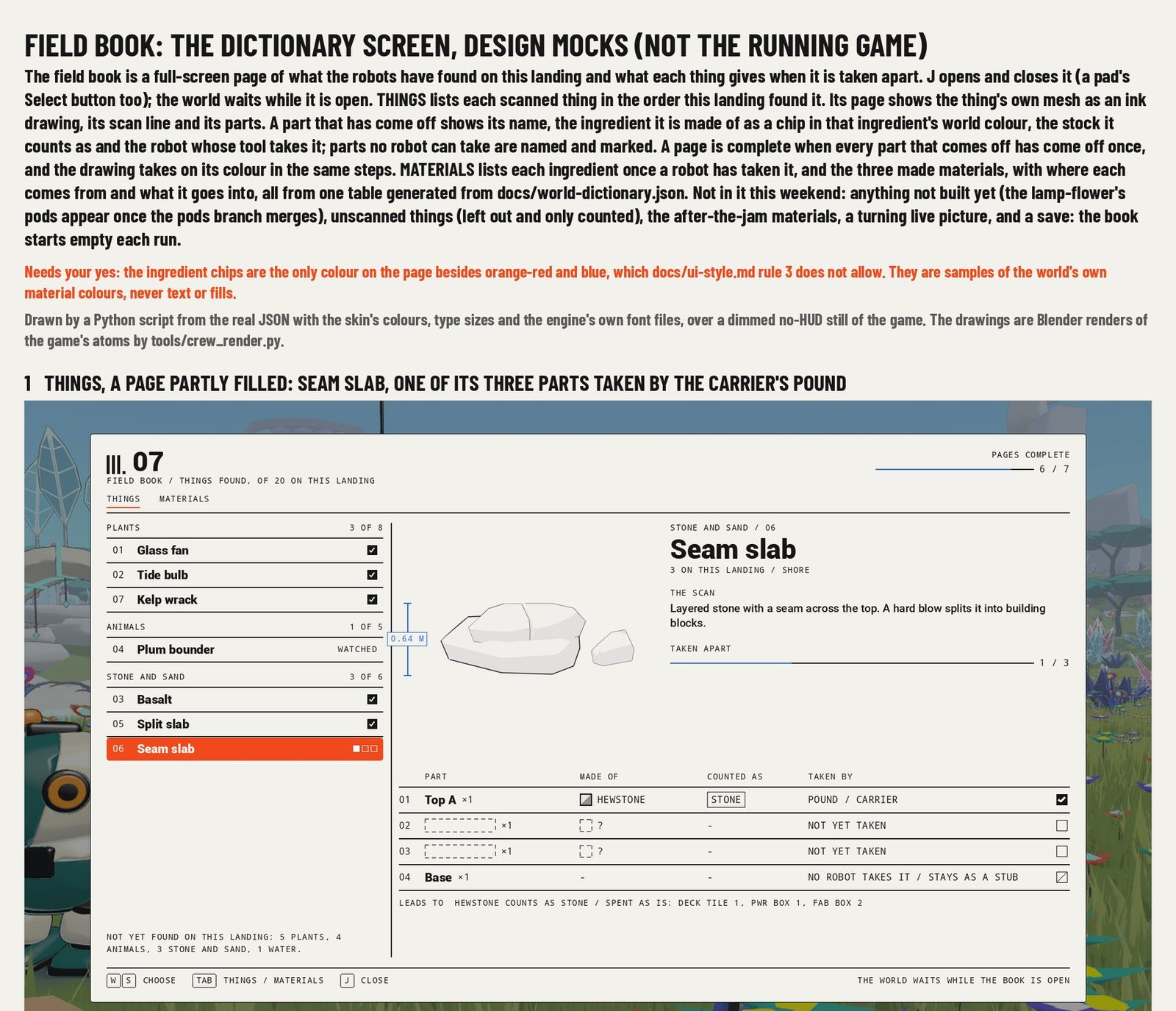
Sheet 260 · Fri 15:39, top partThe design mock I answered. A script drew it from the game's data. It is not the running game. Open full size -
Build everything, triage on Sunday
A plan for materials that combine came back with 89 materials and 71 rules. A critic that checked the science judged 76 draft rules as 38 real, 31 fair compressions and 7 wrong, and the wrong ones were fixed. Its summary set some work aside for after the jam. I answered:
My message
are you saying this as after we submit a version for the jam session? Don't worry about that let's just build as much as we can and then Sunday morning we will start to see what we can finish to be in the final game.
From then on nothing waited for after the jam. Each system is built one commit per step behind its own switch, so that a part can be left out on Sunday.
-
A world from a seed
I had asked for the world to be generated outside the landing zone. The first prototype computed each landing's ground from a seed in integer arithmetic, so that one seed gives one world on both machines. The sheet showed six seeds from above and sketches of six kinds of place.
My message, on sheet 270
they are all good as ideas but need to be refined to look as good quality as the landing zone. We also need to generate underwater areas and sky island areas.
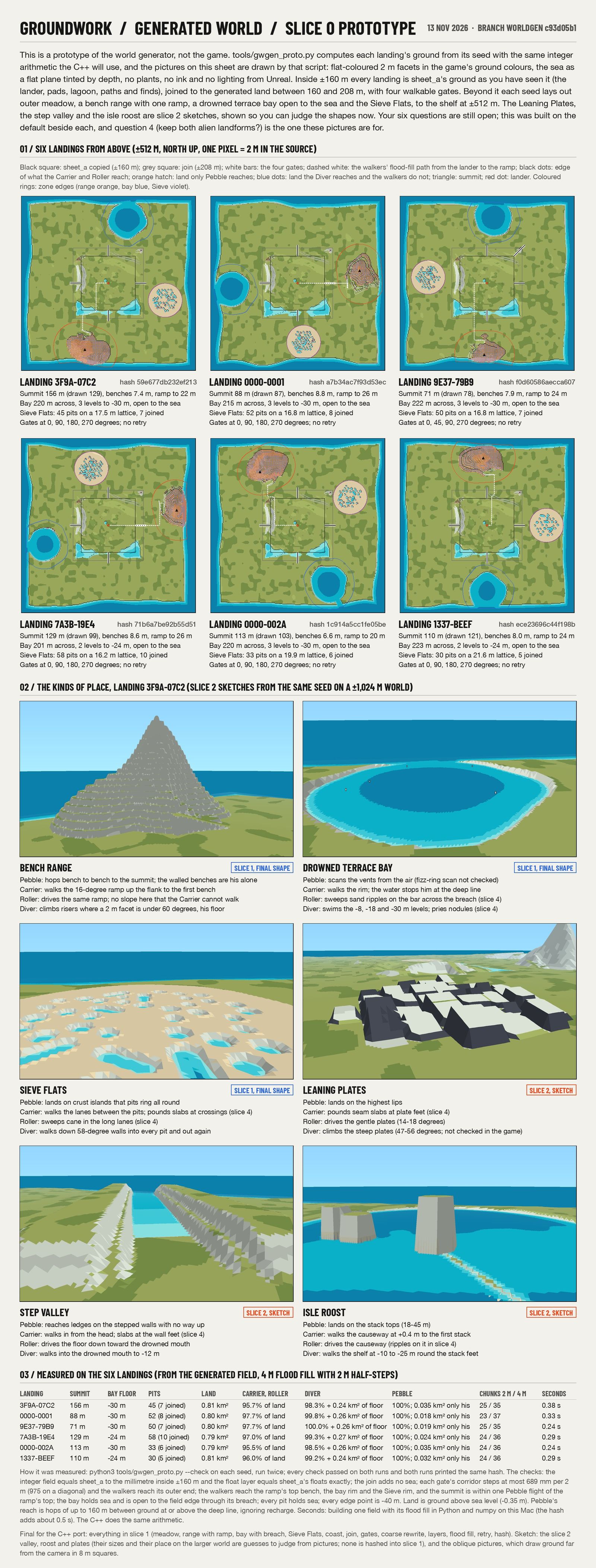
Sheet 270 · Fri 17:14The prototype sheet. A script drew these pictures. They are not from the game. Open full size -
No ending, and a way to call a robot
My messages
the game should be open ended with the goal of making the best colony for the human arrival but no clear ending and more of a sandbox build game
we should be able to call one of the other robots over if it's a task that the current robot you're playing can't do
Two lanes started, each behind a switch. An hour later I asked for a default name for each robot, and the coordinator picked Cobble and Tumble. It dropped two other names because a toy franchise has robots with those names and the same jobs.
-
Twenty-five decisions, one line
I asked to see in the chat what I needed to decide. The coordinator listed 25 numbered decisions, 10 waiting on me and 15 already running on a default, each with its own pick. I wrote “Go with your recommendations”. Six minutes later:
My message, 21:10
Heading to sleep. Let's keep everything going over night and make sure Hermes is building out things.
The second night: the PC models, the Mac measures
-
Hermes had been idle and I'd been told otherwise
Five minutes after I went to bed the coordinator looked at the PC and found that Hermes had done nothing since 18:51. Four briefs had been posted as pull request comments, and Hermes only acts when a run is started for it. The coordinator had assumed it picked comments up by itself and had told me it was working on the base's module pieces. It started a run at 21:17 and Hermes wrote its first file at 21:28.
-
Four modelling jobs from the PC
Hermes delivered a pass on the three material stations 37 minutes after its run started, then six base module pieces at about 20 minutes a piece, then ten props for the generated places and a relief pass on three older props. It finished at 01:06 and then sat idle for 80 minutes, because nothing told the Mac that its run had ended. A second order went out at 02:27.
-
Nine lanes came back
A merge put the lander with lit window panes, the plant-to-fuel chain, the field book and the robots' names on main. Nine more lanes returned with their review rounds done, among them three sky looks, the open-ended sandbox and a key that calls a robot over. The first slice of the generated world followed at 02:45. In it the game, a standalone program and the prototype printed the same hashes on three seeds.
Film 300 · Sat 02:33Calling a robot over, 13 seconds, no sound. Film 302 · Sat 02:43A flight over generated ground, 14 seconds, no sound. This is the first slice, before any dressing pass. 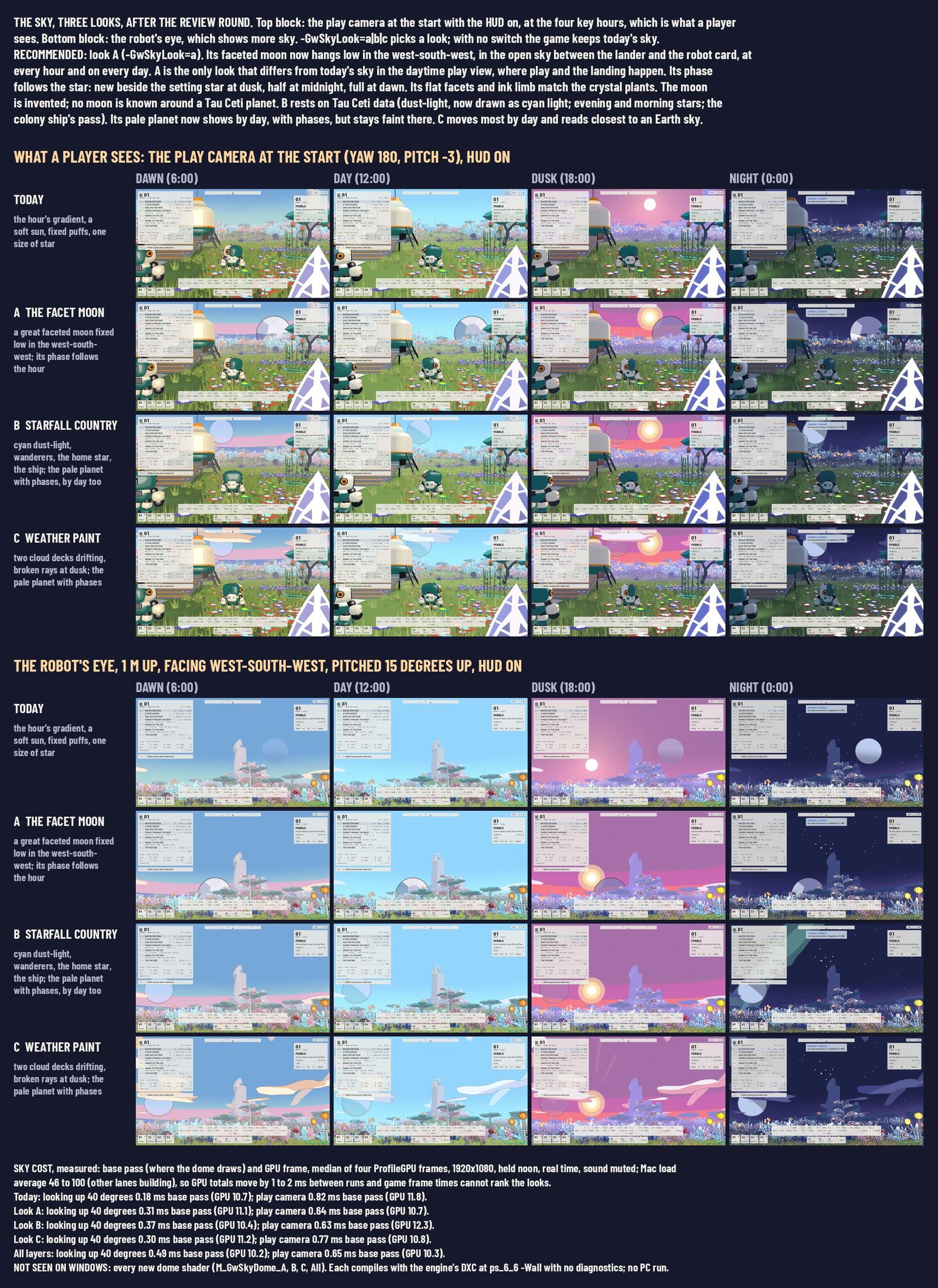
Sheet 287 · Sat 02:33Three sky looks. The coordinator made look A the default while I slept, as one commit that can be reverted. I agreed in the morning. Open full size -
The PC's pieces tore the ink line
Hermes's six module pieces imported with every measured claim holding, and they fixed an old flicker on the door (4,526 changing pixels down to 55). But the ink outline tore at every hard edge. The cause was in the export: the PC's files stored several normals at each corner, and the game's ink pushes each vertex along its own normal, so the line split wherever the normals did.
Welding to one normal per position closed the line and brought the door's flicker back (3,712). A third route kept the shading as delivered and gave the ink its own direction, stored in two spare texture channels. With that the door measured 10. One view got worse, though: from the play camera the settled frames changed by 340 pixels where the old pieces changed by 24. Nobody has found why yet.
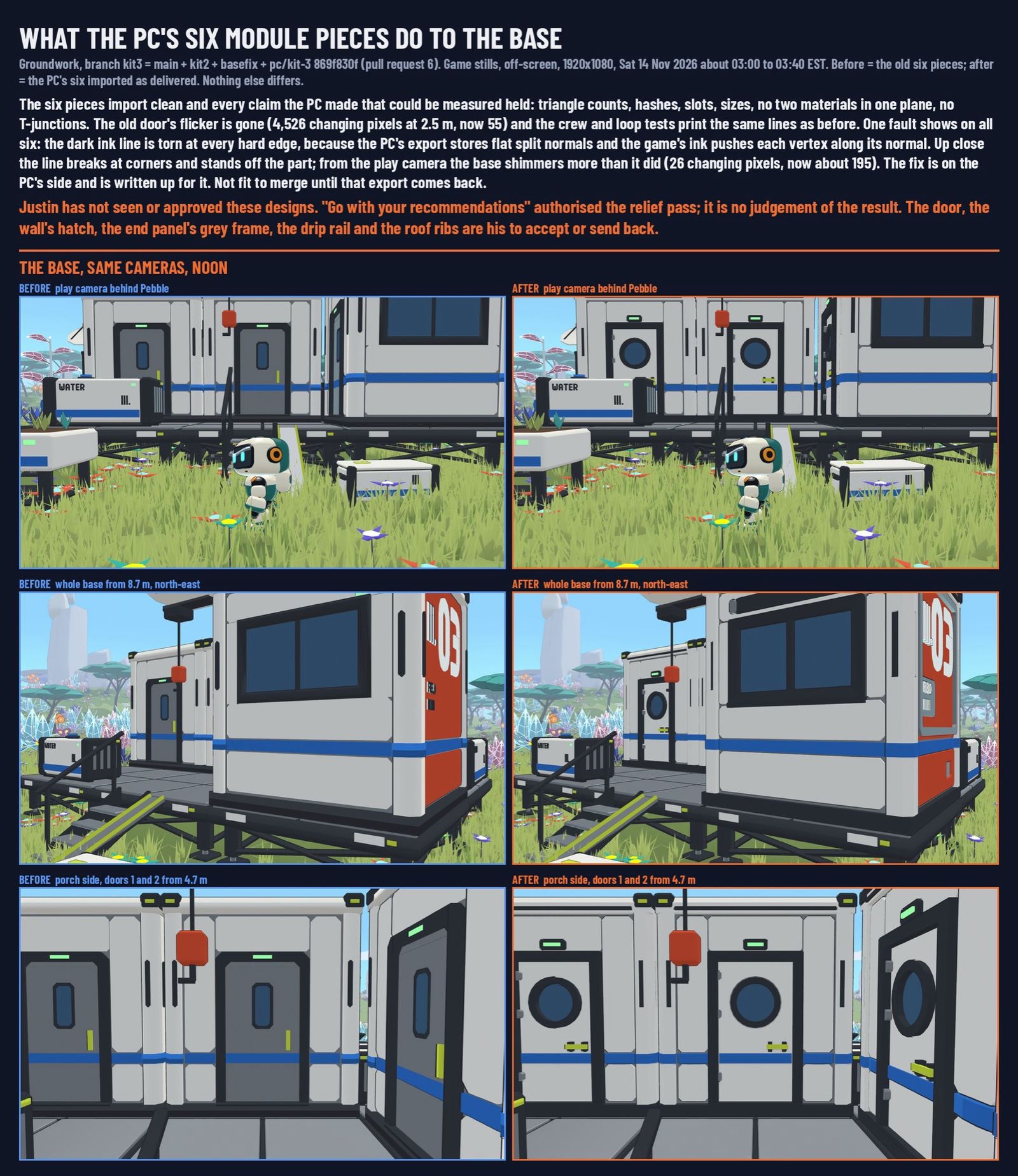
Sheet 306 · Sat 03:53, top partBefore and after the PC's module pieces. Open full size 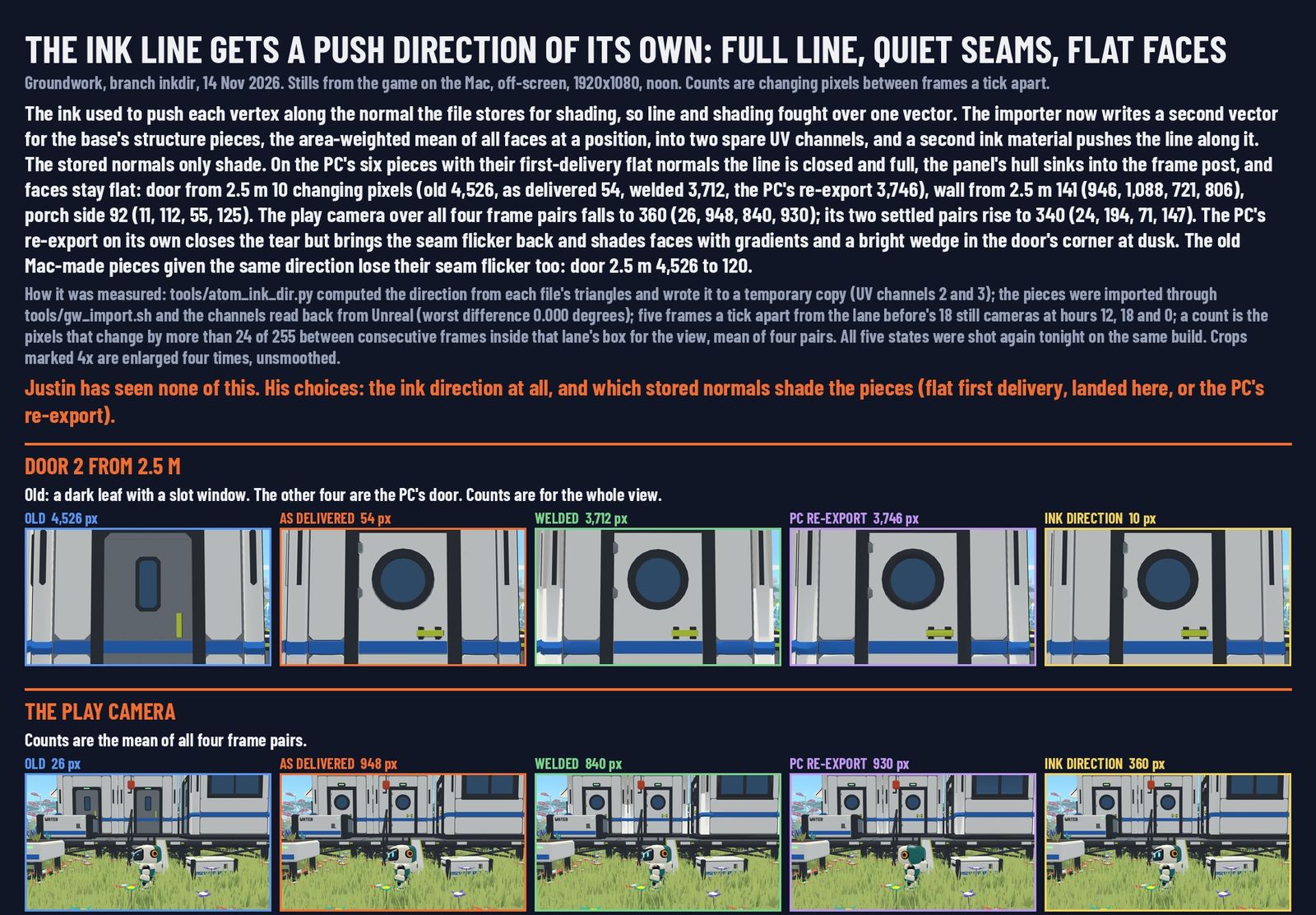
Sheet 319 · Sat 07:34, top partThe door in five states, with the count of changing pixels for each. Open full size -
The coordinator ran nothing for 87 minutes
For 87 minutes the coordinator ran nothing. Lanes that were already going finished by themselves. Hermes's run ended at 05:48 and it waited eight minutes for its next order.
-
One line broke the Windows build
The next merge reached main, and the PC's build of it failed on a single line,
Blocks.Add({FVector2D(PodB), PodB.Z}): error C2397, a double going into a float. The Mac's compiler accepts it. The fix was one cast. The lint got a wider rule, which finds that line and nothing else on main or on five open lanes. -
Windows had more flowers
The rebuilt Windows package ran the whole opening (53 of 53 checks) and the colony loop. Comparing its frames with the Mac's turned up something else. From the same camera, flower pixels were 2.5 to 17 times more on Windows, and the same seed gave a different layout on each machine: 170 lamp flowers against 150. Both machines placed nearly the same amount of ground cover, 232,096 instances on the Mac and 232,735 on Windows. Nobody knew the cause yet, and a lane started on it.
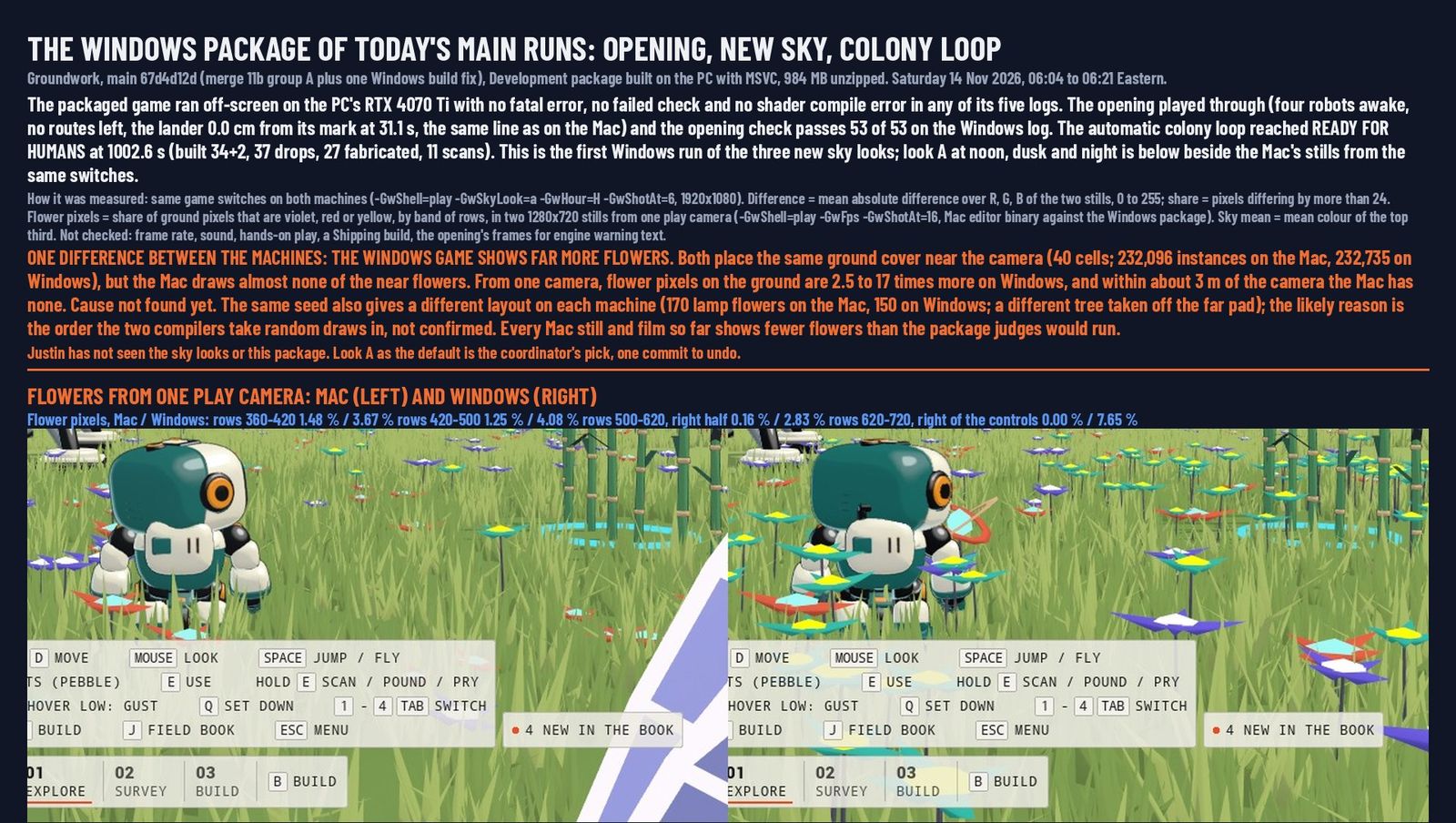
Sheet 313 · Sat 06:41, top partThe same camera on the Mac (left) and on Windows (right). Open full size
Six answers in one line, and the flowers explained
-
A film of the night
I woke up and asked for a video of everything that had been done overnight, narrated in a voice the coordinator thought represented how it sounds. A lane designed nine voice previews and picked one by measuring them. The film was finished at 09:18: 22 minutes in nine chapters, too long to put on this page.
-
“Go with your suggestions”
The coordinator showed me six open questions, each with its pick. I took all six in one line: the narrator's voice, the ink direction for the base pieces if its last two tests passed (they did, at 07:58), the stations kept faceted, the lander's ramp left as delivered, a thin dark band round the wall's door and window, and sky look A. I didn't say which sheets I'd looked at.
-
Why the flowers differed
The lane's first reading was that the Mac was culling flowers near the camera. That was wrong, and its notes say so. The Mac draws every flower it places.
The two machines differed because of the order in which each compiler evaluates the random draws inside one statement. The Mac's compiler takes them left to right and Microsoft's takes them right to left, so the same seed produced two layouts. The proof was a test switch that makes the Mac draw in Windows order. With it the Mac placed 232,735 instances, the Windows count to the unit.
The fix writes each draw on its own line in one fixed order, and the build now stops on any new statement with more than one draw in it. The game keeps the Mac's layout, since every still and film I've judged shows that one. This isn't finished. The same pattern sits in 12 more statements in the code that places stones and boulders, 10 in the weather, 3 in the creatures and 7 in files that other lanes hold, and at 07:55 Microsoft's compiler had not yet built the new code.
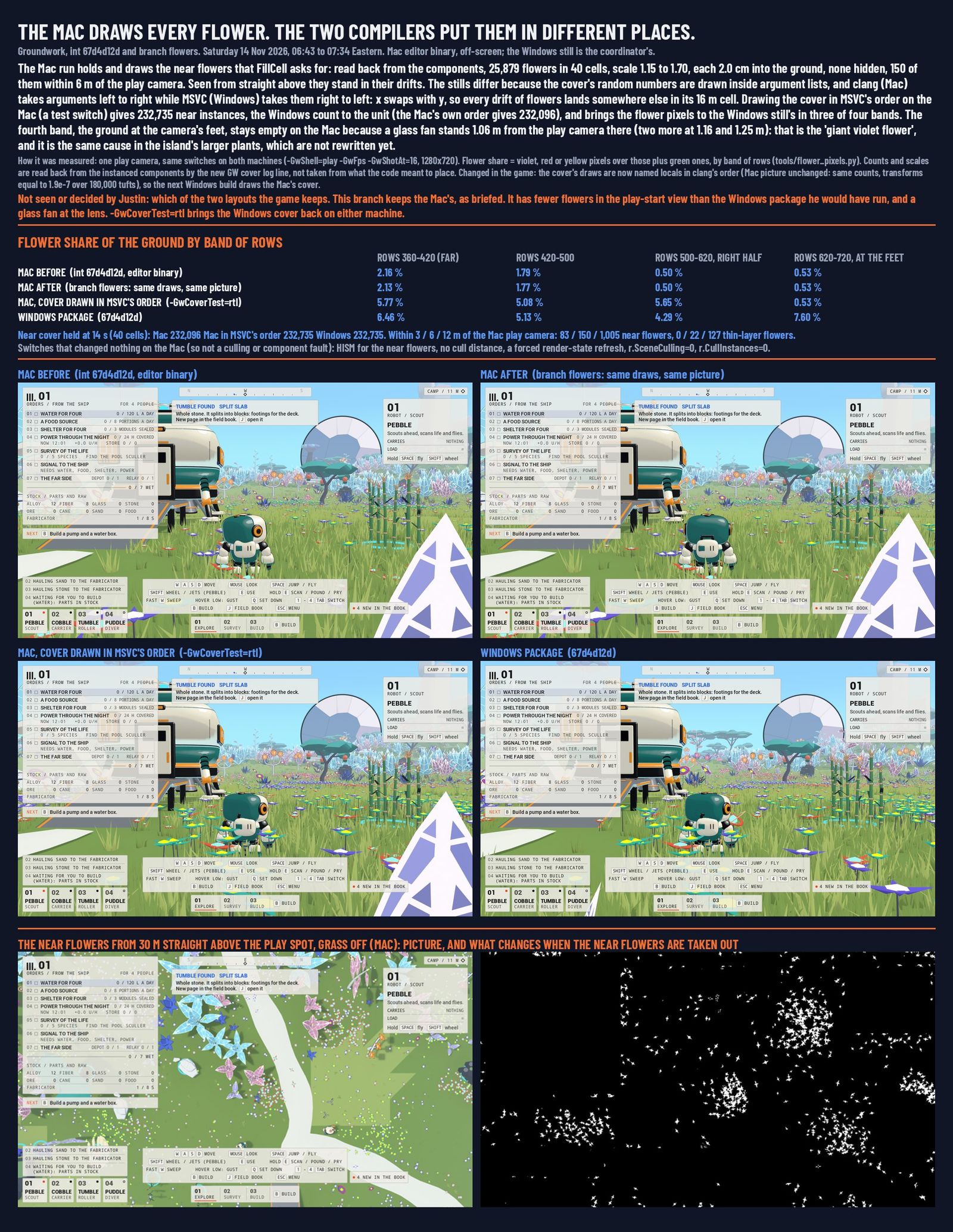
Sheet 320 · Sat 07:51The cause, with the counts from both orders. Open full size -
The three-bar mark is invented, so it stays
The jam's rules don't allow trademarks or logos in an entry. A three-bar mark from my concept picture is on the title card, the panels and the crates, so the coordinator asked whether it was a real logo. I asked to see it, then wrote “oh that mark is fine to use”. It's an invented emblem that only exists in this world.
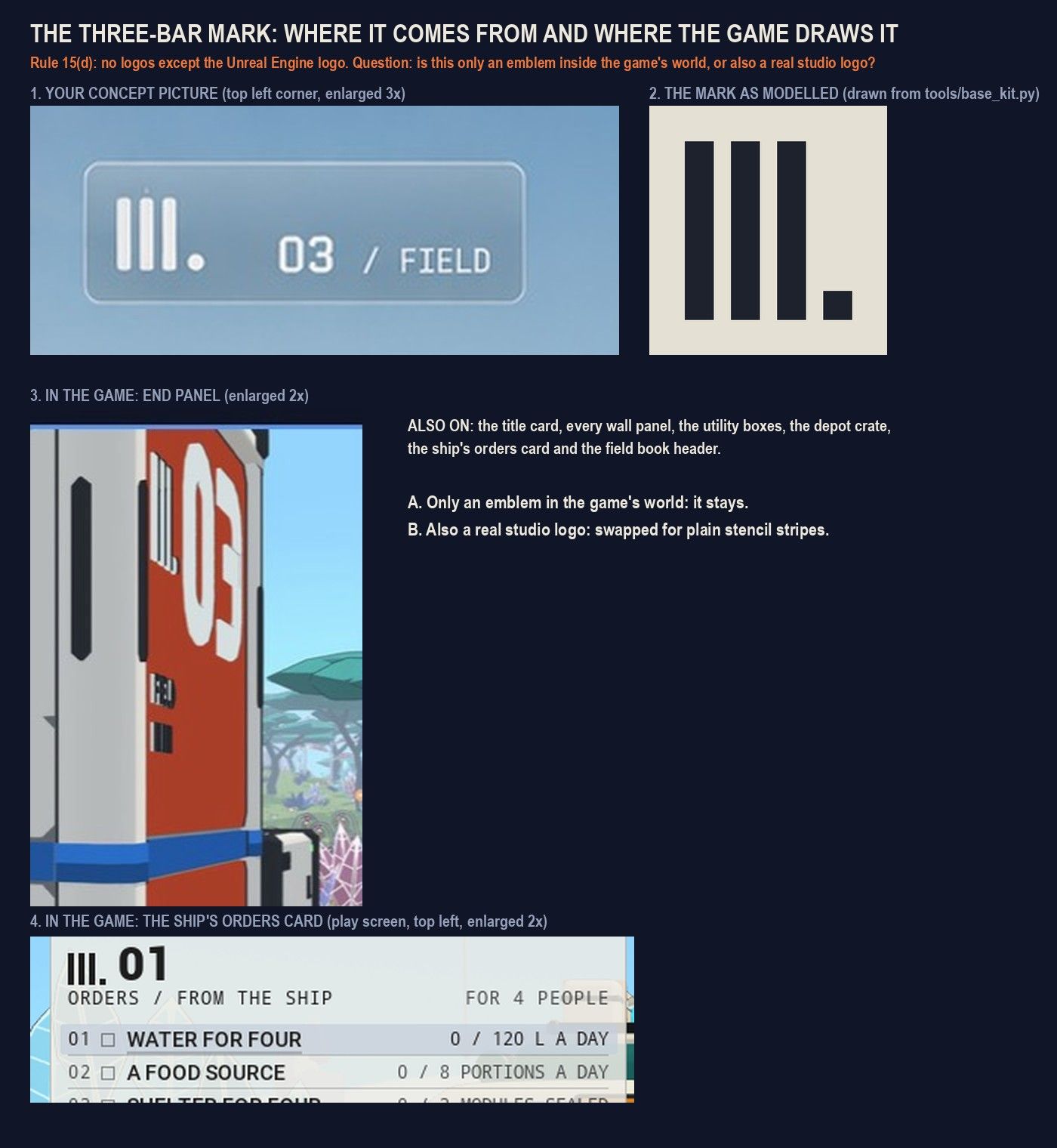
Sheet 321 · Sat 08:01Where the mark comes from and where the game draws it. Open full size -
The sandbox reached main
The second half of the night's merge went to main: calling a robot, the open-ended sandbox, and a first batch of generated models, on by default with a switch that turns them off. The PC had already compiled, packaged and run it. One difference between the machines is still open. In a 900-second test, Windows met 22 orders and the Mac met 20, because the two still build different layouts. Nobody had played this build by hand yet.
A glider, ten generated things and three giants
-
Three agents on the PC
I asked: “Could we pass off more work to Hermes on my pc or is it bottle necked at what it's doing now?” Hermes was building through a single Blender, so a second run would have shared it. I said to open another thread, and another after that if the PC could take it. A second thread started at 08:32 on dressing for the generated world, in its own worktree with its own Blender. With two running, the PC's processor sat at 43 %, so a third started at 08:36: one small model for each of the 34 materials in the game.
At 08:56 the first thread's run died halfway through a stair piece. The Mac starts each Hermes run over a remote session, and the script holding that session gave up after three hours, so the run ended with it. The script now holds the session for 12 hours.
By early afternoon the three threads had delivered 33 material item models, deck and sea dressings, room pieces (two lamps, a bunk, a bedroll and a warm panel) and eleven new base kit pieces. The Mac picked the shapes. Some of the deliveries, such as the item models, were imported and checked in the game; the rest have only Hermes's own checks in Blender. I haven't looked at the pieces one by one.
-
The night film, twice
My message
did we ever make the overnight video? idk if you sent it and it got lost along the way and I missed it
It was still being made, and the first 80 seconds came to me. Then I wrote: “the film should show more of the images we have in our posters so I can see the evolution of how it evolved overnight and improved”. The first cut had 524 seconds of text cards, 542 of pictures and 96 of clips. A second film started alongside it, built from the sheets as before-and-after pictures.
At about 10:20 I wrote “From now on though - don't redo the video.” The second film kept going anyway and arrived at 13:44, 19 minutes long. I asked “Wait why did you make another night film?” The coordinator said it had started the film from my message about the posters and hadn't stopped it after the 10:20 one, and that this was its mistake. I also wrote “It looks good though”.
-
What the credits had bought
My message
have we been taking advantage of using Hyper3D or trippo or anything we got credits for?
The record showed 17 Hyper3D Rodin runs on the jam's perk credits, eleven converted pieces on main, and no Tripo runs. A third Rodin batch started on the credits that were left, and at 11:38 it kept five pieces: a coil frond, a hoop stack, seep cones and a bed star for the sea floor, and wind horns for the sky isles' decks. The Tripo credits I redeemed that morning only work in Tripo's own app. Its API wallet read 0.
-
A rover, then a hover, then the glider
My message
Let's try using Rodin to make a rover the robots can drive around to get around really fast. let's make some mockup images first
Six wheeled concept pictures came back, drawn by Codex image generation with the crew and the lander as references. A quarter of an hour later I wrote “I was imagining a hoover vehicle for the robots to use.” Six hover mockups followed, and I picked one: “I like the glider. Pebble should be able to fit in it.”
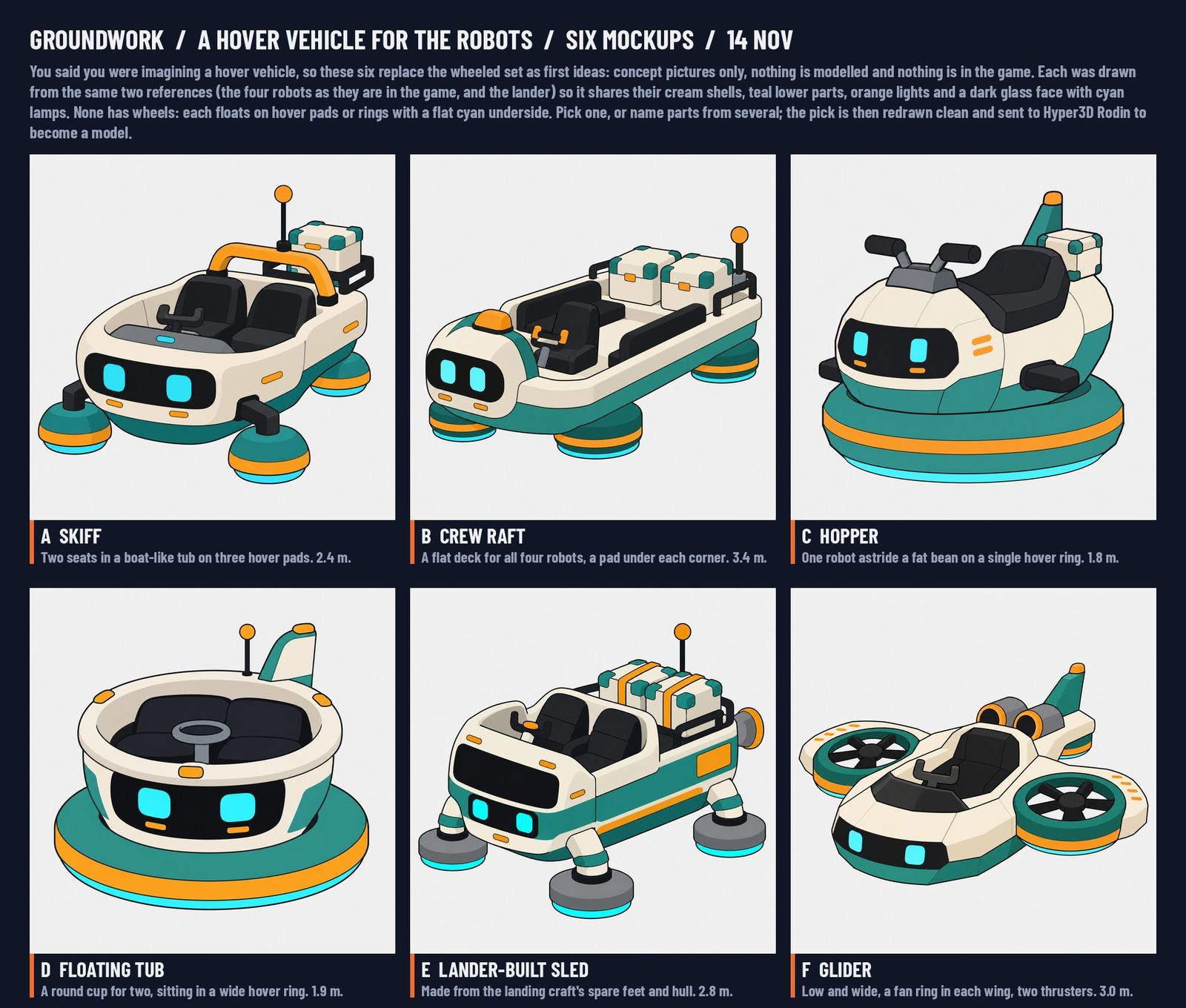
Sheet 326 · Sat 09:48, top partSix hover vehicles as concept pictures. I picked F, the glider. None of these is a model. Open full size -
Sixty-two decisions on one page
My message
can you put an artifact for me on decisions I still need to make
The coordinator made a private page with one card per open question: what happens if I say nothing, answer buttons, and its own pick where it had one. I answered all 62 cards between 10:07 and 10:22. 35 answers matched the pick shown, 17 differed, and 10 cards had no pick. Three of my typed notes changed the plan: the glider may fly upward once a rare charging material is found, the colony “needs room, food, water at minimum”, and the relief on the base stays as built. The build of sixteen of the answers came back at 19:43.
-
Generators for the shapes Blender can't make
The glider was generated twice from the same picture. Rodin's take ran in 38 seconds and came back with 19,212 triangles and no open edges. Tripo's, run through fal, took 139 seconds and came back with 18,699 triangles and 4 open edges. Neither went into the game.
Generated views for Tripo didn't match the reference, and I changed what the generators are for:
I offered to try Tripo in its app myself: “I can try tripo in the app if you send me 3 views of an object”. The two view sets I got didn't match the reference: the hull came out stubbier and the wing rings turned into bars. I asked: “wait how did you generate those images? You should have just gave codex image gen the refernece image and asked it to create the other angles”.
My message
actually for tripo and rodin I think we should create models that are more complex than what we can do in blender. I think the vehicle is something we can do better building from blender like we did for the robots. What would make more sense for the AI calls?
By 12:35 the glider was built from 12 atom files, the way the robots are, and all four robots fit in it.
-
Lanes on another team account
Merge 11d ran in a session on another team account and reached main at 15:13, with the materials system on by default.
To help with usage limits I suggested giving defined tasks to sessions on my team's other accounts. At 11:17 the first one went out: merge 11d (the batch of finished lanes after 11b and 11c, which had reached main that morning) ran in a Claude Code session on another team account, started from a written request and answering in a reply file. The item models from the PC and the giants later went the same way. Merge 11d reached main at 15:13. It turned on the materials system by default, with 89 materials and 71 rules, 23 of them in play, and put the generated world in behind a switch.
-
DLSS: a no, then a trial
My message
"NVIDIA award needs DLSS" is this something my PC can handle? Maybe start up a new hermes lane and ask it to look into it and suggest how we can have it included for the Jam
A fourth Hermes thread wouldn't start, so the research ran on the Mac. At 12:02 it recommended leaving DLSS out. NVIDIA's plugin listed Unreal 5.5 to 5.8 and not 5.9, and NVIDIA's licence asks for its marks on the splash screen and in the credits, and for written approval two weeks ahead. I answered: “this doesnt make sense because they are offering a prize for using it for this contest”. The coordinator agreed. The jam's FAQ allows the credit that a plugin's owner asks for, and NVIDIA sponsors the prize.
A trial on the PC came back at 15:17. It used DLAA, the anti-aliasing mode of DLSS, from NVIDIA's plugin 8.9.0. It built on Unreal 5.9 after ten one-line casts and ran in the packaged game. On two near surfaces the ink outline stopped flickering: 0.0 changing pixels a frame, against 45.5 and 29.3 with the engine's default anti-aliasing. The frame time showed no measurable cost. On a second decision page I chose to merge it, with a text line in the credits and no logo.
-
Ten things to generate
The shortlist came back at 12:10 as one sheet of concept pictures: five animals to scan and five landmarks to travel to, nine of them shapes that a Blender script would get wrong. I wrote “I like all 10 of those. Let's make them all.”
By 15:32 all ten were on the large land behind a switch. The landmarks took 11 Rodin runs. There are 21 animals of the five kinds, and they move. Four of the kinds are Rodin models made from the pictures I approved. The fifth, the tipper, is built by a script, because the generated one came back with unequal arms. Three Tripo runs were tried for the animals, and none of them is in the game.
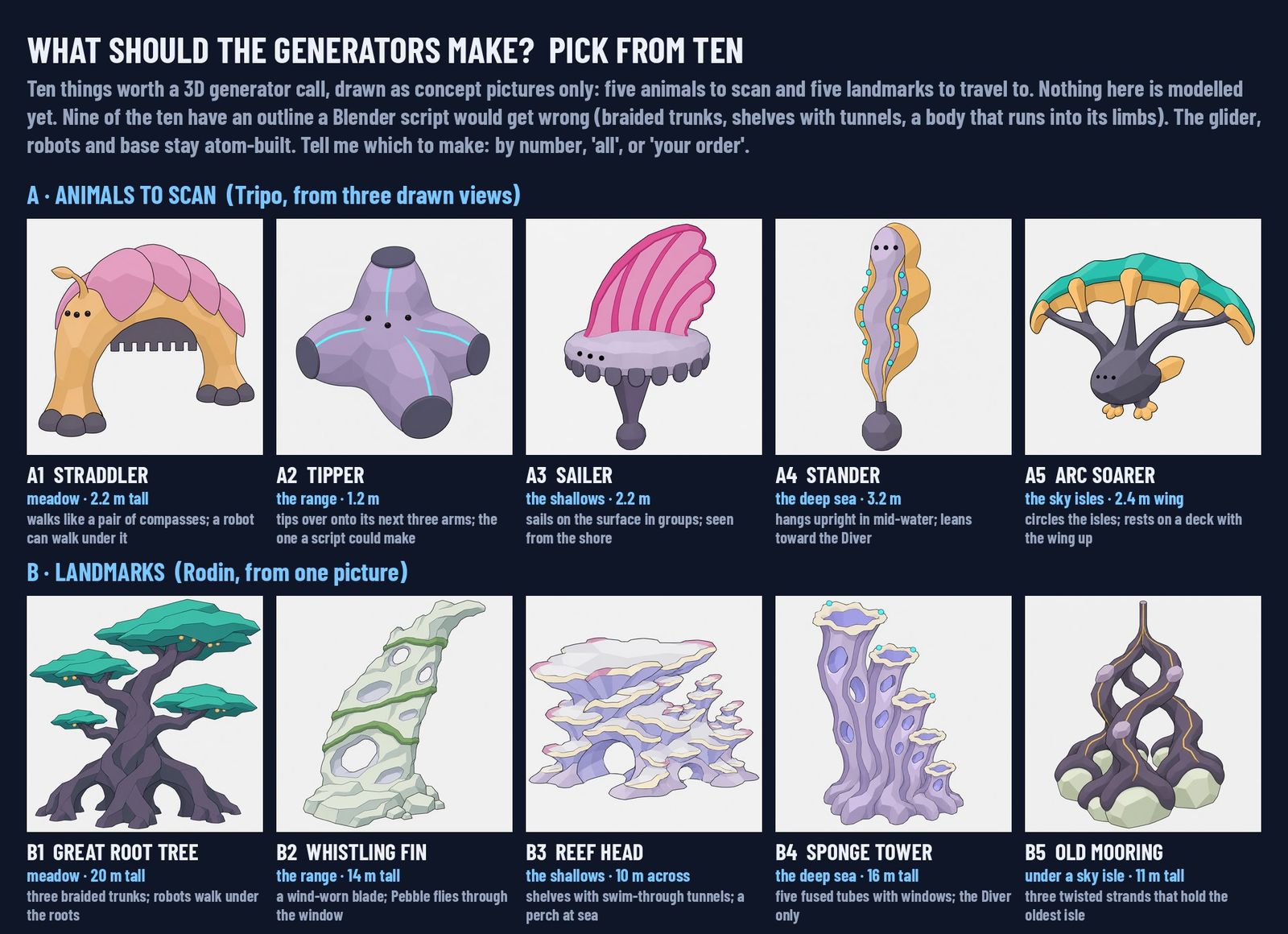
Sheet 338 · Sat 12:10, top partThe ten I approved, as concept pictures. Nothing on this sheet is a model. Open full size 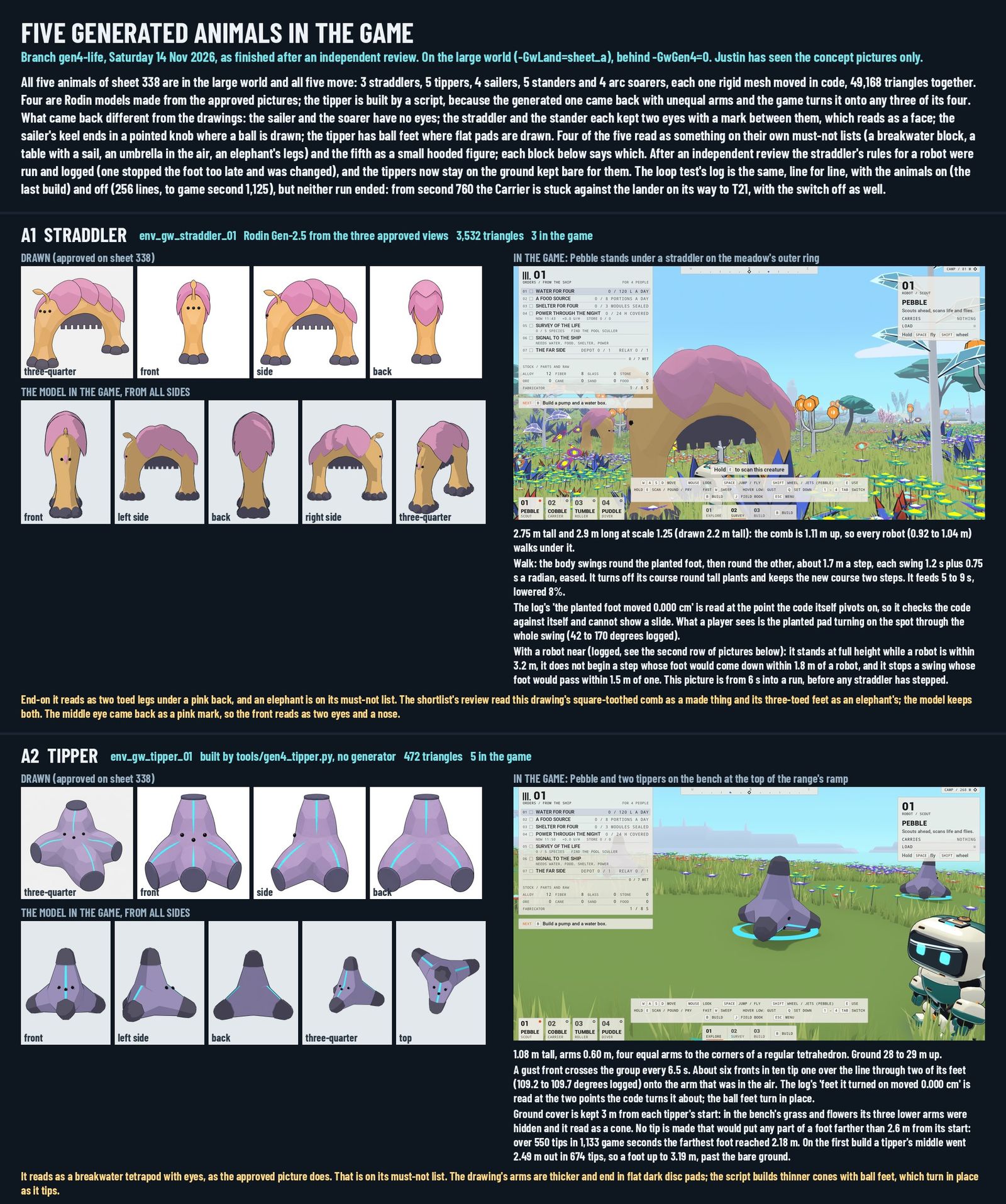
Sheet 347 · Sat 15:32, top partThe straddler and the tipper: the drawings I approved, the models from all sides, and each one in the game with Pebble. Open full size -
Rare giants
With the ten I asked for one more thing:
My message
Also i think each kind of biome should have a really rare, super big […] alien. monster like that. Something that is really scaled huge and you will rarely ever encounter.
Five designs came back at 15:18, one for each kind of place, each 73 to 150 m, to be scanned and not fought. For the sky one I had given an example of what I had in mind, and the design took only one thing from it: a very long body in the high sky. On the second decision page I picked two to build, one to build only if time was left, and skipped the sky one. Of the meadow's Great Straddler I wrote “Make it have more complex structure to make it look more alien and overpowering.”
Three redraws came back. I first wrote “Braided legs”, then eleven minutes later “Let's go with version C instead of B”. Braided legs was the panel labelled A, so the coordinator asked which one I meant. I answered “Hanging strands (labelled C)”.
At 17:50 three giants were in the game behind a switch, built in a session on another team account. The Spire Tipper is built by script. The Basker is a 120 m animal that lies off the shore like a low island, and Pebble can land on its deck and ride its drift. The Great Straddler is take C: one Rodin run with 240 strands added by script. One dawn in six brings a giant day. The Straddler leans 23.6 degrees mid-step, its feet stand 32.45 m apart where the design says 60, and no giant makes a sound.
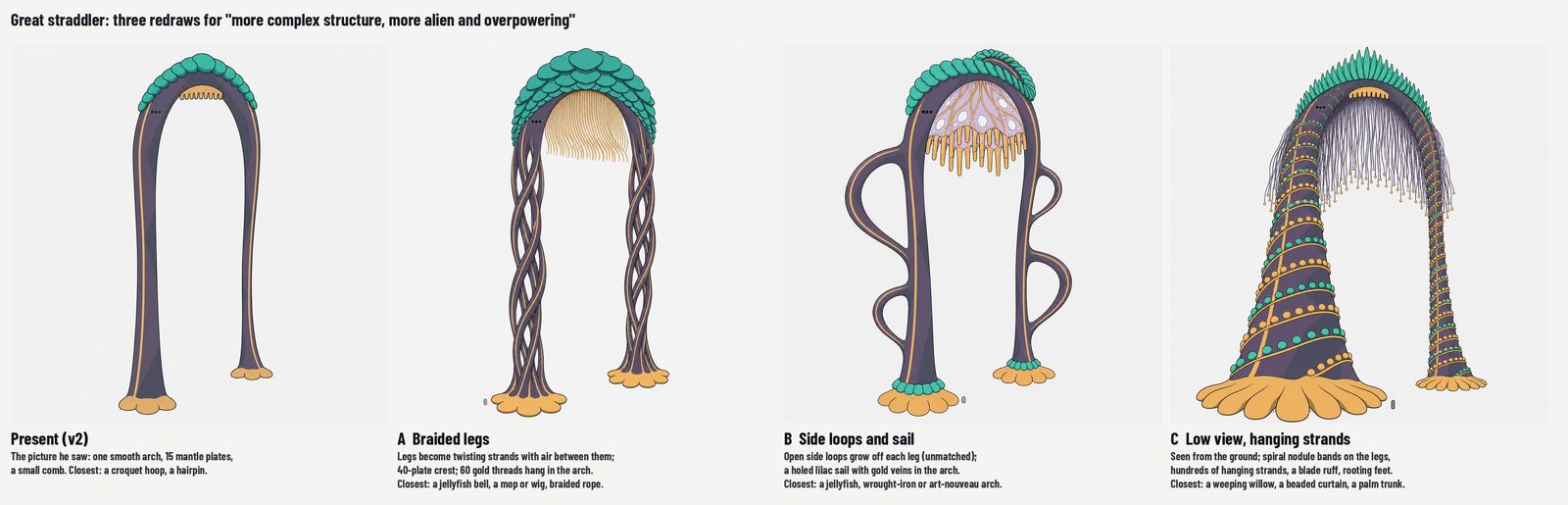
Picture 351 · Sat 15:59The Great Straddler as it was, and three redraws. I took C, the hanging strands. Open full size 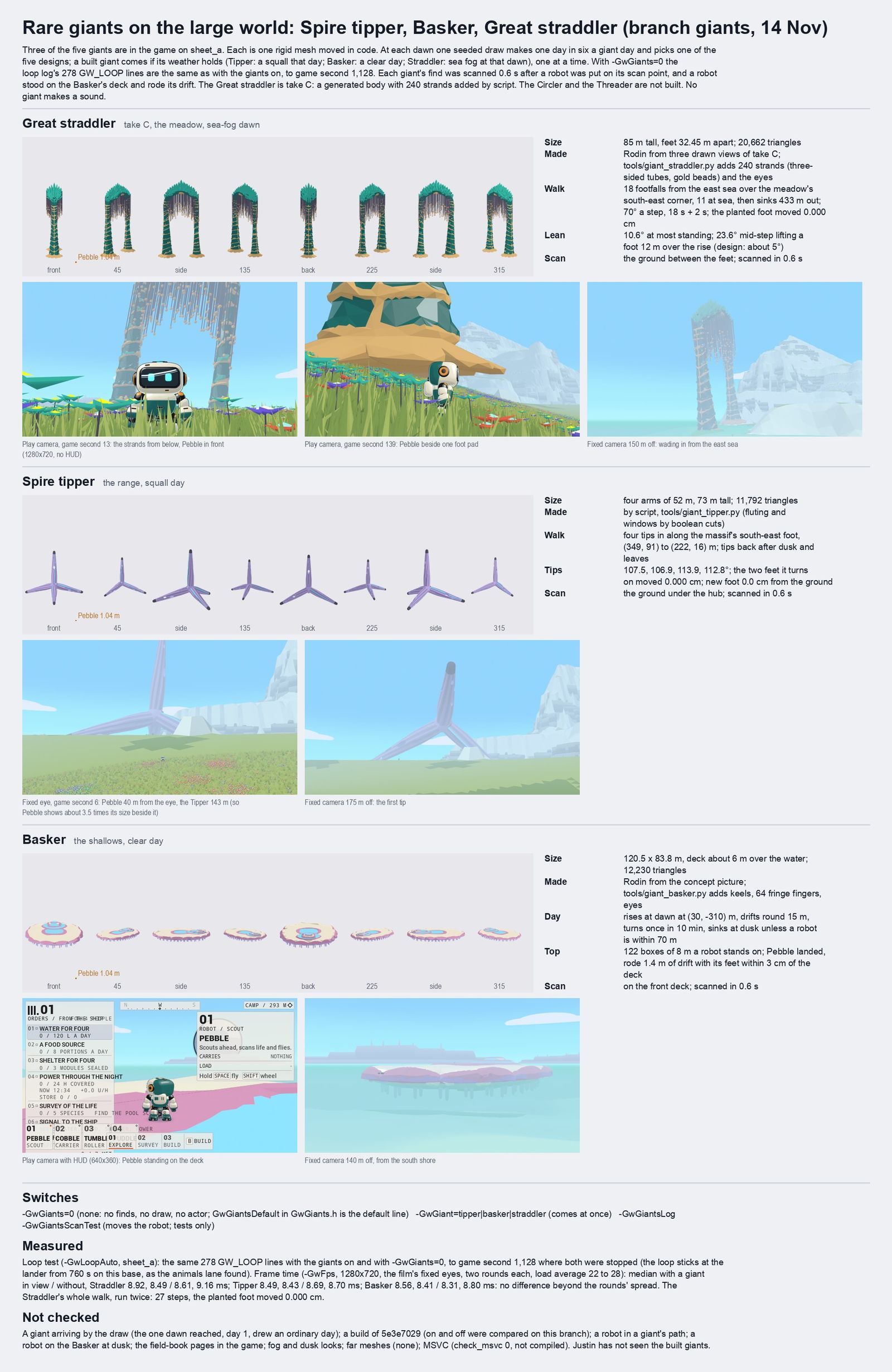
Sheet 352 · Sat 17:50Three giants on the large land, each from all sides and in the game, with what was measured and what nobody has checked. Open full size -
A tagline
For the jam's page I wrote “Tagline: Discovering the city of tomorrow”. Three minutes later I asked for it on the title screen too: “Change it there too”. It reached main with merge 11e at 19:13.
-
The glider flies
The first playable glider came back at 15:55. G boards it and leaves it, Shift boosts, and it holds about 45 cm over land and a little less over water. It reaches 24 m/s on the boost and cruises at 17.8, where Pebble's jets reach 14.5. All four robots fit. In that build the body was a stand-in made of 190 blocks, because the atom glider hadn't been swapped in yet, and nobody had flown it by hand or heard its sound.
At 16:16 a lane started on the next step: the atom glider in place of the stand-in, and upward flight that only works with a cell charged from a rare find, as my note on the decision page asked. It was still running at 20:00.
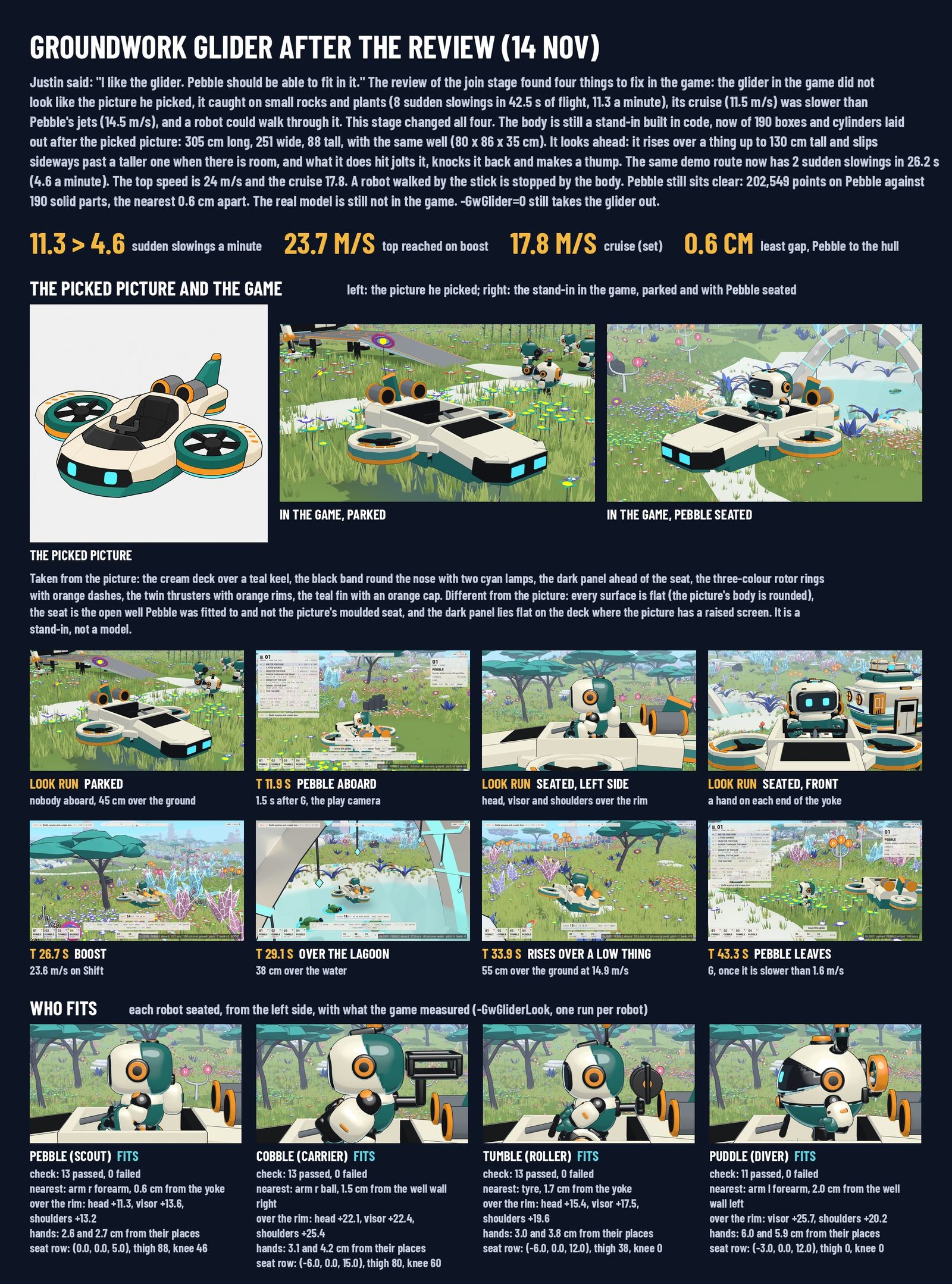
Sheet 349 · Sat 15:55, top partThe picture I picked, the stand-in body in the game, a test flight by script, and the four robots seated. Open full size
The large land, a clean Windows run, and a cluttered HUD
-
Start on the large land
I asked “Can you recap what's left before we can turn the game in”, then “I mean specifically in game”. Part of the answer was that the game still starts on the small meadow island. The large land, with the massif, the crater bay, the isles, the animals, the landmarks and the giants, only loads with a switch. I wrote “Start on large and start covering the gaps”.
At 18:29 the PC ran the day's packaged build on the large land by switch. The opening woke all four robots, the colony loop reached READY FOR HUMANS at 1,025.4 game seconds, and no log had a fatal line. A lane to make the large land the default start, with the animals and landmarks on and the field book listing the materials, finds, landmarks and animals, was still running at 20:00.
-
The HUD says too much
I asked: “Can you send me images of how the HUD looks while playing.” Seven frames came back from 45 seconds of scripted play on the PC. I wrote “The orders are collapsable I hope? There's a lot of boxes on screen at once it looks like”. The orders had no fold: the card fades while a robot moves and comes back when it stops. A lane added a key, O, that folds both orders cards down to their header and one progress line on a spring. I looked at the folded stills and wrote:
My message
It just seems like an overly verbose cluttered HUD and needs more transparency and to be simplified.
In the same message I compared it to three commercial games. A lean HUD started at 19:25 behind a switch. It keeps one NEXT line with the count of orders met, puts the orders on O, shows the robot card for five seconds at the start or after a switch, hides the key strip at rest, and makes the panels a little more than half opaque. Today's HUD stays the default until I say yes. At 20:00 the lean one was still being built.
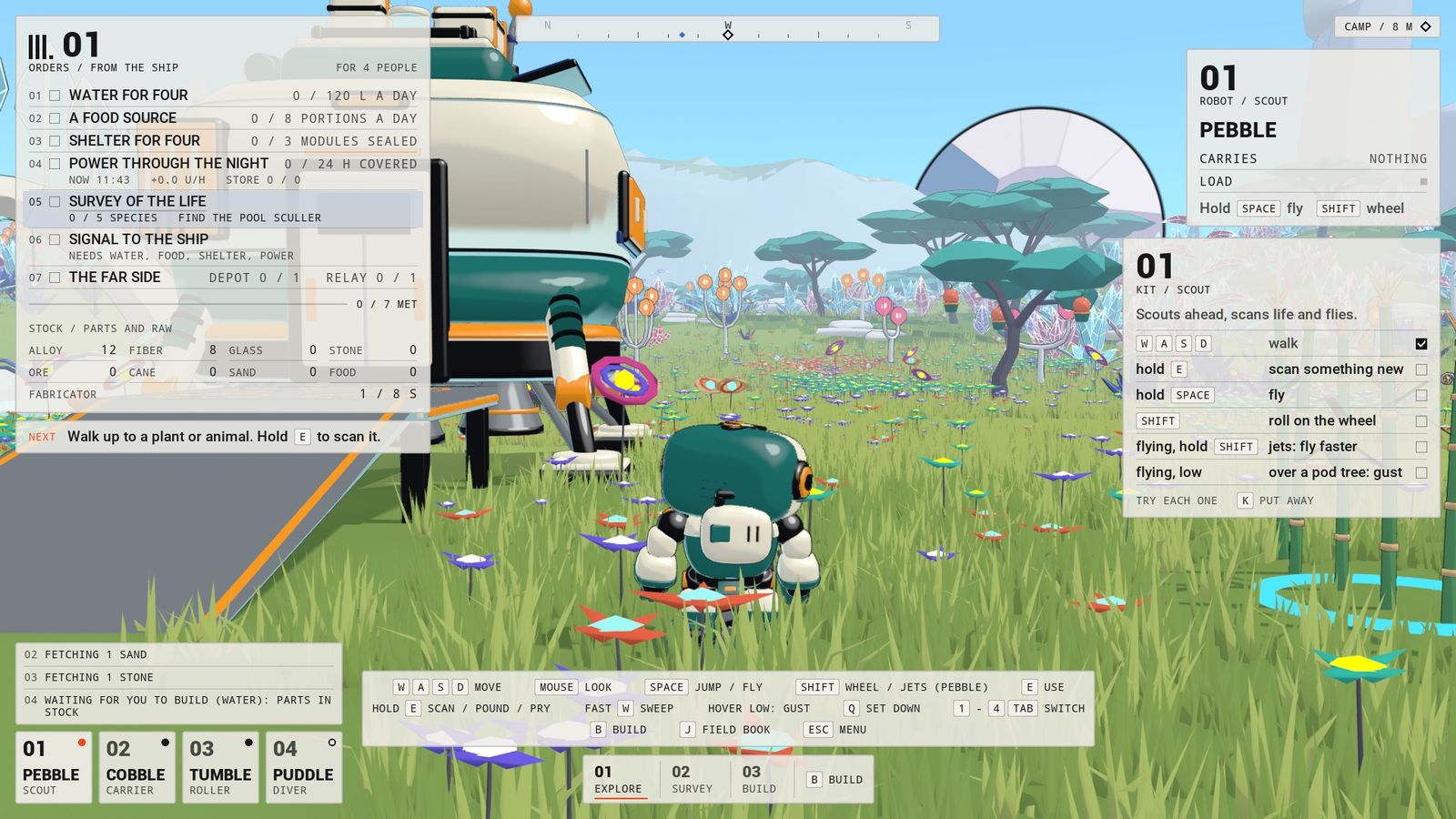
Still 355 · Sat 18:34Play on the large land with the HUD as it was: orders top left, the robot and kit cards on the right, key hints and robot tabs along the bottom. This is the HUD I called cluttered. Open full size -
Merge 11e: the tagline, a glowing kiln and the PC's dressings, checked on Windows
Merge 11e went to main after a full run on the PC. It brought the tagline, a kiln that glows while it fires, the third Rodin batch, the PC's sea and deck dressings, nine relief pieces and the wall's dark band. Two pieces, a deck tile and a grow bench, stayed out because they flickered. The Windows run of the merge:
On Windows every check passed: 22 of 23 orders in the 900-second test, the loop on three lands, 20 quick starts, no fatal line.
- Build and package
Succeeded
- Opening
All four robots awake
- Calling a robot over
Pass
- Colony test, 900 s
22 of 23 orders met, pass
- Colony loop
READY FOR HUMANS at 1,003.5 s on the default land, 1,017.8 s on a generated land and 1,025.4 s on the large land
- Quick starts
20, none bad
- Logs
No fatal, exception or assert line in any run
-
Sixteen of my decision-page answers, built
Sixteen of my answers from the morning's decision page came back built and reviewed, each as one line in a single header so it can be turned off. The reviewer found one fault that would lose a saved colony and four smaller ones, and all five were fixed. The colony loop still ends at 1,003.5 s, and a save and reload keeps all 315 fields. There's no Windows build of it yet, and a few calls from it wait for me on Sunday.
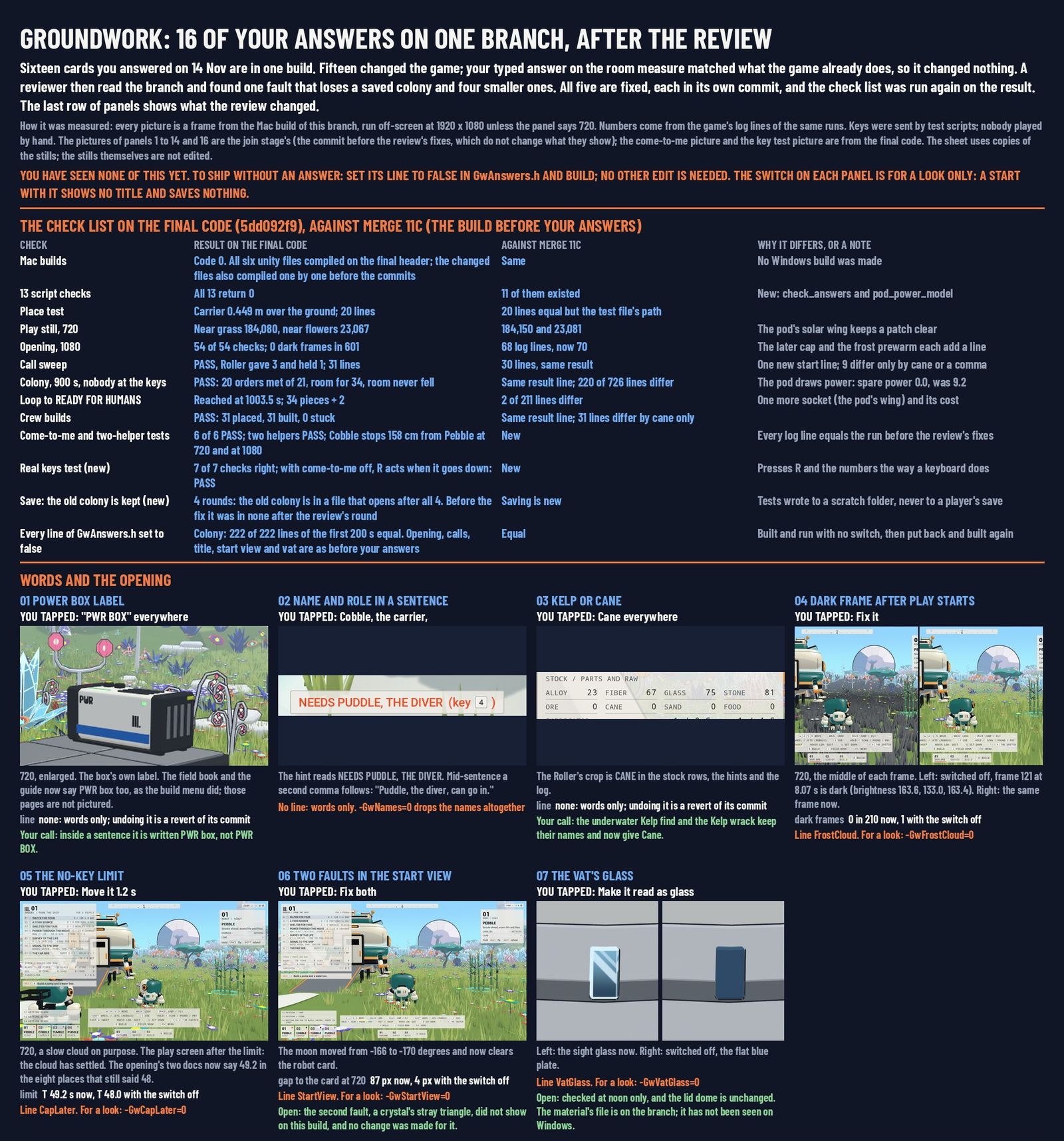
Sheet 365 · Sat 19:43, top partThe check list on the final code, then the first answers, each with what I tapped and what changed in the game. Open full size -
The Fable limit, again
At 20:00 my Fable 5.2 limit ran out again and stopped three agents mid-work: the glider's lift lane at its fix stage, the large land's lane, and the lean HUD's builder. All three were restarted on Opus 5.5 at high effort, with a note to read their state files and keep what was done. Merge 11f was running at the same time in the session on another team account.
The glider climbs, the large land becomes the start, the HUD gets lean
-
Codex joins the lanes
My message
Let's start using codex Astra xhigh subagents to share the load with our opus 5.5 agents. Don't end any agents going right now- just when you spin up more
From then on a new lane could hand its building to Codex running GPT-6 Astra at extra-high effort, with a Claude Opus 5.5 agent checking the result. The first was the submission pack: the list of tools, the sourced assets, the checklist and the draft text for the entry's page. By 20:44 Astra had written it, and the Opus checker had found two privacy problems (a machine path in the two files meant for pasting), six wrong facts and one missing item. All nine were fixed.
-
A list for the video, then sleep
Before going to sleep I asked whether anything was needed from me. Nothing was needed that night. One question waited for the morning: could I try the zipped game on a clean Windows machine?
Then I sent a list of what the gameplay video should show and the game should let you play: the landing, discovering things, using materials to build a colony from small up to something like a mansion, the aliens, every kind of place, the vehicle, what each robot can do, and giant creatures far off in the sky. Three pieces of work started from it at 20:50. One was a plan with a storyboard. Another was a lane for the sky giant, the Threader, as a far-off tease behind a switch. That afternoon I had answered “Skip it” about the sky giant, so the coordinator flagged this lane as going against my call. The third was a showcase switch that puts up the colony at three sizes from the pieces we already had. Codex on Astra built the two lanes and Opus looked at what they made.
-
The glider climbs
The glider's lift lane finished. Its fix stage had been restarted on Opus after the Fable limit. The glider now has its atom-built body, and it climbs only with a charge cell, which fills only on the charger's pad. Pressing SPACE without a cell names the charger, and when the cell runs out the glider comes down slowly. It holds its height while I drive another robot, and a robot carrying the cell can't board it. Each generated land gets two pockets of amber sand for the cell. The lift's checks passed 15 of 15 on the island, the large land and a generated land, the opening passed 54 of 54, and the colony loop ended READY FOR HUMANS at 1,004.1 s with no robot stuck.
-
The lean HUD, finished
The lean HUD came back after two review rounds, with the orders fold from earlier in the evening included. It sits behind a switch, -GwHud=lean, and the full HUD stays the default. On the meadow at rest it shows 6 boxes instead of 12 and covers 3.1 % of the frame instead of 30.6 %. Its busiest moment, with the orders open, covers 17.3 %. The reviews also removed the O key label from the NEXT line, because it read as a zero, and made the compass thicker.
Full HUD · Sun, merge 11gThe default until Sunday 08:23. Open full size Lean HUD · Sun, merge 11gThe same camera at the same moment, with -GwHud=lean. Open full size -
Windows stopped on names a third time
Merge 11f finished at 21:27 in the session on another team account. It brought the sixteen built answers, DLSS, the first step of the large land, the giants, and the item models for the materials with 13 models from the PC. The glider's lift stayed out, because its report wasn't ready when the merge's checks began.
Three minutes later the PC's build stopped on two variable names, the fix taught the Mac-side check the game's own classes, and the fixed merge reached main at 22:16.
Three minutes later the PC's build of it failed with C4458, another warning treated as an error. Two local variables, More and Left, had the same names as members that their classes inherit from the game's prop class. The Mac-side check for this only knew the engine's members. The fix renamed the two variables and taught the check to read the game's own classes, and what each inherits, from the headers. It also stopped the check from mistaking some expressions for declarations. The new check finds both lines on the failing merge and none on main.
At 22:16 the PC's run of the fixed merge passed and it went to main. The build and package succeeded (1,074 MB), DLAA was on, all four robots woke in the opening, calling a robot passed, the 900-second colony test met 22 of 23 orders, the colony loop reached READY FOR HUMANS on the island, a generated land and the large land, 20 quick starts had none bad, and no log had a fatal line.
-
The large land as the start, with the field book
The large land's lane and the field book's lane came back joined on one branch, reviewed and fixed. A plain start now loads the large land instead of the meadow island, which is one switch away. The five landmarks and the five kinds of generated animals are on. The field book lists the materials, the finds, the landmarks and the animals, and the page of a landmark or an animal says where it was met and which robot scanned it. In an unattended test the game made two materials, scanned a find and took from it, scanned all five landmarks and an animal, and opened the book with J on the right page each time: 10 pages checked, none failed.
The whistling fin, one of the landmarks, was meant to stand on a knob of the massif. My card on the decision page said that a robot would be walked up to it at the merge, and that the fin would move if the walk failed. All four robots stalled 15 to 27 m short, so by that rule it stands on the bench below the knob, where every walk arrived. A switch puts it back on the knob, where only Pebble's jets reach. The colony loop ends READY FOR HUMANS at 1,020.8 s on the large land, 1,003.5 s on the island and 1,023.4 s on a generated land, with no robot stuck.
Large land · Sat 20:26, part of the sheetTwelve places on the large land from the land lane's run. Open full size 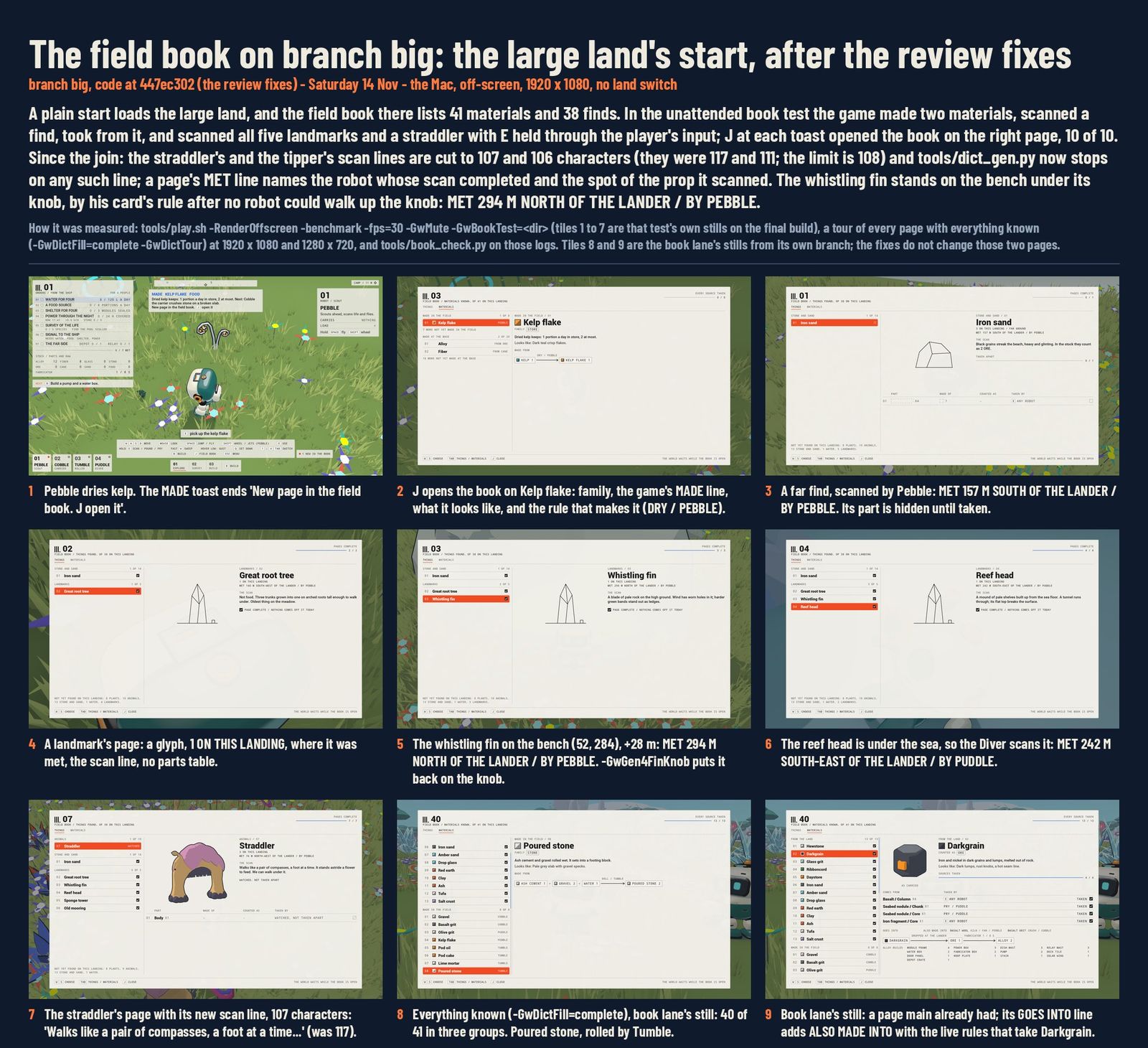
Field book sheet · Sat evening, top partStills from the book test on the joined branch. Tiles 8 and 9 come from the book lane's own branch. Open full size -
Merge 11g, and a room lost to the rain
Merge 11g ran in two parts. The first, built by Codex on Astra with an Opus look, joined the glider and its lift, the fix for the two names, the lean HUD (still off by default) and two of the PC's pieces, the grow bench's collars and the wall's dark band. The PC's deck tile stayed out again: its flicker count went from 0 to 14 across four pairs of frames. The bench's collars flicker too, 0 to 16 on the same test, and went in under an exception the merge's brief allowed.
The Opus look listed six things to fix before the second part. One was code that neither branch had: about 200 lines the merge worker wrote so that a save keeps the glider, its charge cell and its rider. The second part added the large land and the field book, with more save code of the same kind for the book.
The review of the finished merge found a blocker. In the 900-second colony test on the large land, the colony's ROOM count fell from 60 to 59 when rain started. The water supply had been stored with the rain already in it, and then the new rain was subtracted from it. The fix counts water from the pumps and the built pieces and leaves rain out. After it the colony test passed on the large land, the island and a generated land, with 53 of 53, 21 of 22 and 53 of 53 orders met, the loop's lines matched the run before the fix, and a save and reload kept all 528 fields.
-
Four rounds on the sky giant and the showcase
The plan came back at 01:14 with a storyboard of 54 seconds in 16 shots. The first looks at the two lanes were poor. The Threader read as a pale stick, and the showcase as a sparse sprawl with a habitat standing on the island's walk path. Three more rounds followed through the night, each a Codex fix and an Opus look. By 04:25 the Threader read as a long ribbon with its tether lines showing, but the blue band along its edge barely showed and its far still was over open sea. The showcase had its habitats in facing rows and used the island's coast, but its second stage still cleared ground that only the third builds on. The coordinator stopped the rounds there and kept seven stills for me for the morning. Neither branch is in the game.
The showcase also showed what the kit can't do. Every habitat is two modules with its own solar wing, nothing stacks, and sites don't join, so no colony built from it can look like a mansion. A proposal listed twelve new pieces for that, among them an upper floor on a module frame, a stair, a passage between modules and a connector deck between sites. None of them was built that night.
-
The glider, the large land and the field book pass on Windows and reach main
The PC built, packaged and ran merge 11g, and it went to main after a secret scan of the changes came back clean.
On Windows every check passed: 53 of 53 orders with no fall in ROOM, the loop on three lands, 20 quick starts, no fatal line.
- Build and package
Succeeded, 1,076 MB, with DLAA on
- Opening
All four robots awake
- Calling a robot over
Pass
- Colony test, 900 s
53 of 53 orders met, the ROOM count never fell, pass
- Colony loop
READY FOR HUMANS at 1,025.4 s on the large land, 1,017.8 s on a generated land and 1,004.1 s on the island
- Quick starts
20, none bad
- Logs
No fatal line in any run
-
Cut 2 of the video
The trailer lane started from main once 11g was in: 13 shots from the plan at 1920 x 1080, then an Opus look and a Codex fix. Cut 2 came back at 05:06. It runs 50.25 seconds in 15 shots, with the lean HUD in the play shots and an end title that fades out. The lane's notes list what is weak in it: no colony at mansion scale, the Basker (one of the giants) reads as flat ground, and the water is hazy. The Threader and a few other planned shots were left out. In most shots a test switch set up the scene and the game played it, with nobody at the keys.
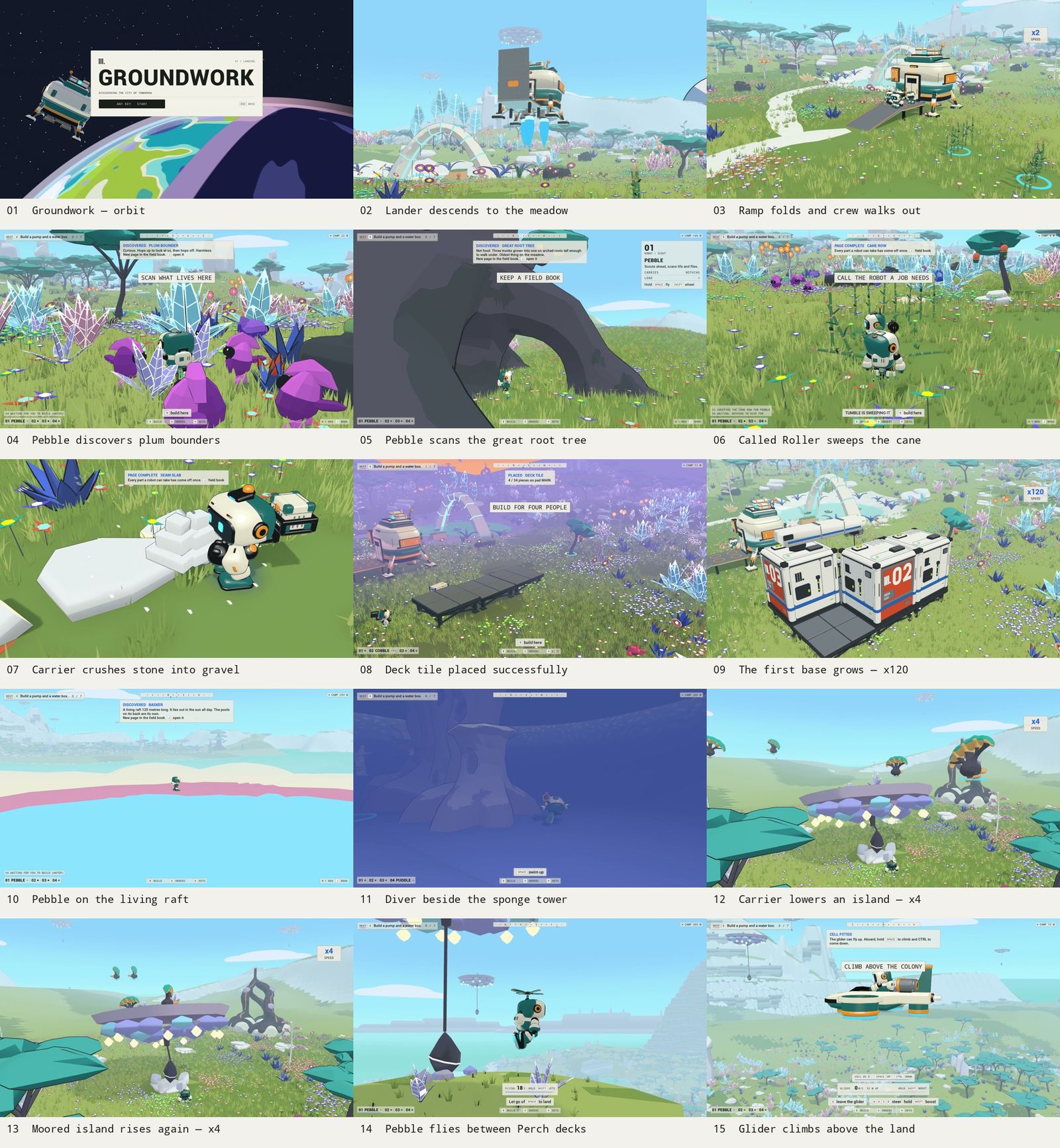
Cut 2 · Sun 05:06One frame from each of the 15 shots. The subtitle on the title card still reads “Discovering the city of tomorrow”. Cut 2 was filmed from main, so the deck tile in shot 8 is not the PC's new one that was kept out. Open full size -
Six decisions for the morning on one page
The coordinator put up a private page for me to read when I woke, with six decisions: the lean HUD as the default, cut 2, whether to reverse my “Skip it” on the sky giant, what to do about the showcase and the mansion pieces, whether I could try the package on a clean Windows machine, and what to try when I play. It also listed what was left for the day.
-
The first Shipping package since Friday
The PC built a Shipping package of main. The first try stopped at once because an engine path wasn't set. The second came back at 05:41: 725 MB in 43 files, of which 248 MB is a debug symbols file (the .pdb) that the zip should leave out. The opening and the loop each ran, took their screenshots and exited without an error, and the screenshots show the game playing: the meadow at 60 seconds and building at night at 360 seconds. Nothing crashed.
The 20 quick starts couldn't run the way they do on a Development build. Each one ends by sending the game a console command to quit. Shipping ignores console commands, so every one timed out. That check needs another way to quit.
-
My answers: the lean HUD, a played video, no sky giant, a campus
For the HUD I picked “Lean (-GwHud=lean)”, the label under the lean still, so the lean HUD becomes the default. On the video I wrote:
My message
Can you make it so you can record the demo as if someone was playing it. And the tagline should actually be "Building the city of tomorrow"
The tagline had read “Discovering the city of tomorrow” since Saturday. On the sky giant I wrote “skip sky giant for now”, so the Threader stays out. On the showcase and the new pieces:
My message
Let's try to build it the connectors today in parallel and if we finish it in time then we can merge it to the main game. The bigger colony should look like a campus basically with a common area, each person has their own room, a place for entertainment, multiple stories. It should be modular so that players can build it as fancy and big as the way.
And on the clean machine:
My message
I do not have an other machine. And we shouldn't need one. We should just be able to unpackage and play.
-
Three lanes for Sunday
Three pieces of work started from those answers. A small lane on a branch called sunday makes the lean HUD the default and changes the tagline. It also puts the runtime files the game needs inside the package, so nothing has to be installed, adds a script that checks what the package depends on, adds a quit switch that works in Shipping, and keeps the .pdb out of the zip.
The campus and the pilot each run in a separate Claude Code session, started from a written request. The campus lane designs the joining pieces on the base's 3 m grid first: a connector deck between sites, a passage between modules, an upper floor with a stair, terraces, and a spine along the back for solar and power. Then it builds them as atoms, puts them in the build panel, and lets the colony count the rooms. The coordinator set the campus decision for 15:00. The pilot records the video through the game's own controls. It holds keys, moves the mouse to look, steers along a route and waits for something to happen in the game. No test switch in it may place, spawn or move anything, or skip time. Its cut 3 was due by 13:00.
-
A campus, not a row of pods
The campus lane's first concept sheet came back. The small campus was a commons hall, a link and quarters with four rooms on two storeys. The large one had three quarters with 12 rooms, a lounge with a roof terrace, and link decks around a court. I wrote “the campus mockup still looks like individual pods instead of one independent structure”. The lane was asked for one joined building instead: shared walls, a continuous roof, enclosed corridors or a covered gallery in place of open decks, one front with one entrance, and power on the roof or along one spine. The pieces whose look depends on that wait for a new concept sheet, and the work on the systems goes on.
A little later I wrote “yes to wings”, to its question about wings that can be turned, and asked whether there was a better way to define a room. The proposal I was shown: a room is an enclosed space reachable from inside the building, and its furniture decides what kind it is. A bunk makes a private room for one, a common table a common room, a play table a play room. I answered “use this rule”.
-
The campus as one building, still too square
The second concept sheet made the campus one building. Each wing is two cells deep, wall to wall, and a corridor and corner wings replace the open link deck. It adds a roof cap, a seam cover, a plinth, a gallery floor and an entry canopy, puts the solar panels on the roofs and the power along one spine at the back, and drops the link deck and the arcade. The small campus has six rooms, a commons and a lounge, and hosts six. The large one has 18 rooms, a commons and two lounges round a court, and hosts 16. I wrote:
My message
much better but it is still too square. We need like angle and more building like structures. but for time sake let's go with this for now
The lane went ahead with that look. Angles are noted for a later pass, and cheap shapes that break up the boxes come only after the core pieces are built and checked. The decision was set for 15:00; the campus passed its Mac and Windows checks (one Development opening run was stopped for lack of a quit switch) and reached main by 10:33.
-
The lean HUD and the new tagline become the default
The small lane finished its branch. With no switch the game now shows the lean HUD, and the title reads “Building the city of tomorrow”. Every build type takes a timed quit switch, -GwQuitAfter. The package carries the Visual C++ runtime libraries in the game's own folder, a script lists every library the package imports and where it comes from, and the zip leaves out the .pdb. The review added three fixes. One of them stops the zip from being made when those runtime libraries are missing. On the Mac it built both ways, passed 12 checks, played the colony loop to READY FOR HUMANS at 1,020.8 s and quit by itself after 20 seconds. An Opus review approved it.
-
A Shipping zip, tested from the unzipped copy
The PC built a Shipping package of that branch and zipped it: 322 MB, 97 files, no .pdb, 507 MB once unpacked. Every test ran from an unzipped copy, the way a player gets the game. The opening, the loop and the title runs each exited with code 0, and 10 quick starts with -GwQuitAfter=20 each quit by themselves in 28 to 30 seconds, so the timed quit works in Shipping. Nothing crashed. The stills show the lean HUD and the new tagline.
The dependency script's first run reported 4 libraries missing and 9 loaded from outside the package. The coordinator traced each one to a gap in the script's own lists, such as libraries the engine loads late from its own folders. With the lists fixed it read 74 binaries and 446 imports, none missing and none from elsewhere. The packaging wrapper's own tests failed 6 of 33 on the PC and passed 33 of 33 after a fix. A secret scan of the changes came back clean, and the branch went to main at 08:23.
-
A clean Windows machine, which I don't have
My message
Can you ask Hermes to run in a sandbox for a test?
Hermes was asked to find a sandbox that the PC could run without installing anything, and if there was none, to record which libraries the running game loads. My PC runs Windows 11 Home, which has no Windows Sandbox and no Hyper-V, and no virtual machine software is installed. It isn't a clean machine either: nine Visual C++ redistributables are installed on it.
So Hermes unzipped the package into an empty folder, ran it for 73 seconds with -GwQuitAfter=60 (exit code 0), and listed the modules it had loaded: 122, of which 14 came from the unzipped folder, 106 from Windows itself and 2 from an NVIDIA program folder. The four Visual C++ runtime libraries loaded from the package's own folder, and nothing loaded from an Unreal or Visual Studio install. That is what the game used on my PC. It doesn't prove the game starts on a Windows machine without those redistributables, and Hermes's verdict for a clean Windows was “cannot-tell”. Its options were an upgrade to Windows Pro for the sandbox, or a virtual machine. At 08:47 I wrote “leave it might be the way to go for now”.
-
The pilot plays the game for the video
The pilot merged the small branch and began recording its five takes again with the lean HUD: the landing, the crew, the glider, the places and building. Everything in them happens through the game's controls: landing and a scan, calls to the Roller and the Carrier, the Diver prying a nodule, the glider charged, boarded and climbing to 67 m, a scan of a straddler, an arch, the deck of a moored isle. By dusk the building take reaches 14 of 34 pieces, so a colony the size of a mansion is out of reach for a played take today. Cut 3 was due at 13:00 and arrived at 09:18.
-
A Mac build, but not for the submission
My messages
no we should still do the mac build but not depend on it for the submission.
we need you or other agents to be able to play the game for demo recording pourposes.
A separate session started on a Mac package: a zip that runs from an unzipped copy, signed ad hoc, with a report of what macOS's Gatekeeper says about it. The Mac has no Developer ID certificate, so the app can't be notarized today. At 09:10 I wrote “I signed into my developer account in xcode.” The Mac still listed no Developer ID certificate after that. The pilot lane was asked to write down how any agent can drive the game.
-
Five readers for this page
My message
Oh we should also think how to make our devlog the best then shouldn't we. How would you improve our devlog?
Five agents read the preview of this page, each from one angle: a judge with three minutes, another entrant who wants to copy the method, an editor, a reader of the pictures and films, and a skeptic who checked 27 claims against the log. 24 held, 2 differed and 1 wasn't in the log (it is in the merge's reply). Their main point was that the page told the method and never showed it, and kept the failures near the end. This version is the revision that followed.
-
Cut 3, played through the controls
The pilot delivered cut 3 of the video: 54.75 seconds in 17 shots, at 1920 x 1080. By its report every take was played from a fresh start through the game's own controls, with no test switch setting up a scene. Its limits are that the base reaches 13 of 34 pieces, the sky giant isn't in it, and the Diver's pry comes from a short take of its own. The coordinator looked at the contact sheet and two frames and found the kit card and the key-hint bar on screen in the play shots and under the end card, so the pilot was asked to put them away with the game's own keys if a player can. Its 720p copy is below; cut 4d now leads the page.
Cut 3 · Sun 09:18The gameplay video at 09:18, 54.75 seconds with the game's sound and its day music. The pilot, an agent that holds keys and moves the mouse, played every shot through the game's own controls from a fresh start, and its report says no test switch set up any scene. Two building shots run at 2 and 8 times speed. The colony base gets to 13 of its 34 pieces, the rare giant of the sky isn't in it, and the robot's kit card (its list of controls) and the key hints are still on screen in the play shots, so the coordinator asked the pilot to put them away with the game's own keys if a player can. -
The captions need to read as part of the film
My message
“Is the text like "Scan what lives here" information for the video only and not the HUD? It should be if not and we should make it bigger on screen so it is clear we are explaining something and not compete for the other HUD elements”
The coordinator checked the source. Those words came from the video tool's caption list and were drawn over the film; they were absent from the game's C++ files. They used 32-pixel type in the HUD's panel style. The pilot made a first still with 86-pixel Roboto Black, sentence case and no panel, under the compass. It was sent to me by 09:43.
-
The campus kit is built
The campus lane finished with five kinds of wing: QUARTERS on two storeys, COMMONS, LOUNGE, CORRIDOR and CORNER. Thirteen new part files supply floors, passages, the stair and rail, roof caps, seams and plinths, a utility spine, canopy, lamp posts and two kinds of table. The wings share the base's three-metre grid and can turn a quarter. A mark near a standing wing pulls against it.
The room rule now follows the building: an enclosed space must be reachable from a commons entrance, and its furniture determines what it provides. Hosting is the smallest of the private-room count, four places per common table and eight per play room. A wing with no commons counts zero. The lane sent four stills: small and large campuses, each from above and at eye height. These are two of them.
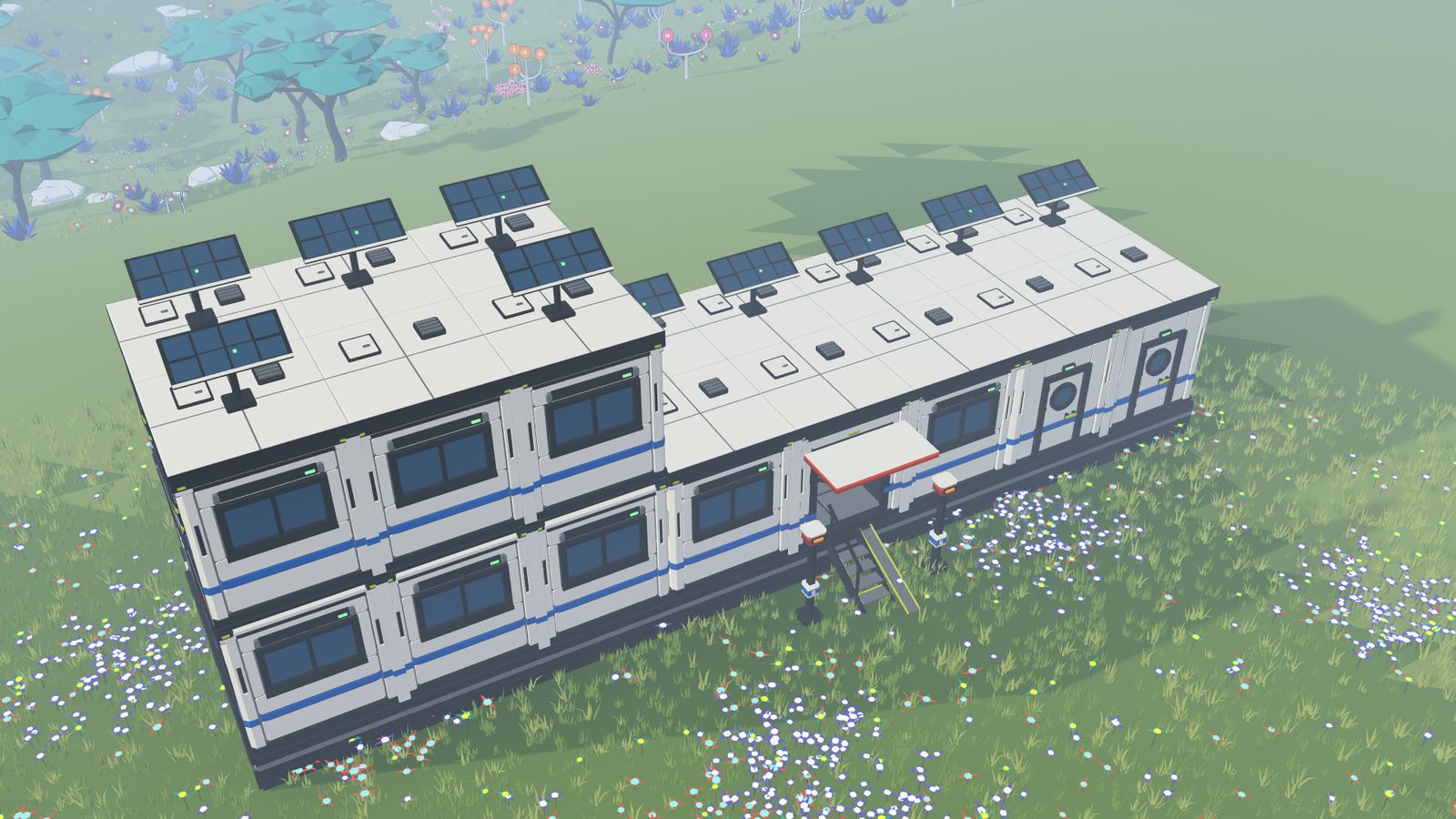
Small campus · Sun morningQuarters, commons and lounge as one building. The showcase switch placed the pieces with supplied stock for these stills. Open full size 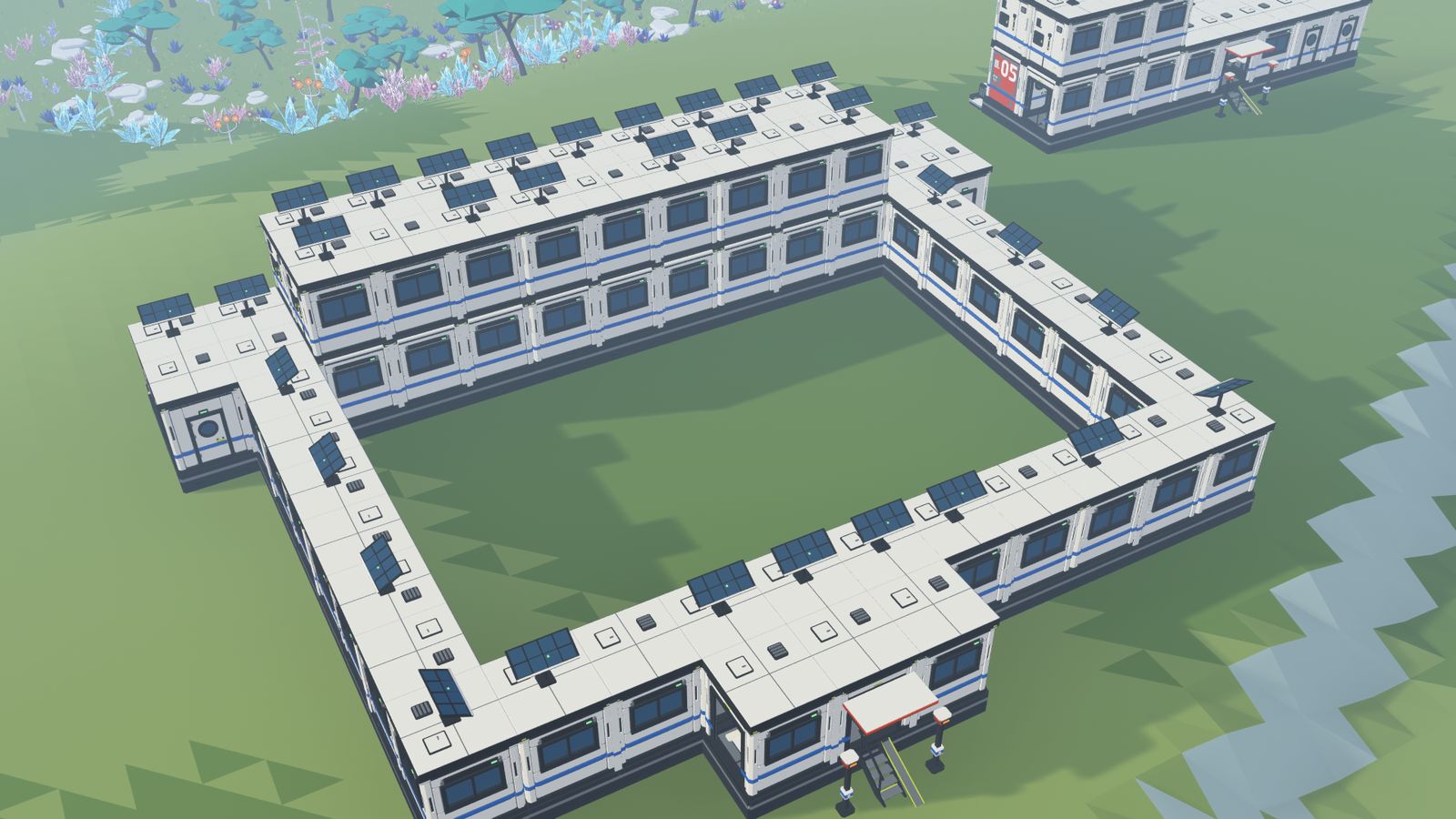
Large campus · Sun morningSeventeen wings round a court, from the same staged run. Both stills show the first canopy, before the angled version. Open full size On the Mac, both builds and the Microsoft-compiler lint passed. The unattended loop's 214 lines matched main byte for byte, the 900-second colony test met 53 of 53 orders, and a save and reload compared 1,210 fields with no difference. The room-rule checks passed and all four robots walked up the stair. Seven findings from the lane's own review had been fixed.
The crew built only 19 of the small campus's 187 pieces in 900 game seconds while it met the colony orders; campus work has the lowest priority. A snapped mark can put the robot inside the new wing. The upper passage opens onto a neighbour's roof without a rail, and the large commons has an end passage that opens outside. A robot's head can pass through the ring beam over the stair.
Nobody had marked a wing with the keys, walked a loaded stair, or tried the campus on the island or generated lands. The lane had not run Windows or a package. Its three answers to my request for angles were still proposals: an angled canopy, a sloped commons roof or a 45-degree corner. The coordinator began an independent review and the PC checks.
-
The dev log goes public
I wrote “push the devlog.” The coordinator made two fixes first: the share image now uses cut 3's title and its current tagline, and sheet 220 loses the paragraph naming the PC's graphics card. The branch passed its secret scan, merged to the site and went live at 09:51.
The live page matched the committed page, all 65 files it referenced responded, and it appeared in the journal and sitemap. The implementation notes stayed private and the preview banner was gone. The log records my instruction in its 09:52 row, alongside those publish checks.
-
I choose the dark caption strap
After the first still I wrote “caption style still doesn't look like it is contrasted enough against the surrounding HUD.” The pilot sent three variants on one sheet: a dark strap, a dimmed frame, and a view with the HUD hidden by the photo key. The sheet keeps the first still beside them.
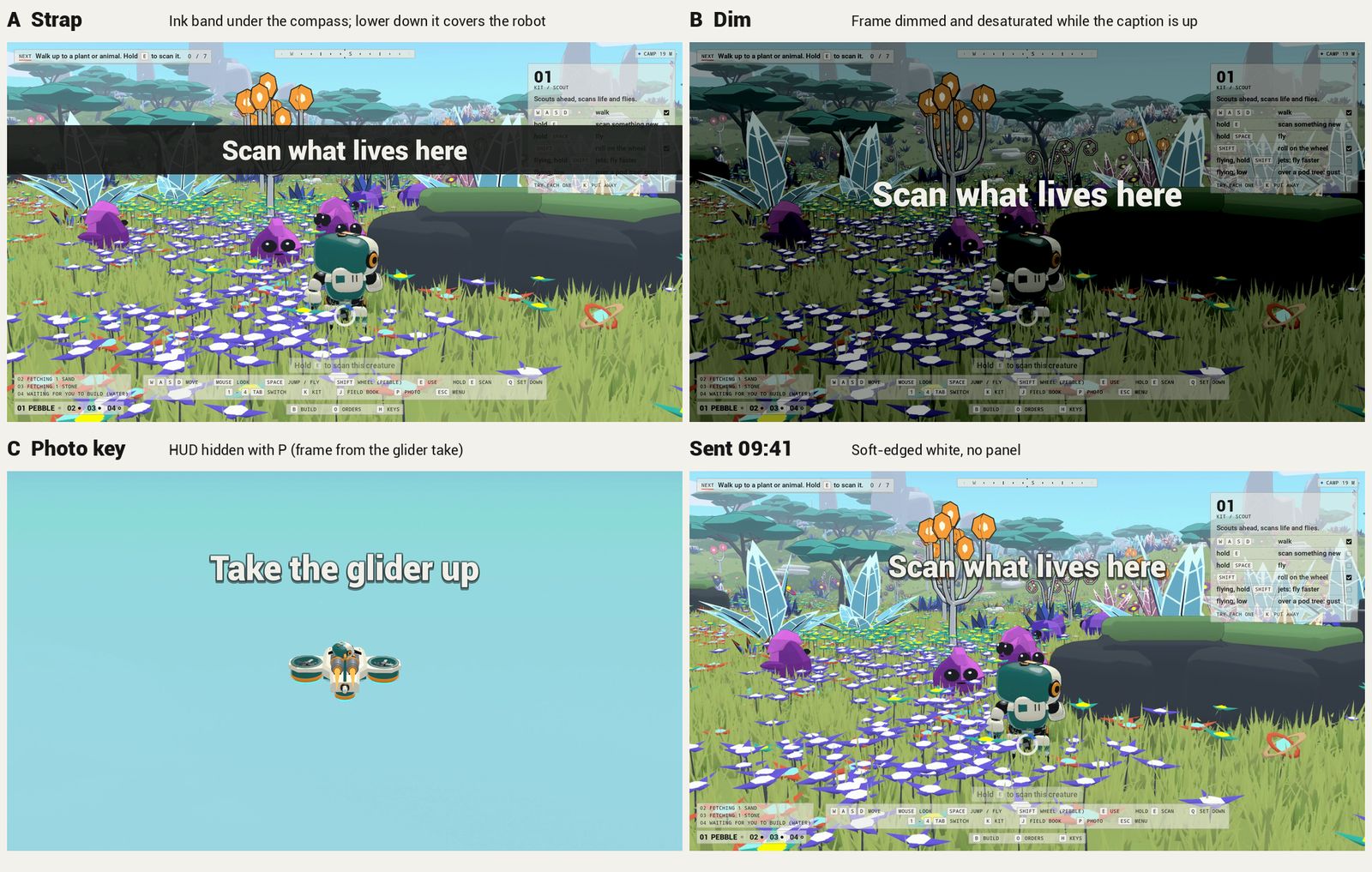
Caption variants · Sun morningThe three choices and the first still. I picked A. Open full size My message
“A: a solid dark strap under the compass with large white words.”
I also wrote “if we have time we can show the campus walk through but I think if anything we just pan up to show the campus on the ending”. The pilot was asked for that ending once the campus reached main. It would use the showcase switch, so that shot would show a staged campus. For this page I said “live straight away on dev log updates.” and “draft for what made the cut is fine”.
-
An independent review, then a save from main
The independent Opus review said “merge”, with no blocker for campus
f94d198f. It found no change to play without a campus wing, apart from cycling through more wing kinds on the mark card. It listed five notes: the stair fix made nearby frames pass-through and never restored them; building a joint by hand could place both wings' panels and plinths; the crew searched across the campus sockets again for each target; the save version had not changed; and a half-built wing could draw power before its solar was up.The review had read the old-save path but nobody had run it. The follow-up loaded a save written by the 08:23 main at 200 game seconds. All 156 pieces on 13 pads and all 11 sites returned, with no missing socket or fatal line. Of 656 compared fields, one differed: the list of wait times grew from four kinds to nine, with the four saved values kept. They were all zero, so a save with a non-zero wait time remains untested. Loading a campus save in an older build would still lose campus pieces; the review did not ask for that backward path to be fixed.
-
The Mac Shipping zip comes back
The Mac lane delivered a trial zip of the 08:23 game source, with packaging changes only. It contains one app for Apple silicon, requires macOS 14 or later, is signed ad hoc and keeps the App Sandbox. It is 415,564,495 bytes. The lane measured 98 seconds for its packaging command with shaders already cached; a final build with code changes will take more work.
The unzipped app passed its signature check and ten quick starts. All 1,189 loaded images came from macOS or the app. Opening, loop and title runs produced stills, with no crash reports from the fixed Shipping zip. The review found ten items. Two were blockers: extra
._entries broke the signature when the zip was unpacked, and a failed Shipping package could fall back to a Development app and replace the player zip. Both were fixed, with nine script tests and runs of the rebuilt zip. The fixes did not get a second independent review.Two of four Shipping save round trips differed in robot height by 0.000002 to 0.000005 cm, beyond the check's 0.000001 cm limit. All other fields matched. Two of fourteen Development starts crashed in the engine's memory tracker before a log appeared; Shipping did not show that crash. Two Shipping loop stills at 360 seconds show different progress, and that was not investigated.
The app is not notarized and cannot run on Intel Macs. No other Mac, real browser download, first-open dialog or update over an older app was tried. Earlier in packaging, removing outside library search paths had broken a library's signature even though the bundle check passed. Signing and checking each code file fixed that launch failure.
-
My first hand play since Friday
I opened the Mac Shipping zip and played the 08:23 build. It has the lean HUD, but predates the campus. I wrote:
My message
“few things to fix. When we go into menu screens we should be able to have our cursor come up so we can click on menu items. We need to be able to change sensitivity and other controls. Also there is no reticle. we need a reticle so its easier to tell where we are scanning.”
The source explained all three. Input was set once at start to game-only with the cursor hidden, mouse look used a fixed factor of 1.2, and there was no reticle. A new feel lane began from the campus branch, with Opus overseeing Codex builders.
Its brief asks for a cursor and clicks in menu screens, settings for sensitivity and invert Y, a HUD choice, volume and a controls page, and a reticle at the true aim point that changes when a target is in range. Key rebinding is a stretch. Stills come to me first. The target is cursor and reticle by 12:30, settings by 13:30 and checks by 14:30; the finished work and its remaining hand checks are recorded below.
-
Cut 4, and blue while scanning
Cut 4 came back at 54 seconds. It uses caption A, puts the kit card and key strip away with K after landing, reframes the sweep and pound, adds Cobble gathering, and shows the glider climbing, boosting and banking. The end card sits over photo mode. The scan shot still had its kit card under the strap, so a Codex worker was asked to record the landing take again and make the campus ending. The base still stops at 13 of 34 pieces, and the pilot listed only one alien interaction as another weakness.
My message
“looks good and when the reticle is added it will look better. The scanning should turn the object being scaned into like a holographic blue like when we place down the building parts.”
That became part of the feel lane's reticle work: use the build ghost's blue on the target while the scan is held, then restore its materials when the scan ends, is abandoned or leaves range. A still comes back to me before it is finished.
-
More of the building moves to Codex
My message
“the 5 hour limit is going to be hit soon so send more sessions and sub agents to Codex Astra”
The pilot, campus and feel lanes were told to hand building to detached Codex workers on GPT-6 Astra at extra-high effort and keep state notes with commands for resuming. A standalone Codex worker, started by the coordinator, took the submission pack refresh. The coordinator wrote a hand-over note too.
At 10:29 I asked for no new work on one of my accounts, while work already there could finish. The feel lane stayed running. New work went first to Codex workers, then to another team account.
-
The campus passes on Windows and reaches main
The PC run finished at 10:31. Its first start at 09:42 had stopped because the transfer bundle needed a commit the PC did not have; the coordinator rebuilt the bundle from an older shared commit. Development then built and packaged, passed the campus test and all four stair walks, took four campus stills and kept the room and hosting counts across a save and reload.
The Windows loop ended READY FOR HUMANS at 1,025.4 game seconds, with the same end and summary as main, and the 900-second colony test met 53 of 53 orders with ROOM at 86. The Development opening run hung until it was stopped at 600 seconds: the coordinator's script had given it no quit switch.
The Shipping zip was 322 MB with 97 entries and no .pdb. The dependency check read 74 binaries and 446 imports, with none missing or from elsewhere. From an unzipped copy, the opening exited with code 0 after 71 seconds, the loop after 370 seconds and the title run with code 0 too. It produced four campus stills, passed ten of ten quick starts and left no crash folders.
The coordinator looked at one Shipping still, the small campus at eye height: the joined building, canopy and lamp posts were visible. These runs were on my PC; they do not settle the clean-machine question.
The changes passed the secret scan, and campus
f94d198freached main by 10:33. The cursor, settings and reticle were still in their own lane. -
Three campus fixes and an angled canopy
The campus lane fixed three notes from the independent review in
09ff07d7. Building by hand now skips duplicate panels and plinths at a joint. The stair's frame exception is limited and collision is restored when the stair goes away. The crew's target search caches which sockets are redundant.On the Mac, both builds passed, the campus test passed eleven steps and all four stair walks, the loop's 214 lines matched main at 1,020.8 seconds, the colony test passed, and a save and reload matched all 1,210 fields. Those fixes had not had an independent review or a Windows run.
A Codex worker then built the first answer to my “too square” note: an angled entry canopy, one changed part with no C++ change. By 10:59 the canopy was committed as
ccd566a7, with final checks and stills running. These follow-up changes were still on the campus branch. -
Cut 4b keeps a finished version ready
The pilot delivered cut 4b with the landing take recorded again and K pressed to put the kit card away. It is the version without the campus ending; cut 4d has since replaced it at the top of this page. The shot list gives 19 shots over 54 seconds, with building footage at twice and four times speed, game sound and day music. The contact sheet shows the scan with the dark strap and the kit card gone.
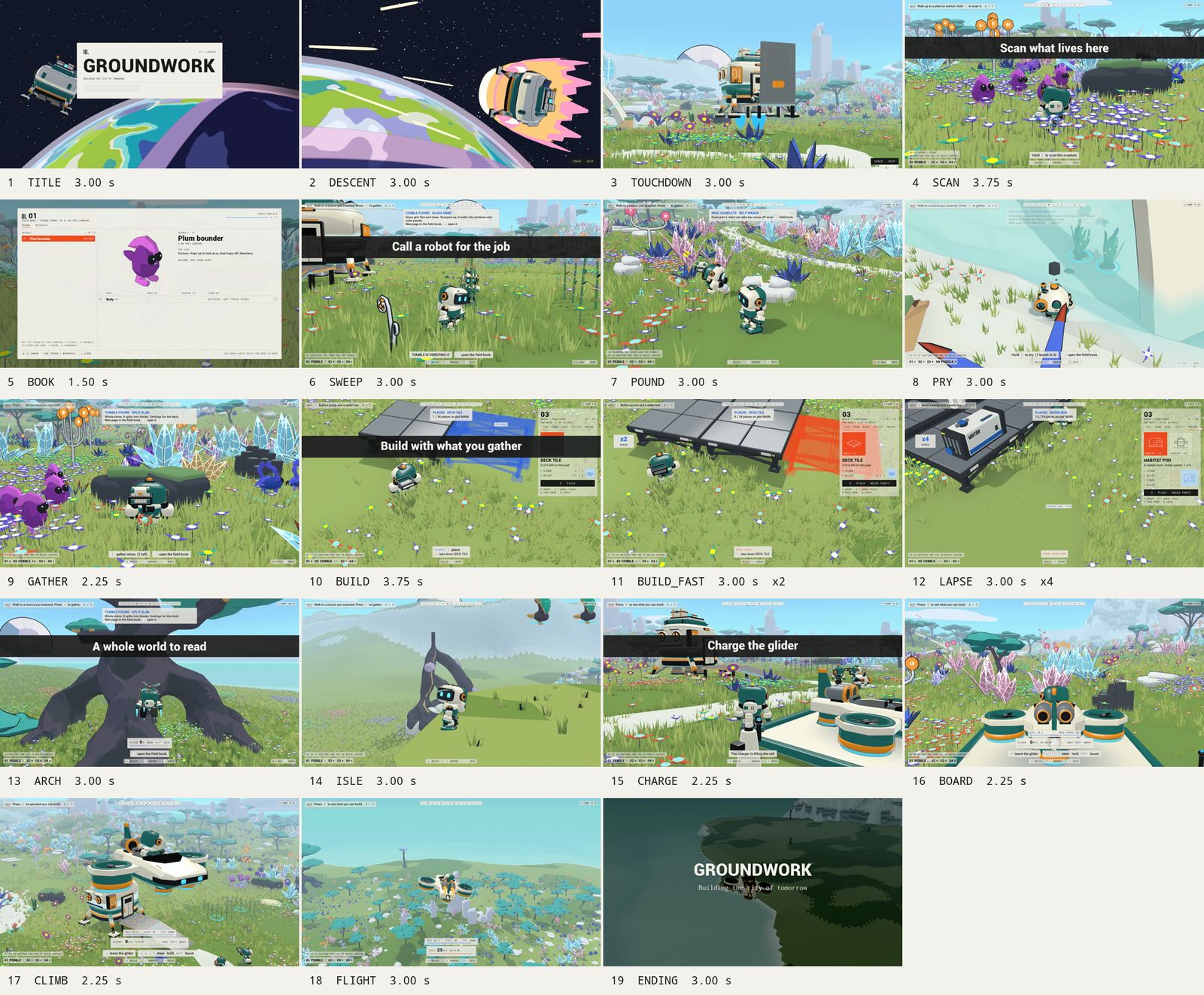
Cut 4b · delivered by 10:59One frame per shot. The building shots marked ×2 and ×4 are sped up. The campus and the new reticle are absent from this cut. Open full size When I asked whether everything was still running, three Codex workers were on the cursor, settings and reticle, and others were on the campus checks and cut 4c's campus ending. The submission pack worker had finished with exit code 0 and a clean secret scan.
-
The log catches up with the fixes
I asked “is the dev log updated with the fixes?” It still stopped at about 09:20. A Codex worker took this update through 11:26, with the campus on main, my Mac play and cut 4b. The coordinator checked it and published it at 11:46 after the corrections below.
-
The scan turns blue
The feel lane sent me a creature halfway through a scan, in the build ghost's blue. Its scripted checks completed a creature and a plant scan, released E early, opened Escape, the field book and photo mode, and switched robots. Across 15 on/off pairs, the target returned to its own material with no fatal line. Giants, landmarks, a save during a scan and Windows had not been tried.
-
An index down the left side
My message
“in the dev log can we have an index guide on the left side”
A second Codex worker took the page after the content worker finished. It added a left index on wide screens, with the current section and entry marked, and a Contents sheet on narrow screens. The links still work without scripts. The coordinator merged the published corrections into that branch before checking it in real Chrome at 1600 and 1440 pixels wide.
At 11:55 one of my accounts hit its usage limit. After the reset I wrote “Try again”, and the index went live at 12:18. The live page, stylesheet and script matched their committed files; the notes stayed private. The coordinator had not opened the Contents sheet at phone width or clicked an index link with a mouse.
-
Six corrections before the update went live
The Sunday update passed its mechanical checks, then an Opus reader checked it against the sources. The report asked for six corrections: put cut 4 before the Codex entry; say it was sent to me by 09:43; credit the shot list for the shot count in two places; name the coordinator as the one who started the standalone Codex worker; and record the stopped Development opening run beside the line saying the work passed its Mac and Windows checks. The worker attribution needed changing in two places too. The reader found no misquote or privacy problem.
The coordinator applied the corrections and looked at the four new pictures for private text. The update went live at 11:46. The page matched main after an initial request returned the older page, all 69 media references responded, and the implementation notes were not public.
-
The campus ending and scan brackets
Cut 4c arrived with the pan up to the campus at the end, on the pilot branch with the campus fixes and angled canopy. The campus lane had finished its Mac checks on that canopy; its Windows run was still to come. I also received the two eye-height canopy views and the reticle sheet.
The reticle puts brackets on the thing E will scan and a ring at the centre when nothing is in reach. I wrote “reticle brackets work for now.” I had no further notes on cut 4c or the canopy.
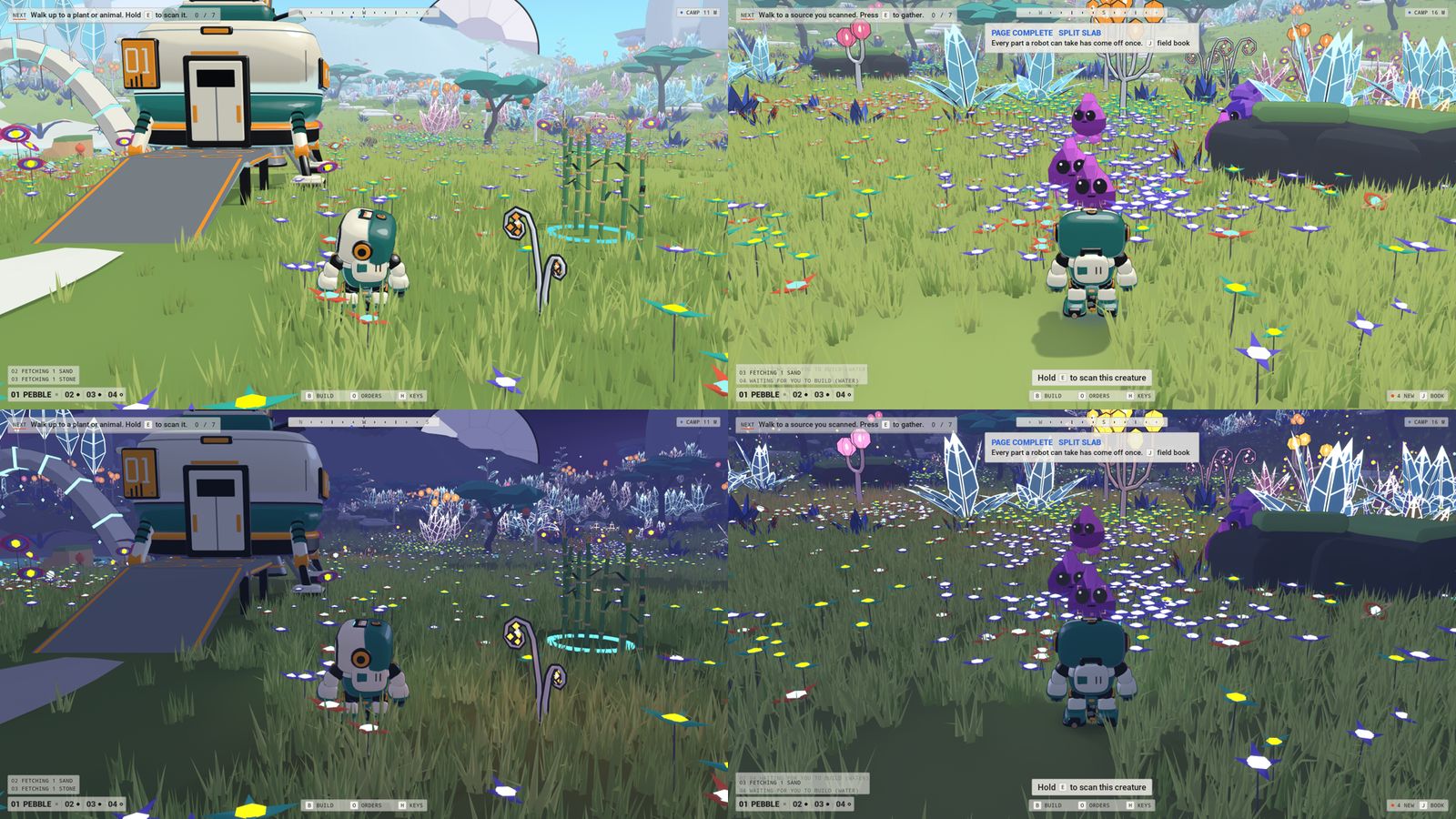
Reticle sheet · sent at 11:46The brackets follow the game's scan target. I kept this version after seeing the sheet. Open full size -
The film needs to say what we are building for
My message
“In the demo we need to explain what the purpose of the game is. we never say we are building a colony for 4 human explorers to live and work in.”
The pilot put two dark straps into the opening: “Four human explorers are on their way.” and “Build them a colony to live and work in.” Cut 4d and the two stills reached me at 12:18. That is the cut at the top of this page, with cut 4c's campus ending.
The pilot checked those words against the game's opening. Four humans and a place to live were in it. Explorers and work were my description, absent from the game text. The first strap said they were on their way too soon: in the game they follow after the signal. At 12:27 I answered “go with your pick.” The first strap was changed in the pilot's code to “Four human explorers will follow you down.” Cut 4d still has the earlier wording; the next recording will use the change.
The same 12:18 delivery included the feel lane's menu cursor. The title, opening, pause, controls, quit confirmation, field book, milestone and end cards now have cursor handling. Screens where the robot keeps moving stay on keys. Those clicks were exercised through the pilot's pointer, with no real window open.
-
The campus fixes run on Windows
The coordinator used the idle PC for an interim run of
6164b3ce: main plus the campus fixes, canopy and pilot work. By the 12:48 log row its editor build and Development package had passed. The campus test passed, all four robots completed the stair walk, four stills were made and a save round trip kept the campus counts at 24 rooms and 24 hosting places.The loop reached READY FOR HUMANS at 1,025.4 seconds with 215 log lines, the same count and end as the earlier Windows run of main. The colony met 53 of 53 orders with room for 86. The opening woke all four robots and exited in 72 seconds with the new quit switch. No run had a fatal, exception or assertion line. This run made no Shipping package.
-
Beyond the whole landing island
I asked “Have we had added the bigger generative world?” The coordinator checked main: a plain start still loaded the hand-built large land with its five landmarks and five animals. The seeded generator was on main behind a command-line switch, with no menu entry.
My message
“well i was thinking the landing area was pre-made but once we go further out then it's generative. Can we start that build in a separate lane.”
A new Outland lane started on another team account, with a Claude coordinator and a Codex builder. At 12:37 I added “and to be clear i mean outside of what we already have pre-made built right now”. The existing generator kept only the centre of the land, out to 160 metres from the lander. The brief changed to keep the entire hand-built sheet, with its places, creatures, finds and campus spot, and put generated ground beyond it.
The lane had to show me a sheet before building, offer a tested version, and run the builds, colony, opening, campus and save checks. A journey out and back, frame times and an independent review were required too. Its progress report was due at 15:00, with 16:30 the last time it could offer a branch for the final build.
-
Generated land across the water
The sheet showed that today's large land is one island inside a 1,280-metre grid, with sea on every side down to a flat floor 40 metres below. There was no edge of dry land to extend. The lane proposed a second land across the water, from one tested seed, centred 1,152 metres south of the lander.
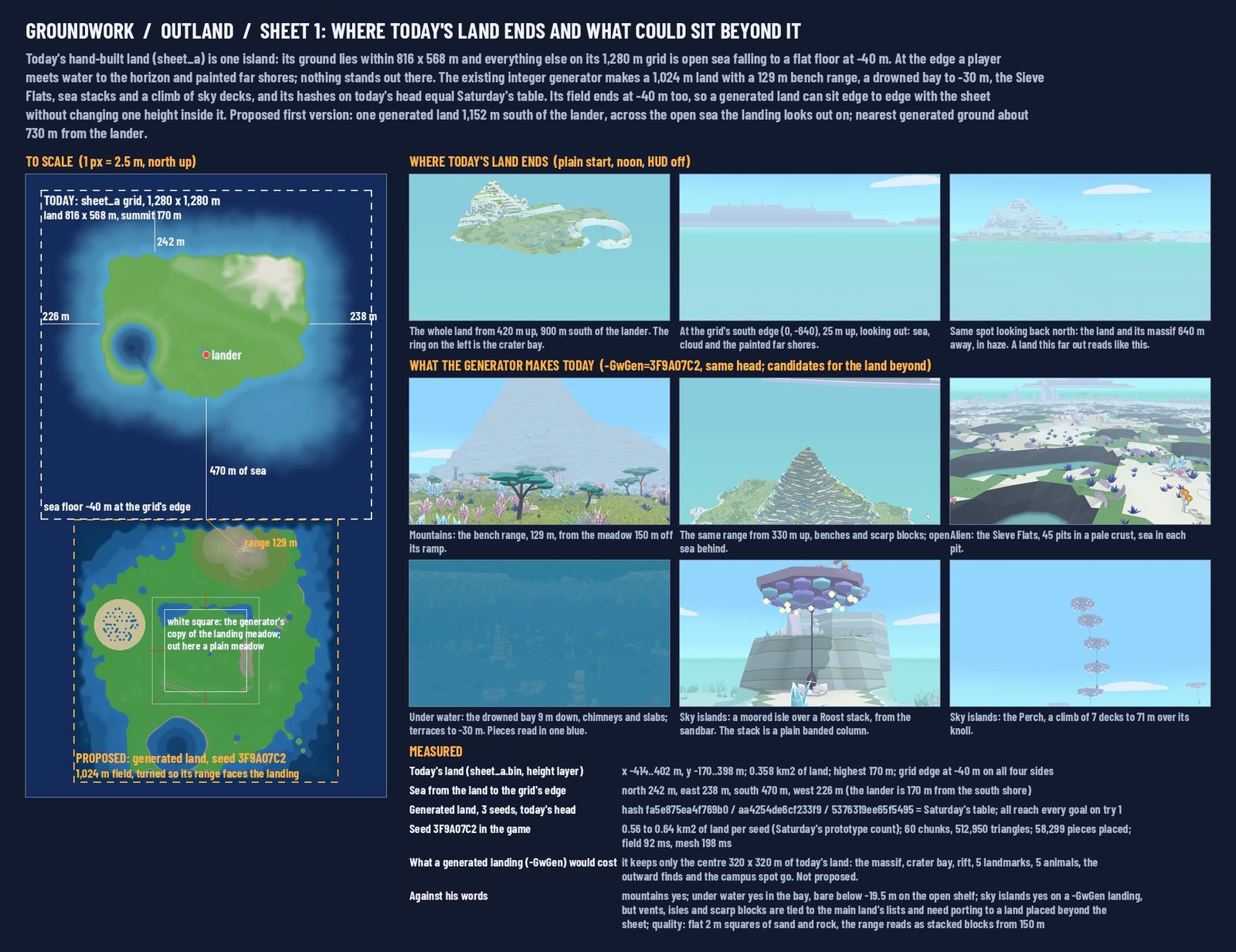
Outland sheet 1 · sent at 12:48The scale map is a proposal. The generated views are candidates from the existing generator; the vents and sky islands shown here did not enter version 1. The estimate of about 730 metres to the nearest generated ground became 673 metres in the build. The footer is cropped. Open full size I answered “south” for the side and “yes” to letting the new land appear on the video's horizon. Version 1 would use a fixed seed, ground and dressing, with one constant to turn it off. Scarp blocks, bay vents, moored isles and the Perch decks needed porting and were left out. A different world on each landing was left out too.
-
Settings, with key binding left for later
The settings still arrived with SETTINGS as row 02 of the pause menu. The card has look sensitivity from 0.25 to 3.00 times, with 1.00 as the default; invert Y; lean or full HUD; master, music and effects volume; controls; reset; and back. Keys and mouse both operate it. The controls page shows the keys.
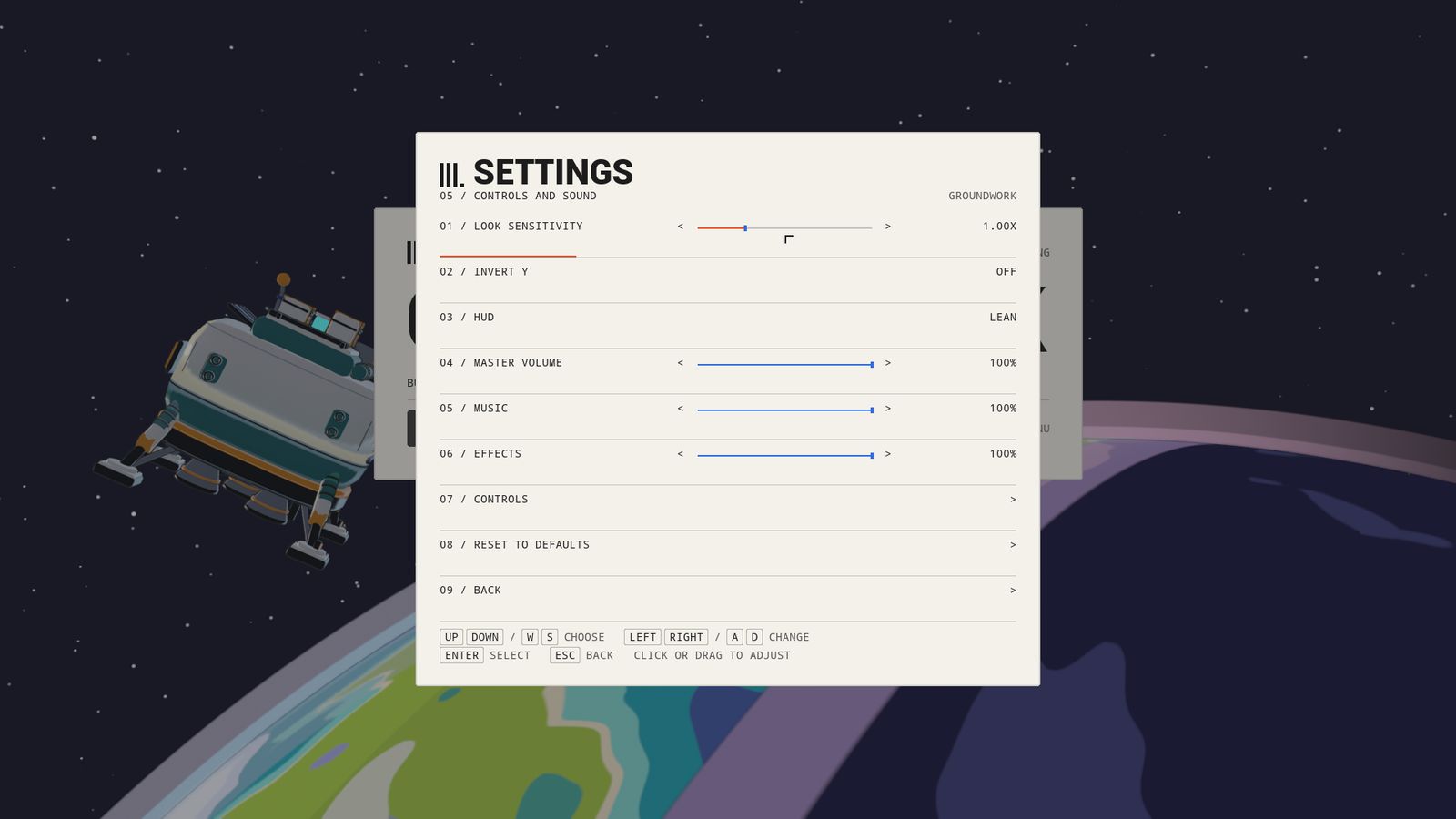
Settings · sent at 12:59The nine rows, checked through the pilot's keys and pointer. A real mouse and window still need hand play. Open full size At 13:00 I wrote “lets leave key binding for later”. The controls page stays a guide for the jam build. By 14:19 the lane had counted about 75 direct key reads across 18 files; rebinding would need a shared action-to-key table, saved choices and conflict handling.
-
The review catches the glider's old boundary
Outland version 1 was committed with 64 chunks with collision and 59,332 dressing pieces. Against the same commit with the new land off, the loop's 214 lines were equal and ended at 1,020.8 seconds; the colony met 53 of 53 orders with 996 equal lines; the opening passed 54 checks; the campus had 192 equal lines and all four walks passed. A save round trip compared 533 fields with no difference. No fatal line appeared.
The independent Opus review found no blocker, but the glider was still held five metres inside the old sheet's boundary. Only Puddle could reach the new land. The lane fixed that limit, with four smaller review fixes, in its working tree, and held the commit until the gates passed again. At this point a body had not crossed the sea, and the capped frame rate could not establish the extra cost. The coordinator started a Windows build of the version before those fixes to check the compiler and generator hash.
-
One seed, another Windows hash
The first Windows Outland run passed its build, Development package, campus, loop and opening checks, with no fatal line. It placed the same 64 chunks and 59,332 pieces as the Mac. But the generator's hash, a fingerprint of its output, differed for the same seed:
afb207bb4cee06cfin the Windows game againstfa5e875ea4f769b0on the Mac. The layer and ground hashes matched. The coordinator asked the lane to explain it before offering the branch.At 14:23 the coordinator checked the input land sheet on both machines. Its 8,217,620 bytes were equal. Building the generator on its own with the Windows compiler, both optimized and unoptimized, gave the Mac's hash and all seven stage hashes. At 14:32 adding the fast floating-point flag,
/fp:fast, reproduced the Windows game's hash. Meadow, provinces, relief and coast still matched; join was the first stage to differ, followed by gates and coarse.The lane found one line that turned the sheet's float heights into millimetres:
floor(double(f) * 1000.0 + 0.5). With the fast flag, the Windows compiler evaluated it in single precision. Five heights differed by one millimetre, with no zone difference. All five were inside the copied centre, where the game draws and collides with the original sheet's float heights, so this discrepancy changed nothing visible.The fix works out millimetres from the float's bits with integer arithmetic. At 14:39 the coordinator confirmed it on the PC under four flag sets: each standalone run gave the Mac's hash and seven stages, and its dumped output was byte-equal to the Mac's. The fixed generator inside the Windows game still needs its run on the final head.
The four checks used
/O2 /fp:fast /arch:AVX2,/O2 /fp:fast,/O2and/Ox /GL. The fix isd04f4909. Two lines in the hand-built land's seabed code still use the old float conversion. Windows can differ from the Mac by one millimetre at some of 241 seabed points; that work was left for after the jam. -
The feel review
The feel lane committed the settings and fixes from an Opus review: four confirmed findings, two plausible and two minor. A smoke run with saving off could read and write the player's settings; it now leaves that file alone. Holding the mouse to scan, opening Escape and releasing could click SETTINGS; a release now counts only on the screen where the press began. The glider's rotor and boost had ignored the volume sliders mid-ride; they now follow them.
The other fixes covered the film script's new menu row, saving on exit with the card open, choosing the nearest landmark copy for scan glow, a look hold that should apply only to real windows, and the orders fold after a HUD change. The coordinator started a full Windows run on
6e7711c6, with the campus fixes, pilot and feel work but no Outland. Development passed at 14:40: campus and four stair walks, a save round trip, the loop, all 53 colony orders and an opening with all four robots awake, with no fatal line. Shipping followed.The lane's final reply at 14:56 says it used no real window, packaged build or Windows run itself, and heard no sound. Its pointer tests do not settle cursor capture, focus changes or the feel of a mouse. Milestone-card clicks, glow on giants and landmarks, and a save mid-scan were not exercised. The coordinator's package runs are separate evidence.
-
The final video starts again
The pilot started a new recording on the feel candidate, with all seven takes to be recorded and checked again. It is making versions with and without the campus ending, both with the revised purpose straps and tagline end card, due by 17:30. Cut 4d remains the fallback. The new land may appear if its branch makes the final head.
The feel lane had found that the shared job gate did not prevent overlapping Unreal jobs. The coordinator passed that warning to every lane: check what is running and run one Unreal job at a time.
-
Pebble crosses and comes home
The Outland pilot boarded the glider at 23.2 seconds, crossed 577 metres of sea in 24.5 seconds and put Pebble on the generated beach at 63.83 seconds, with his feet three centimetres above the ground. He walked 110 metres inland and 108 back, then rode home. The run had no fatal line. The first attempt had wedged the glider between slabs; the lane called that a script fault, and the possibility of wedging remains in its limits.
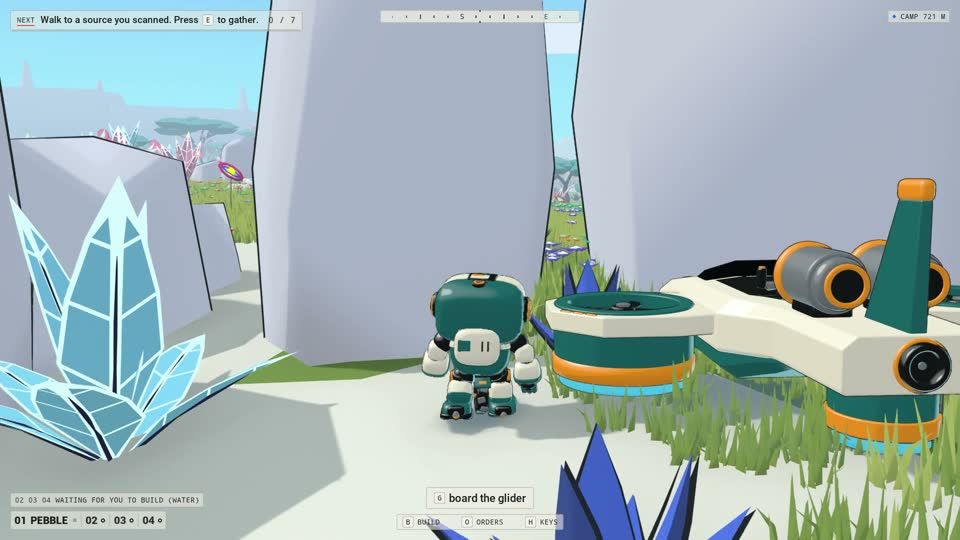
Outland crossing · sent at 14:23Pebble on the generated beach after the glider's boundary fix. This journey was played by the script. Open full size The gates on the fixed tree matched the base again, and a base-build save opened with 533 fields unchanged. The piece count after review was 59,432. At 14:39 the lane reported the Mac's engine timings at 1080p, medians over 900 frames: GPU work from 4.6 to 5.6 milliseconds and game-thread work from 1.9 to 2.8, with the land on or off. The on/off difference was smaller than the difference between runs. Windows frame times had not been measured.
-
A fallback zip and the final merge
The Windows Shipping zip of
6e7711c6passed as the fallback: cursor, settings, reticle and blue scanning, without Outland. It is 322 MB with 97 entries and no debug-symbol file. The dependency check covered 74 binaries and 446 imports, with none missing or loaded from elsewhere. From the unzipped copy, opening, loop, title and campus-still runs exited with code 0, all ten quick starts passed and no crash folders appeared. It lacks the feel lane's last three-line fix, which makes settings follow the save switch's default.Outland offered
814cddf4with every Mac gate passed: both builds, the equal loop and colony runs, opening, campus, save round trips and the crossing. Its own limits remain: the save does not record this land; no objective sends the player there; it has no scarp blocks, vents, isles, finds or creatures; and the glider can wedge between beach slabs. The lane had made no Windows measurements.The coordinator merged the finished feel head
7b292bff, Outland and the Mac packaging tools into371f7b78on the final branch. One conflict in the glider file was resolved by keeping both includes. The Microsoft-compiler lint and merge secret scans found nothing. A full Windows run began, with Development tests, an in-game generator hash and dump, then Shipping and its checks.The Outland lane confirmed that its scratch merge had the same game tree as the final head. Its build and source checks passed, with the loop, colony, opening, campus, hash, dump and crossing runs still underway. At the last log row, 14:57, neither that set nor the final Windows run had reported an end. This update goes to the coordinator to check and publish; the final video and build results follow.
-
The land matches inside the Windows game
The final head's Development build on the PC printed
GW gen: seed 3F9A07C2 hash fa5e875ea4f769b0, the same line as the Mac. All seven stages matched, along with the layers, ground, scarps and water. The integer field had zero millimetres of difference in the copied centre, the piece count was 59,432, and the dump was byte-equal to the Mac's. This closes the in-game comparison left open in the last update. The land took 2.2 to 2.7 seconds to build at start on the PC.The campus test passed and all four walks arrived. The save round trip's counts were equal. The loop reached READY FOR HUMANS at 1,025.4 seconds with 215 lines, as on the other Windows runs today. The colony, opening and Shipping zip were still running.
The Outland lane tested a merge with the same game tree as
371f7b78. The build succeeded and the Microsoft-compiler lint found zero issues. The loop's 214 lines were equal and it ended at 1,020.8 seconds. The colony met 53 of 53 orders with 996 equal lines, the opening passed 54 checks, and the campus had 192 equal lines and four of four walks. The generator hash and dump matched the lane's earlier build, the glider crossed and returned, and there were zero fatal lines in six logs. At this point the lane had not repeated the two save checks or frame timings on the merge. -
Puddle takes the west shore
The Outland lane finished. Its save round trip on the merged tree compared 533 fields with none different. Puddle, the Diver, crossed the seabed and stepped onto the generated ground, but the straight walk from the landing stalled 49 metres short of the beach on the steep north coast. A gentler route from there round the west shore arrived after 764 metres and 455.7 seconds. A ramp or landing place on the north coast would be a design change for me to choose.
The lane left limits with its reply. The save does not record the generated land, so loading a robot saved there with another seed, another placement or the land switched off could put it over open sea. The glider can wedge between the beach slabs, and no objective, prompt or map mark sends a player out there. This version adds ground and dressing; it has no scarp blocks, crest stones, vents, seabed garden, moored isles, Perch decks, finds or creatures.
It did not test a colony working on the new land, saving and resuming there, or its night, weather and sound. Glider and camera behaviour among the slabs remain untested beyond the wedge it found. Another seed and placement had only read and collision checks. Windows frame times and memory were not measured, and frame times were not repeated on the merged tree. The lane did not test Shipping itself; the coordinator's Windows run was still underway.
The lane removed its 1.3 GB comparison worktree and 314 MB of scratch builds and films, kept the logs and dumps, and left nothing running.
-
Seven corrections to the log
The update through 14:57 was public. Its mechanical checks counted 127 unique IDs, 140 fragment links, 105 timed entries in the index and 73 media references with none missing. The privacy scan found only model names already used on this page, and the coordinator looked at the four new pictures. An Opus 5.5 reader at medium effort checked the facts, found no misquotes or privacy problems, and asked for seven corrections. The coordinator applied them in a second commit.
The comparison with the live site found only the changed page and six new media files. The deployment reported ready, and the live page was byte-equal to main on the second try. All 73 media references returned 200. Cut 4d returned 404 once in the first seconds, then 200 with the right size. The implementation notes returned 404; the home and journal pages returned 200. By then the Windows results had overtaken the update's pending lines.
-
The final head reaches main
The coordinator pushed
371f7b78to main after the full Windows run passed. It brings together the campus fixes and canopy, pilot changes, feel work, Outland and Mac packaging tools. The scan of the changes before the push found only the engine's shared install path. The coordinator also looked at the Shipping opening and loop stills, and had the Outland lane's Mac checks on the same game tree.Development passed the generator hash and byte-equal dump, the campus test and all four walks, and the save round trip. The loop ended at 1,025.4 seconds with 215 lines. The colony met 53 of 53 orders, and all four robots woke in the opening.
The Shipping zip is 322 MB with 97 entries and no .pdb debug-symbol file. Its dependency check covered 74 binaries and 446 imports, with zero missing and zero loaded from elsewhere. From the unzipped copy, the opening, loop, title and campus-still runs exited with code 0. All ten quick starts passed and there were zero crash folders. The run left no game or helper running.
This was all on the PC. A clean Windows machine, my hand play of this build and the real window's cursor, focus and full screen were still unchecked. Puddle's direct route onto the new land remained blocked. A Codex worker started the last refresh of the submission documents.
-
The final Mac zip
The Mac zip was built from
371f7b78: 415,883,699 bytes, reported as 396 MB, for arm64, with macOS 14 as its minimum. It is signed ad hoc and keeps the app sandbox. The library check covered 12 Mach-O code files and found zero problems. The coordinator stopped a helper left by the build and began the checks from an unzipped copy.The Mac zip is an optional extra. The Windows zip is the one for the submission.
-
Three heights fail the save check
The unzipped Mac copy finished with 17 PASS lines and one FAIL over 14 game runs. Signature verification passed. The library check found zero problems in 12 code files, and all 1,189 loaded images came from macOS or inside the app. All ten quick starts exited with code 0. The opening and loop exited with code 0 and produced stills, with no new crash report or files in Unreal's crash folders.
The save round trip failed: three robot heights differed by 1.3e-6 to 3.0e-6 centimetres against the checker's 1e-6 centimetre limit. The other 530 of 533 fields were equal. The comparison covered 100 pieces, five sites and four robots, with 41 entries marked found. The colony comes back. The Mac lane had reported the same item on the trial zip, where two of four round trips differed by 2e-6 to 5e-6 centimetres. It remains open for the save lane after the jam.
The system's assessment returned “rejected” because the app is not notarized. The packaging checks passed; the height difference remains a save-check failure. The existing colony save and backup in the app's own save folder were left alone. These runs used saving disabled, a named test save or an unattended switch.
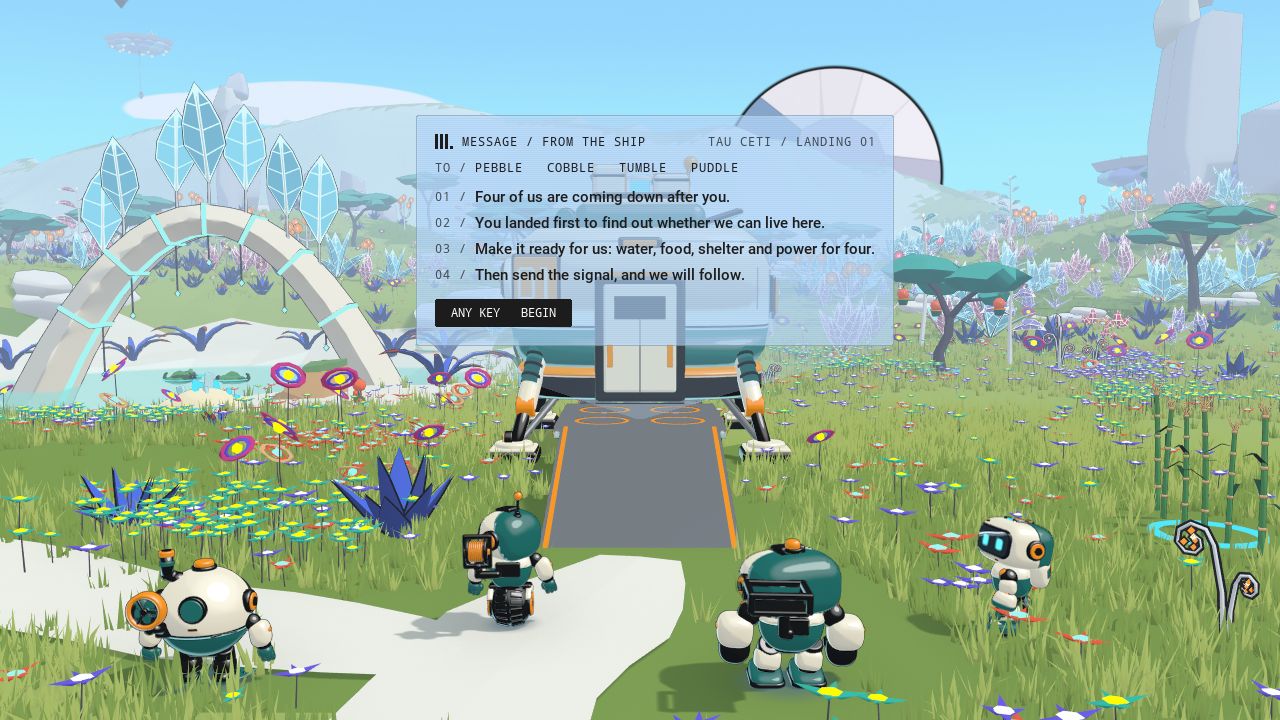
Final Mac zip · openingThe unzipped copy reaches the ship's message and the four robots. Open full size 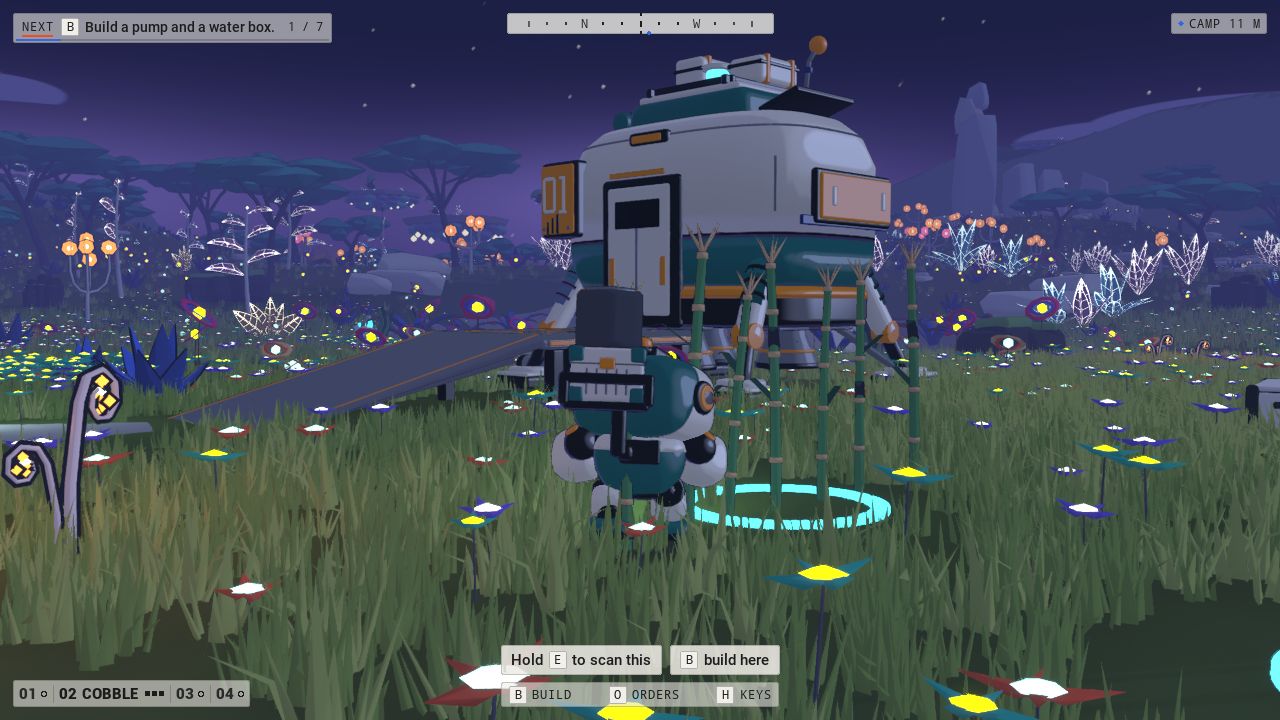
Final Mac zip · loop at 360 secondsThe unattended loop from the same unzipped copy. The separate save comparison failed on the three heights above. Open full size -
The final film arrives
The pilot delivered the final video: 1920 × 1080 at 30 frames a second, 54 seconds in 19 shots, measured at −16.0 LUFS with a true peak of −1.5 dBFS. The master is 72.6 MB and its 720p copy is 3.73 MB. It ends with a pan up to the staged campus. All seven takes were filmed on
6e7711c6, before Outland was merged; each exited cleanly with its expected marks. The pilot moved the ending later so photo mode had hidden the HUD.The coordinator probed the master and small copy and looked at the contact sheet. Both purpose straps use my wording, the tagline appears on the title and end card, and the endings have no HUD. A cut without the campus ending was delivered too.
The lane named four weak spots in the delivered film. Pebble stands between the camera and the bounder, so the blue scan barely shows during its roughly 0.9 seconds. The touchdown strap covers the lander roof. The glider approach stopped 1.8 metres short, though boarding worked. The takes predate Outland, and the isle, climb and flight shots face west to south into haze with no new south land in frame.
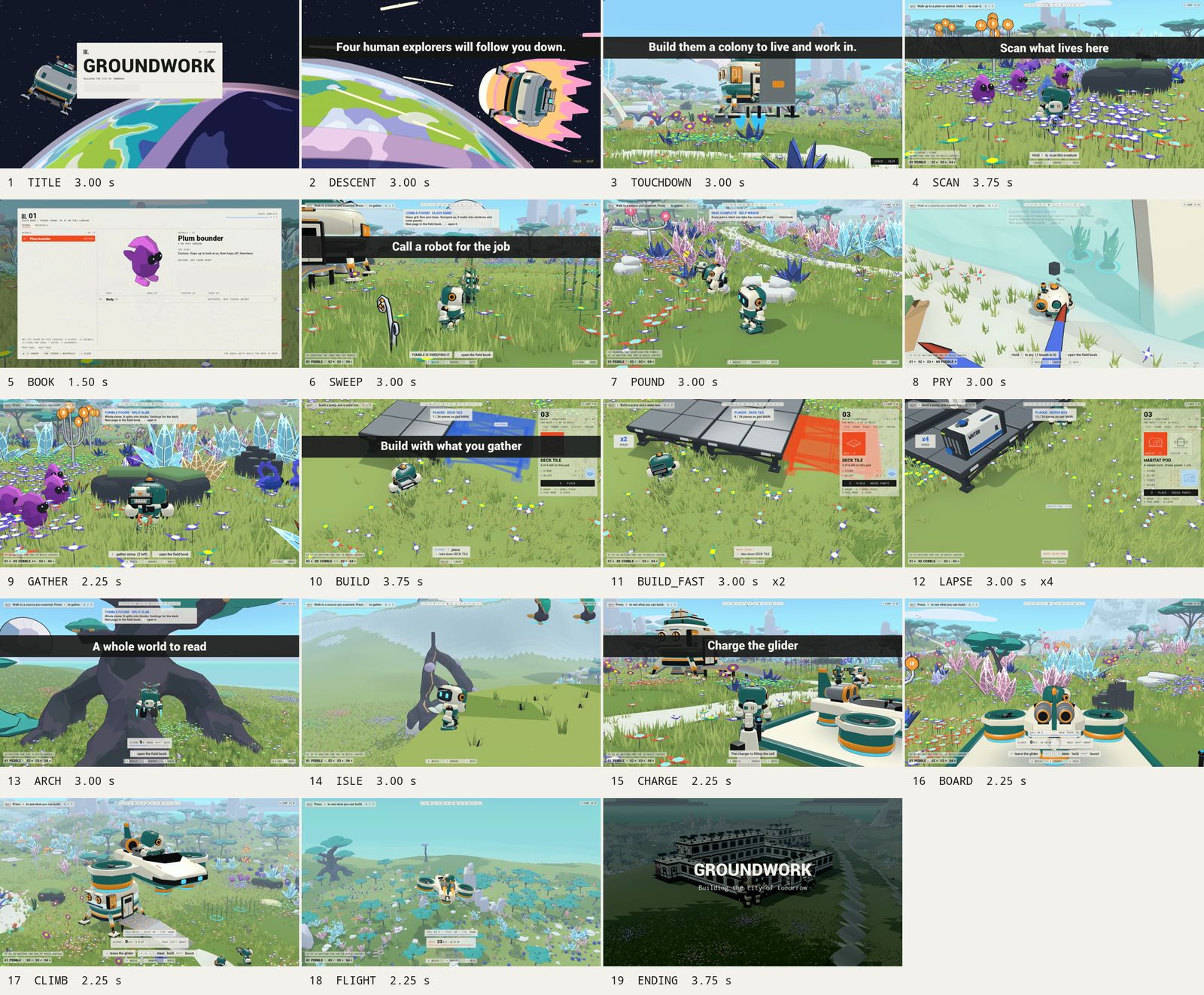
Final film · contact sheetThe delivered cut's shots and durations, from the pilot's edit. The campus ending uses the showcase switch; the new generated land is absent from this recording. Open full size The Codex worker finished the documents through the 15:41 log row, with 35 checklist rows, 22 verbatim answer quotes and a source for each of 103 changed lines. Its secret and privacy scans passed. It left out the final Windows byte count and full checksum, a clean-machine run, the Mac unzipped-copy result and final video approval because those were unsupported at its cutoff.
-
I play the final Windows zip
I played the final Windows zip by hand on the PC.
My message
“pc game feels great and was fun to play”
-
A request for a second film
The pilot was asked for a second version without touching the delivered cut. In the landing take, Pebble should approach the bounder from the side so the blue scan is in clear view. For the glider take, the lane should merge
371f7b78, rebuild and record again so the south land can show. I had said “yes” to that land appearing.Each change can be dropped on its own if it does not work. The files are due by 17:15; if they are not ready then, the delivered cut stays the video. At this log row the second version has been asked for, not delivered.
A Codex worker started this last planned dev log update for the coordinator to check and publish. The unzipped Mac test copies were deleted to free 1.5 GB, with their logs and stills kept. I still have to submit the game myself tonight.
-
The south land, seen in the zip I played
I wrote back: “video is good.” and “yes to mac”. So the delivered cut is the video, and the Mac zip goes on the game page as an extra download. I also asked: “so is the generated outlands in the game version now? i didn't go out far enough to find out”.
Until then the land had been verified on Windows only in the Development build. The coordinator ran the unzipped Shipping copy on the PC three times, off screen and with saving off, and looked at the stills. From the south shore a stepped range stands on the horizon across the sea. With the land switched off, from the same eye, it is absent: 65,107 pixels differ, 7.1% of the frame. The third still is from an eye on the generated ground. All three runs exited 0, and my save from the hand play had the same checksum before and after.
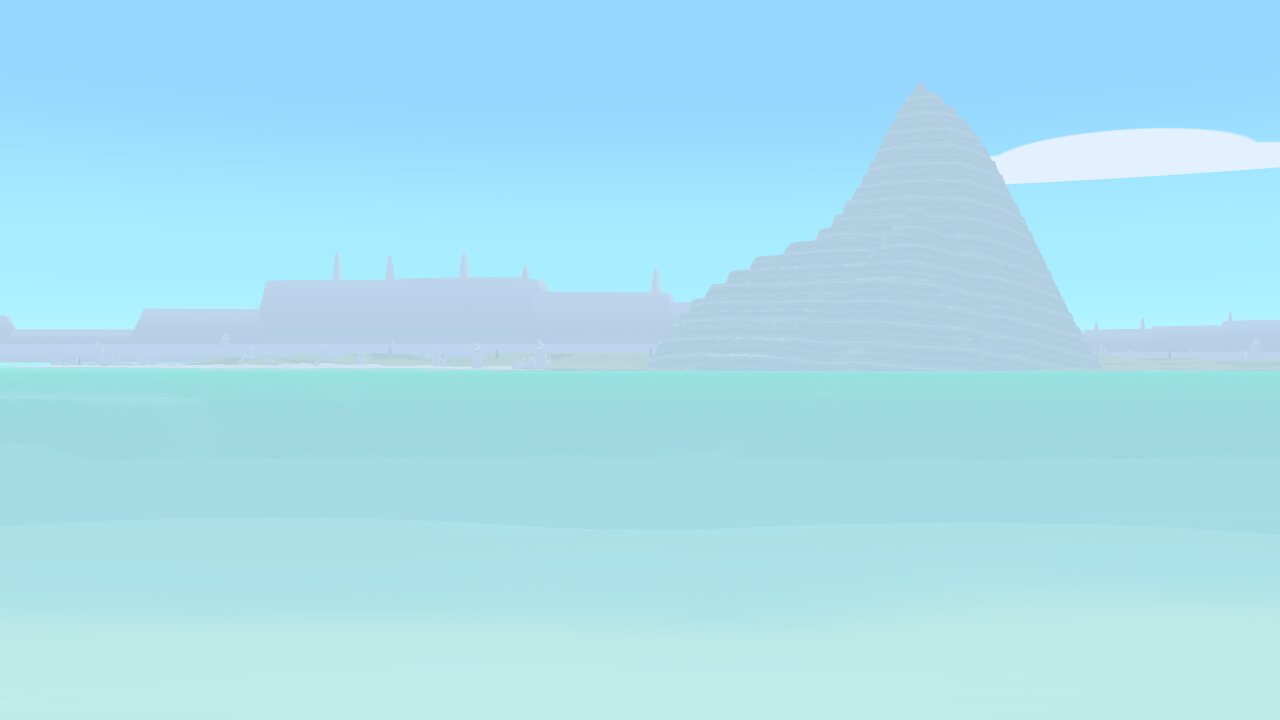
Final Windows zip · south shoreThe generated land on the horizon, from the Shipping build. Open full size 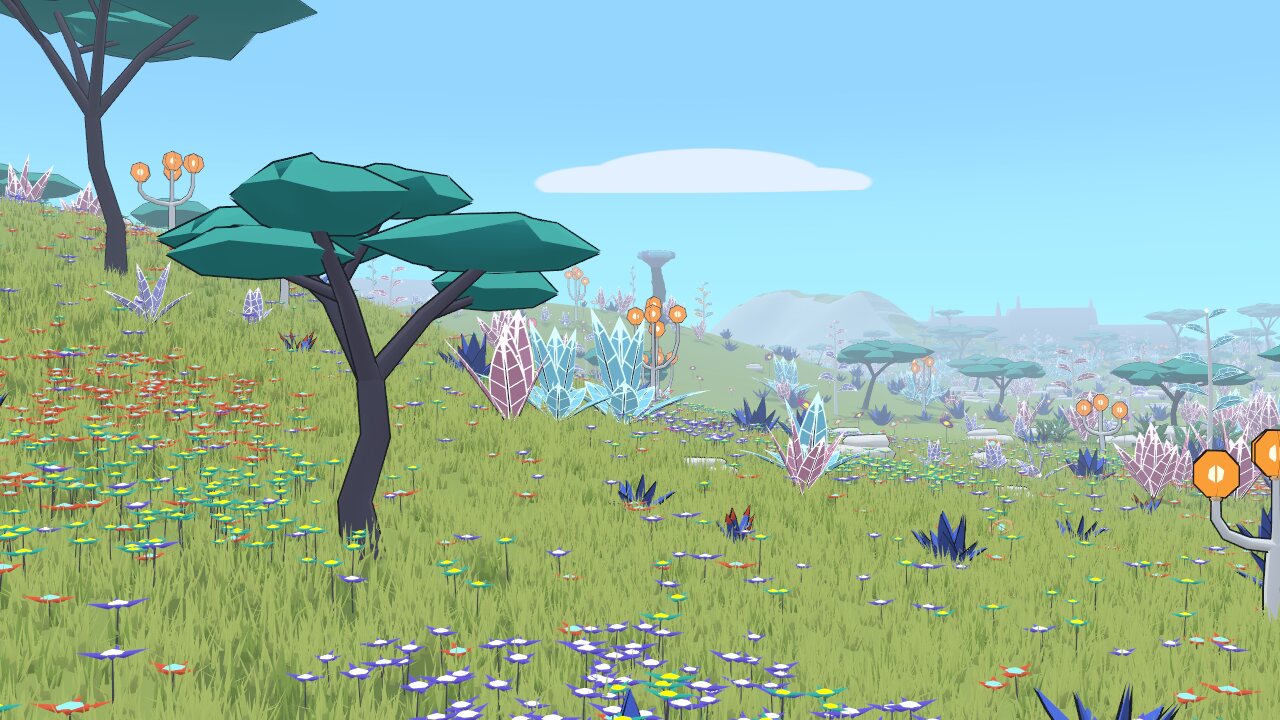
Final Windows zip · on the landGround and plants on the generated land; it has no creatures or finds. Open full size I had not flown there in my own play. The glider reaches it across 577 m of sea, and nothing in the game points the way yet.
-
The last update goes live
The update through 16:06 was public. It added nine entries from 15:08 to 16:00, the first final film as the lead and three pictures. The coordinator added the 16:04 entry and two stills of the generated land from the Windows Shipping zip. An Opus 5.5 fact check found three corrections: only the first purpose strap was reworded, the checklist was updated by hand after 15:41, and the save comparison counted 41 entries marked found. The coordinator applied all three. The check found no misquotes or privacy problems.
The checks counted 137 unique IDs, 150 fragment links, 115 timed entries in the index and 82 media files matching the preview. The privacy scan of added lines found zero hits, and the coordinator looked at the new pictures. The comparison before publishing found only the changed page and seven new media files. The live page was byte-equal to main on the third try; all seven new files returned 200 with the right sizes, and the page's charset was UTF-8. It was not looked at in a browser afterwards.
At 16:18 the final Windows zip finished copying from the PC to my Mac: 337,795,380 bytes.
-
The second cut arrives
The pilot delivered the second cut with both changes. The scan shot turns the view 40 degrees before scanning, so the bounder to Pebble's left turns holographic blue for the hold. That landing take was re-recorded on
6e7711c6, the same build as the first cut. For the flight shot, the pilot merged the final head371f7b78and recorded the glider again. The view is lifted to −8 degrees, facing south at about 40 metres, with the generated range and its peak on the horizon. The other shots predate the land's merge.The film is 1920 × 1080 at 30 frames a second, 54 seconds in 19 shots, measured at −16.0 LUFS with a true peak of −1.6 dBFS. The master is 71.4 MB. The scan shot lasts 3.75 seconds and the flight shot 2.25 seconds; the campus ending stays. The coordinator probed the file, looked at the contact sheet and compared scan and flight frames from both versions side by side. Both changes showed. I was sent the small copy and the comparison to choose between the cuts.
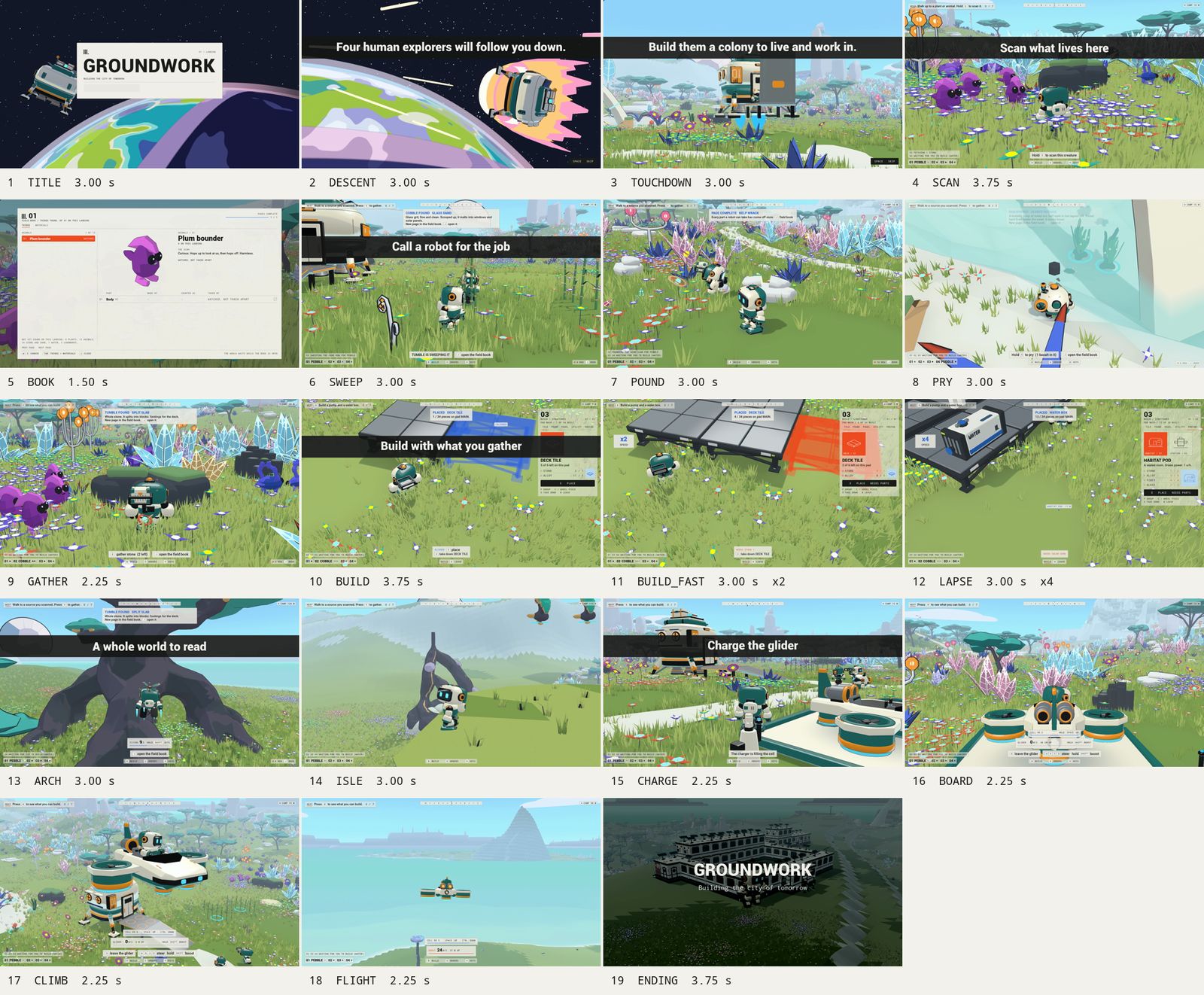
Second cut · contact sheetThe shots and durations from the pilot's edit. The flight now shows the generated land; the touchdown strap still covers the lander roof. Open full size -
I choose the second cut
Asked which video to upload, I answered: “your reccomendation.” The second cut is the video I submit. I asked for it to be uploaded to the studio's YouTube channel. The upload is still to come, and the jam entry is still mine to submit.
-
The video goes up
The coordinator could not drive my usual browser, so I connected the Claude extension in Chrome: “i connected claude to chrome thing with this account try again”. It uploaded the second cut to the studio's YouTube channel through that browser. The extension's own file upload stops at about 10 MB and the master is 71.4 MB, so the coordinator handed the file to the upload page from a small server on my Mac that listened only on the machine itself, and stopped it afterwards.
The video is unlisted, set as not made for kids, with a three-line description that links this log. YouTube's copyright check found no issues. The channel list shows one new video, and the link opens without a sign-in: youtu.be/Emlw260uVYM. The jam entry is still mine to submit.
-
The game page goes public
The coordinator built the game page on itch.io through the same Chrome session and kept it as a draft while I looked at screenshots of it on my phone. I asked for the price to be “$0 or donate”, then said “I think the description might be too verbose”. It cut the description from 5,553 characters to 3,173 and dropped a how-to-run section that repeated the install notes under the downloads.
At 16:52 I said “Publish and yes fill in jam form”. The page is public with the Windows zip, the optional Mac zip and the video: justin-perea.itch.io/groundwork. It opens without a sign-in and shows a download button for each file; a download by someone who is not signed in has not been tested yet. By 16:55 the coordinator had filled the jam's form and left my contact email, the two agreement boxes and the Submit button to me.
-
The entry is in
The jam's form asked for more than its public page listed: a pre-jam content list, gameplay instructions, one platform and the prize categories. The coordinator wrote the first two from the records and the game page, and I asked it about two of its choices. The platform stays on Windows 11 because the form takes one answer; the Mac build is named in the instructions. I entered Solo Driver, Render Royalty with its NVIDIA award, and Glass Box.
I added my contact email, typed and ticked the two agreements, asked for one more review of the form, and clicked Submit at 17:25, three hours and 34 minutes before the deadline. The entry page lists both downloads: itch.io/jam/2026-epic-ai-megajam/rate/5374984.
Failures, in the order they happened
Most of these are told in the entries above. This list puts them in one place, each with what broke and what changed after it.
- Messages lost in a queueThu 17:38 to 18:28
Three messages waited through one long coordinator turn.
After it Long builds go to background agents.
- The look fell short of the earlier PebbleThu 19:40
I said so twice.
After it A study measured the gap; that night's pass didn't close it.
- A film read as the worldThu 21:21
I took a wheel test on a flat shore for the world.
After it Mechanic films are shot in the real world or labelled as test ground.
- Windows crashed at startThu 23:36 to Fri 09:45
A flag from a Mac-written script mismatched the engine libraries.
After it Flag removed, confirmed on the PC ten hours later.
- The Mac package wrote nothingThu 23:36
A missing library, and the App Sandbox.
After it Windows only for the submission. No notarizing without a Developer ID certificate.
- A usage limit stopped everythingFri 01:45 to 04:53
Nothing merged for three hours.
After it Build and review agents moved to Opus.
- The Diver scared off its own scanFri 05:51
It walked to the distance at which the creature bolts.
After it It stops at 190 cm, not 120.
- A sender script cut Hermes offFri 12:44
It stopped a run after 9 minutes.
After it It waits 3 hours and never stops a run.
- A message started a second builderFri 15:47
One copy lost its brief.
After it The builder was restarted at 16:04.
- Screenshots without the browser sandboxFri 16:20
Against my rule.
After it Everything was rerun with the sandbox on.
- My machine's user name in two promptsFri 16:38
From a scratch path.
After it The image tool runs from an empty temporary folder.
- Work offered that wasn't in the gameFri 17:49
Three of Hermes's props that the game doesn't place.
After it The log records no change.
- Hermes idle, twiceFri 18:51 to 21:17, Sat 01:06 to 02:27
Briefs sat with no run started, and I was told it was working; later nothing reported a run's end.
After it The Mac starts each Hermes run itself.
- A render misreadFri 20:30
The kiln was called weakest; in the game the split cell is.
After it The sheet's caption corrects it.
- A tool ate 5 GBSat 03:29
A mesh check, on one model.
After it Its agent stopped it.
- The ink line toreSat 03:55
The PC's export stored split normals.
After it The ink got its own direction; one view flickers more, cause unknown.
- The coordinator ran nothing for 87 minutesSat 04:28 to 05:55
Running lanes finished by themselves.
After it The log records no change.
- One line broke WindowsSat 06:10
A double into a float inside braces.
After it One cast, and a wider lint rule.
- Same seed, two worldsSat 06:43 to 07:55
The compilers evaluate one statement's random draws in opposite orders; the first reading was wrong.
After it One draw per line, and a build stop on new cases. The second fix is checked on the Mac only.
- A sender script cut Hermes off againSat 08:56
After three hours, halfway through a model.
After it It holds the session for 12 hours.
- Views that didn't matchSat, mid-morning
Tripo views with a stubbier hull and bars for rings.
After it The glider was built from atom files.
- A second night film after I said not toSat 10:20 to 13:44
A running film wasn't stopped.
After it It arrived anyway; the coordinator called it its mistake.
- A recommendation against DLSSSat 12:02
It missed NVIDIA's prize for this jam.
After it I pointed it out; a trial ran three hours later.
- Approved pictures redrawnSat 12:21
A review stage redrew five approved pictures.
After it Put back, but 13 of 18 paid runs used the redraws, and none is in the game.
- Windows stopped on a name againSat 15:28
A local hid a global (C4459).
After it A lint rule; fixed on main at 16:05.
- Hermes on another modelSat 15:50
Since Friday 16:13 its settings had named
deepseek/deepseek-v4-flash-0731, provider Nous, at medium reasoning effort, and Saturday's three threads ran on it.After it GPT-6 Astra at extra-high from 16:04 for new threads. Friday night's model isn't recorded.
- The Fable limit, againSat 20:00
Three agents stopped mid-work.
After it Restarted on Opus 5.5 from their state notes.
- Windows stopped on names a third timeSat 21:30
Two locals shadowed inherited members (C4458).
After it The check reads the game's own classes; on main at 22:16.
- The deck tile flickeredSat 22:57
0 to 14 across four pairs of frames.
After it Kept out of 11g, as of 11e.
- Rain took a room awaySun 02:19
ROOM fell from 60 to 59 when rain started.
After it Rain is left out of the water count; caught before the push.
- Shipping ignored the quit commandSun 05:41
All 20 quick starts timed out.
After it A timed quit switch; at 08:23 all 10 quick starts quit by themselves.
- Video captions competed with the HUDSun 09:33 to 09:54
The small HUD-style words and then the larger words without a panel were hard to separate from the game.
After it I chose large white words on a dark strap.
- The PC lacked the bundle's base commitSun 09:42
The first campus build start stopped before it could build.
After it The coordinator rebuilt the transfer from an older commit the PC had.
- Campus joints and stair framesSun 09:54
The review found duplicate pieces when building a joint by hand, frames left pass-through and repeated socket searches.
After it The fixes are in the final head and Windows zip; the campus test, all four walks and save round trip passed before the push.
- A library signature broke after packagingSun, reported by 10:02
Removing outside search paths broke a library signature, while the bundle check passed and the game was killed at launch.
After it Every code file is signed and checked on its own.
- Two blockers in the Mac package reviewSun, reported by 10:02
Extra ._ entries broke the unpacked app's signature; a failed Shipping package could replace the player zip with Development.
After it The extra entries are excluded, the fallback is removed and Development has its own zip name. Tests and rebuilt runs passed; no second review.
- Mac checks still disagreeSun, reported by 10:02
Two of four Shipping save round trips differed in robot height; two of fourteen Development starts crashed; two Shipping loop stills show different progress.
After it These remain open. The fixed Shipping zip passed its ten quick starts.
- Menus without a cursor, fixed look speed, no reticleSun 10:12
My hand play found all three; the source confirmed them.
After it The feel lane built fixes for all three and added blue scan feedback. They are in the final Windows zip, which I played at 15:58. The log does not list individual cursor and window checks from that play.
- A PC opening run had no quit switchSun, reported at 10:32
The coordinator's Development script left the run waiting until it was stopped at 600 seconds.
After it The unzipped Shipping opening run exited with code 0; the earlier Development run is recorded as stopped. With the new quit switch, the interim Development opening run reported at 12:48 also exited with code 0.
- The public log lagged behind the workSun 11:26
It still ended at about 09:20 when I asked about the fixes.
After it A Codex worker wrote the update, an Opus reader asked for six corrections, and the coordinator applied them and published it at 11:46.
- The glider stopped at the old map edgeSun 13:47
The new land existed across the water, but the glider was held five metres inside the old sheet.
After it The lane fixed the boundary, reran the gates, and played a crossing and return with Pebble.
- The Windows generator hash differedSun 14:09 to 14:39
The same seed and byte-equal input land produced different fingerprints in the Windows game and on the Mac. Fast floating-point compilation changed five converted heights by one millimetre in the copied centre.
After it Integer conversion made the standalone Windows output byte-equal under four flag sets. At 15:08 the final Windows game matched the Mac's hash and byte-equal dump too. The separate hand-built seabed conversion remains for after the jam. Read the final check
- The feel review found input and settings faultsSun 14:19
A smoke run touched player settings, releasing a held mouse after Escape clicked SETTINGS, and the glider's loops ignored volume changes.
After it The lane fixed those and the other findings from its eight-item review. The final Windows zip passed its package runs and I played it by hand. That play has no itemized record of cursor capture or sound checks.
- Puddle stalls on the north coastSun 15:16
The direct walk crosses the seabed but stops 49 metres short of the beach on the generated land.
Still open The west-shore route arrives after 764 metres and 455.7 seconds. A ramp or landing place on the direct route needs a design decision.
- The final Mac save check fails on three heightsSun 15:55
Three robot heights differ by 1.3e-6 to 3.0e-6 cm after a save round trip, above the checker's 1e-6 cm limit. The other 530 of 533 fields are equal.
Still open This is the same save item reported on the trial zip. The colony comes back; the save lane will take it after the jam. The packaging checks passed.
- The first final film hid the scan and missed the new landSun 15:57 to 16:24
Pebble obscured the brief blue scan, the touchdown strap overlapped the lander roof, the glider approach stopped short before boarding succeeded, and the recording predated Outland.
After it The second cut arrived at 16:21 with the blue scan hold in view and the generated range in the flight shot. The coordinator compared both changes with the first cut, and I chose the second cut at 16:24. The touchdown strap still covers the lander roof.
What remains unchecked, as of Sunday 16:31
- The package has run only on my PC. Its Visual C++ runtime libraries load from the package's own folder and nothing loads from an Unreal or Visual Studio install, but the PC has the redistributables installed, so it can't show whether a clean Windows machine runs the game. Hermes's verdict was “cannot-tell”.
- I played the final Windows zip at 15:58, but the log does not say which features I tried. It does not separately confirm cursor capture, focus loss and return, full screen, Retina click alignment, milestone-card clicks, scan glow on giants, landmarks and water rings, a save mid-scan or glider sensitivity. The feel lane's own checks were off-screen and it heard no sound.
- Outland frame times and memory have not been measured on Windows, and frame times were not repeated on the merged tree. The old-save check was not repeated on the merged tree; it had passed on the lane's earlier fixed tree. The direct Diver walk is blocked on the north coast; only the longer west-shore route arrived. A colony working on the new land, saving and resuming there, and its night, weather and sound were not tested. Another seed and placement had only read and collision checks. The save does not record the land, and the glider can wedge between beach slabs; its camera among those slabs remains unchecked. The hand-built seabed still has a possible one-millimetre difference at some of 241 points.
- The left index was looked at in real Chrome at 1600 and 1440 pixels wide before publishing. Its Contents sheet open at phone width and a mouse click on an index link were not looked at. The update published at 16:16 was not looked at in a browser afterwards.
- Nobody has marked a campus wing with the keys in a live run. The code probe passed; the key handling and finding the nearby pad were not exercised. The lane also did not walk a loaded stair or run the campus on the island or generated lands.
- A save from the 08:23 main loaded into the campus build with all pieces and sites intact, but all four saved wait times were zero. Loading an old save with non-zero wait times remains untested.
- The second fix for the flowers (stones, weather and creatures) was checked on the Mac only. No Windows run has been compared with it.
- From the play camera the base pieces' frames change by 340 pixels where the old pieces changed by 24, and nobody has found why.
- The save code the merge worker wrote for the glider and the book passes its save and reload tests, but one of its branches has never run in a test.
- The log has no record of anyone listening to the glider's sound. The giants make no sound at all.
- The final Mac Shipping zip passed its packaging checks but is not notarized and supports only Apple silicon. A second Mac, macOS 14 to 26, a real browser download and first-open dialogs, App Translocation and an update over an older app remain untested. I played the earlier Mac zip; hand play and sound on a real device are not recorded for this final Mac zip. Its save-height differences remain open, as do the earlier Development launch crashes and differing loop stills; the packaging fixes were not independently re-reviewed.
- Two licence calls are mine and weren't confirmed with the companies: I chose to treat the ElevenLabs grant as covering the game's sounds and music, and to use the Rodin models without asking Hyper3D which of its documents governs them.
Tools, and what each one made
- Unreal Engine 5.9
The MegaJam Preview build. The game is one C++ module written during the jam, packaged for Windows and for the Mac. On-screen text uses fonts that ship with the engine, Roboto and Droid Sans Mono.
- Blender
Version 5.0.1 on the Mac and 5.2.2 on the PC. Models are built by Python scripts, exported as glTF and imported into Unreal by more scripts.
- Claude Code
Claude Fable 5.2 as the coordinator and for modelling, animation and builder lanes. Claude Opus 5.5 for builders, reviewers and mergers, and for the agents restarted when the Fable limit ran out. Claude Sonnet 5.5 for readers, single checks and imports. From Saturday some sessions ran on another of my team's accounts. On Sunday the campus pieces, video recording, feel changes and Outland each had their own lane.
- Hermes on GPT-6 Astra
The agent on my Windows PC, at extra-high effort: the lander, the stations, base pieces and props in Blender, plus the first Windows builds. From Saturday it ran up to three threads at once and added item models for the materials, room pieces, sea and deck dressings and new base kit pieces. Its threads on Saturday until 16:04 ran on
deepseek/deepseek-v4-flash-0731through the provider Nous at medium reasoning effort, which its settings file had named since Friday 16:13 (see What went wrong). - Codex
The command-line tool. Its image generation made the concept pictures, among them the vehicle mockups, the ten generator candidates and the giants. None of those pictures is in the game. Running GPT-6 Astra at extra-high effort it wrote the creature kit, which is in the game. From Saturday night it also built in lanes that Claude Opus 5.5 checked: the submission pack, the sky giant and showcase rounds, the first part of merge 11g and the fix for cut 2 of the video. On Sunday more building moved to Codex workers: the campus follow-up, the video and the cursor, settings and reticle. A standalone Codex worker, started by the coordinator, refreshed the submission pack and finished by 10:59. Others wrote the dev log update at 11:26, its left index and this update. A Codex builder made Outland. The final pilot worker recorded all seven takes and delivered the film at 15:57. Another worker refreshed the submission documents through 15:41. The second cut arrived at 16:21, and I chose it at 16:24.
- ElevenLabs
Generated sound effects, beds and the title music, paid for with grant credits and no cash: 44,961 credits on the first night, about 11,700 for the opening's sounds and 910 for the robots' actions. The first night's music takes for day and dusk were not used, and the code-made music still plays there. Most of the game's sounds are synthesized by a script. ElevenLabs also made the narrator's voice for the overnight film (7,328 credits) and spoke the narration of both night films (18,504 and 27,203 credits).
- Hyper3D Rodin
Gen-2.5, for a test of generated models: three runs through fal (1.20 US dollars at list price) and 17 through Hyper3D's own API (8.5 credits). The meshes are converted to the game's flat colour slots. On Saturday more runs on the jam's perk credits made sea and isle pieces, a glider take, the five landmarks, four of the five animals and parts of two giants. The batch on main can be switched off. I decided to use the pieces without writing to Hyper3D about the licence.
- Tripo
Tried on Saturday through fal: one take of the glider and three runs for the animals. None of them is in the game. The credits I redeemed for it work only in Tripo's own app.
- NVIDIA DLSS
The DLSS plugin 8.9.0, published for Unreal 5.8, builds on 5.9 after ten one-line casts and runs DLAA in the Windows package. I chose to merge it, with a text line in the credits and no logo. It reached main with merge 11f on Saturday night, and the PC's runs of merges 11f and 11g had DLAA on.
- Everything else
Git with one worktree per lane, GitHub pull requests between the two machines, Microsoft's C++ compiler and Direct3D 12 on the PC, ffmpeg for the films, and Python with Pillow for the sheets.
What predates 12 November
The jam allows tools, prompts and scripts prepared in advance. For everything else its rule 7(h) says: “All other game content, including gameplay, levels, and art assets (other than noted sourced assets), must be created during the Contest Period.” This is what existed before 12 November.
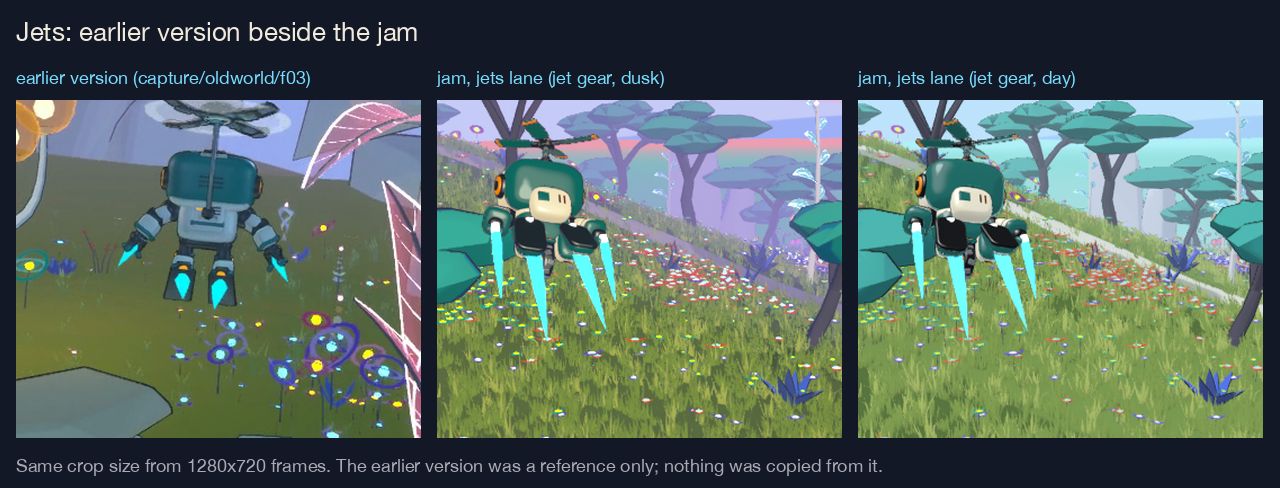
- Pebble and Puddle9 to 12 Nov · not in the game
Two robots I'd directed in the days before the jam, with their meshes, rigs and animation clips, plus an earlier world level and its gameplay code. All of it is kept out of the game. The jam's four robots are new robots of the same family, modelled inside the contest period. For the jam's Pebble, the modeller looked at the earlier one through six pictures only and built every shape new.
- Reference picturesSept to 11 Nov · not in the game
A style-guide painting called Glass Tide from September, preview renders of Pebble and Puddle, and three pictures of a base that I made a month earlier. They steered the concept pictures and the modelling. Frames of an earlier film appear on this page in pictures 158 and 168, as the bar the game was held to.
- Scripts9 to 12 Nov
The reader for my Frontier Colony asset library, which loads part files and checks joints. It was last changed on 12 November at 06:32, a few hours into the contest period. Also two layout helpers for pitch sheets, and the Codex image helper with its prompt guard text.
- The looksince September
Cel shading, the ink line, the robots' proportions and the asset library's file layout carry over as a style and a format. No asset was copied.
- Sourced assets
A search of the game's files found nothing from a marketplace pack, starter content or a download. The only things not made here are the engine's own fonts and three of its basic shapes. This comes from a search, and nobody audited every file one by one.
Still to come
Updated through the 17:26 log row on Sunday 15 November 2026. Times are US Eastern. The jam closes tonight at 20:59.
The final head is on main, its Windows Development and Shipping checks passed, and I have played the final Windows zip by hand. I chose the second cut at 16:24; it leads this page, with the blue scan in view and the generated south land in flight. It went up on the studio's YouTube channel at 16:31 as an unlisted video. The Mac zip is an optional extra with one open save-height check, and the Windows zip is the submission build. The Codex document refresh stopped at 15:41; the later Windows, Mac and video results were added to the checklist by hand afterwards. The game page went public at 16:52: justin-perea.itch.io/groundwork. I submitted the entry myself at 17:25: the jam entry.
What made the cut
The triage table follows the log through 16:00. “In” now means in the final head on main and the Windows zip for the submission. The final head passed its Windows checks before the 15:36 push. The entry went in at 17:25.
| System | In the build | Thrown out or held back |
|---|---|---|
| Four robots and their actions | In, with their action sounds (merge 10) | The atom-built first pass of Thursday |
| The opening: title in space, landing, crew wakes | In (merge 11b) | |
| Orders, building and the colony | In, open-ended since merge 11b | The ending on READY FOR HUMANS |
| Calling a robot over | In (merge 11b) | |
| Weather, seven events | In (Friday 05:51) | |
| Field book | In (merge 11a), with pages for materials, finds, landmarks and animals since 11g | |
| Materials that combine | In by default (merge 11d) | |
| The large land as the start | In (merge 11g), with five landmarks and generated animals | The meadow island as the start (one switch away) |
| Worlds generated from a seed | The older generator remains behind a switch. Outland is in the final head and Windows submission zip: one fixed seed south of the whole original island, on by default, with its in-game hash and dump equal to the Mac's | No new world each landing; no objective, prompt or map mark; no land recorded in the save. The new land lacks scarp blocks, crest stones, vents, seabed garden, moored isles, Perch decks, finds and creatures. The glider can wedge between beach slabs. Puddle's direct walk stalls on the north coast; the west-shore route arrives |
| Rare giants | The Great Straddler, the Spire Tipper and the Basker (merge 11f) | The sky giant, the Threader |
| Glider and its climb | In (merge 11g) | The stand-in body (one switch away) |
| HUD | The lean HUD by default (Sunday 08:23) | The full HUD as default (one switch away) |
| Tagline | “Building the city of tomorrow” | “Discovering the city of tomorrow” |
| DLSS (DLAA) on Windows | In (merge 11f), with a text credit | |
| The PC's base pieces | Module pieces with the ink direction, the bench collars, the wall's dark band | The deck tile, for flicker |
| Generated models | Rodin pieces, landmarks and four animal kinds, in a batch that can be switched off | Every Tripo run, and the 13 runs on redrawn pictures |
| The earlier showcase colony | Not merged; the joined campus kit is on main | |
| The campus | In, with follow-up fixes and angled canopy in the final head and Windows zip; the final campus test and four walks passed | Live hand marking and a loaded stair remain unchecked |
| Menu cursor and clicks | In the final head and Windows zip, which I have played by hand | Individual cursor-capture and focus-change checks are not recorded |
| Settings and controls | Sensitivity, invert Y, HUD choice, volume and the controls guide are in the final head and Windows zip, with the last settings fix | Key rebinding left for later: “lets leave key binding for later” (13:00) |
| Reticle and blue scan target | In the final head and Windows zip; I kept the brackets | Glow on giants and landmarks and a save mid-scan remain untested |
| Mac build | Final Shipping zip of 371f7b78; packaging checks passed from an unzipped copy | Optional extra; not notarized, Apple silicon only, minimum macOS 14. Three robot heights fail the save comparison; left for after the jam |
The second cut leads this page and is the video I submitted. It keeps both purpose straps (the first reworded), the tagline and the staged campus ending. Its scan shot shows the blue hold, and its flight shot shows the generated south land from the final head. The other shots predate that land's merge. It is on the studio's YouTube channel as an unlisted video: youtu.be/Emlw260uVYM. Friday afternoon's draft is below. It predates the opening, the field book, the sandbox and the generated world.
The Windows build, zipped as one file without the .pdb, and the link to the entry on the jam's page.
The final Windows and Mac results and my hand play are recorded above. The checklist has the final results, and I have chosen the second cut. The video is uploaded. I still have to add the files and links and submit the entry myself.